When the people designing your home are the people allocating the capital
Posted on: 8 June 2026
As I do most months in London, I had meant to stay at the Cove in Canary Wharf, but there was no room. It was the staff in the lobby who sent me elsewhere, and they did it with a line that lodged itself in my head: try the newest addition to the family, the Locke, it has only just opened. Family. I should have pricked up my ears right there, because it meant the two places belonged to the same group, and I was being told as much by someone who works inside one of them.
So I went to the Locke, and I looked at it properly. The first impression is unambiguous: it is beautiful. The lobby is a perfect piece of stagecraft, the sort where every corner will hold a photograph. The breakfast bar, Luqa, does not even have a counter; it has a central table loaded with pastries, and the coffee machine sits off to one side on a ledge, operated a little awkwardly, as though the function had arrived after the aesthetic and had been left to find itself a place. The kitchen worktops in the flats are stone, the basins a bronze finish, and spherical lamps hang everywhere with the studied precision of a film set. Take out your phone and any frame works. I do not say that with sarcasm; it is precisely the point I want to start from, because that phrase, works in a photograph, turns out to be the key to everything else.
A qualification, because I do not want to be unfair. The common areas are genuinely lovely and the stagecraft does its job. The trouble begins when you close the door of the flat and try to live in it.
There is a sofa, for instance. Enormous, as deep as a bed. In theory it is somewhere to sit. In practice it is a surface on which to lie and watch television, and for one person that is fine. For two it becomes a problem, because to sit upright you need to put your back against something, and behind you there is nothing: the partition that separates the sleeping area is built from alternating panels with the glass set into them, so the very point where your spine instinctively looks for support simply is not there. Someone designed the shape of that sofa with great care. Nobody thought about how two people sit on it.
From there it is a catalogue. The wardrobes are twenty-five centimetres deep and seventy tall, which means a coat will not hang in them and there is nowhere to put even an empty suitcase. There is a single window and it does not open, so you breathe whatever the machine decides to give you. The bathroom is set apart from the shower in such a way that to reach it you cross the room, which is itself a corridor in disguise. The appliances are SMEG, objects worth half the moodboard on their own. Beside them, tucked under the hob, a small Indesit washing machine that washes after a fashion. And in the kitchen, completing the picture, a mini Brabantia bin that will not hold an evening's fruit. The side table is a minimal disc of marble, ideal for a cup and a photograph, useless for two plates.
Now the reversal, which is the reason I am writing at all. On the other side of the district, on Westferry Road, sits the Cove. And the Cove belongs to the same group as the Locke, exactly as I had been told. It is called Edyn, it owns both brands and two others besides, and it does something I have learned to recognise: the same owner builds two deliberately opposed experiences.
At the Cove the kitchen worktops are quartz, the sink brushed stainless steel, no bronze to photograph but a surface you can actually clean. The table is large, wooden, you can dine at it for two without playing Tetris; the sofa is an ordinary two-seater with the television on the wall opposite, which is to say somewhere you sit rather than recline for the pose, and you can watch a film through to the end without a sore back; the bed is king size, not a 140-centimetre mattress dropped in a corner; the corridors are wide; there is room for the suitcase beside the wardrobe or under the coat rack; the washing machine has its own enclosed nook; the bin allows for proper recycling. And it wins hands down on light, and on the small matter of having an internal balcony with a sliding window that opens. The appliances are all Siemens, a marque that asks nothing of the camera and does its job admirably. The Locke gives you an iconic brand in the shop window and a poor one hidden away; the Cove gives you the same solid thing throughout, and nobody will ever notice it in a photograph.
The punchline, the thing that made me laugh once I had checked, is that the Cove costs less.
Less, I repeat. So the story is not one of a tight budget, and it is not incompetence either. The same group can build the other product, builds it better for those who actually live there, and manages to charge less for it. The difference does not lie in the money spent. It lies in whom they have decided to serve, and with what.
This is where the piece stops being about furniture. Because when ownership of these things passes from those who run them to those who allocate the capital, the unit of measurement changes in silence. Edyn is controlled by Brookfield, one of the largest capital managers on the planet, and here is the important part: to a hotel operator the question is how does one live here, whereas to a capital allocator the question becomes which segment of clientele yields the most per square metre and per night. Two sentences that look close together and lead to different buildings.
And here the two buildings tell two opposing stories of capital, which explain all the rest. The Cove occupies the first ten floors of the Landmark Pinnacle, a seventy-five-storey residential tower designed by Squire and Partners and built by Chalegrove. Edyn did not build it; it bought a slice already finished, in a turnkey deal worth 62.5 million pounds, and turned it into serviced apartments. Those spaces were conceived as homes of quality, meant to be sold to someone who would live in them, and that is why they have the proportions they have: the king bed, the wide corridors, the wardrobe a coat will hang in. Edyn moved in afterwards, inheriting proportions it had not decided.
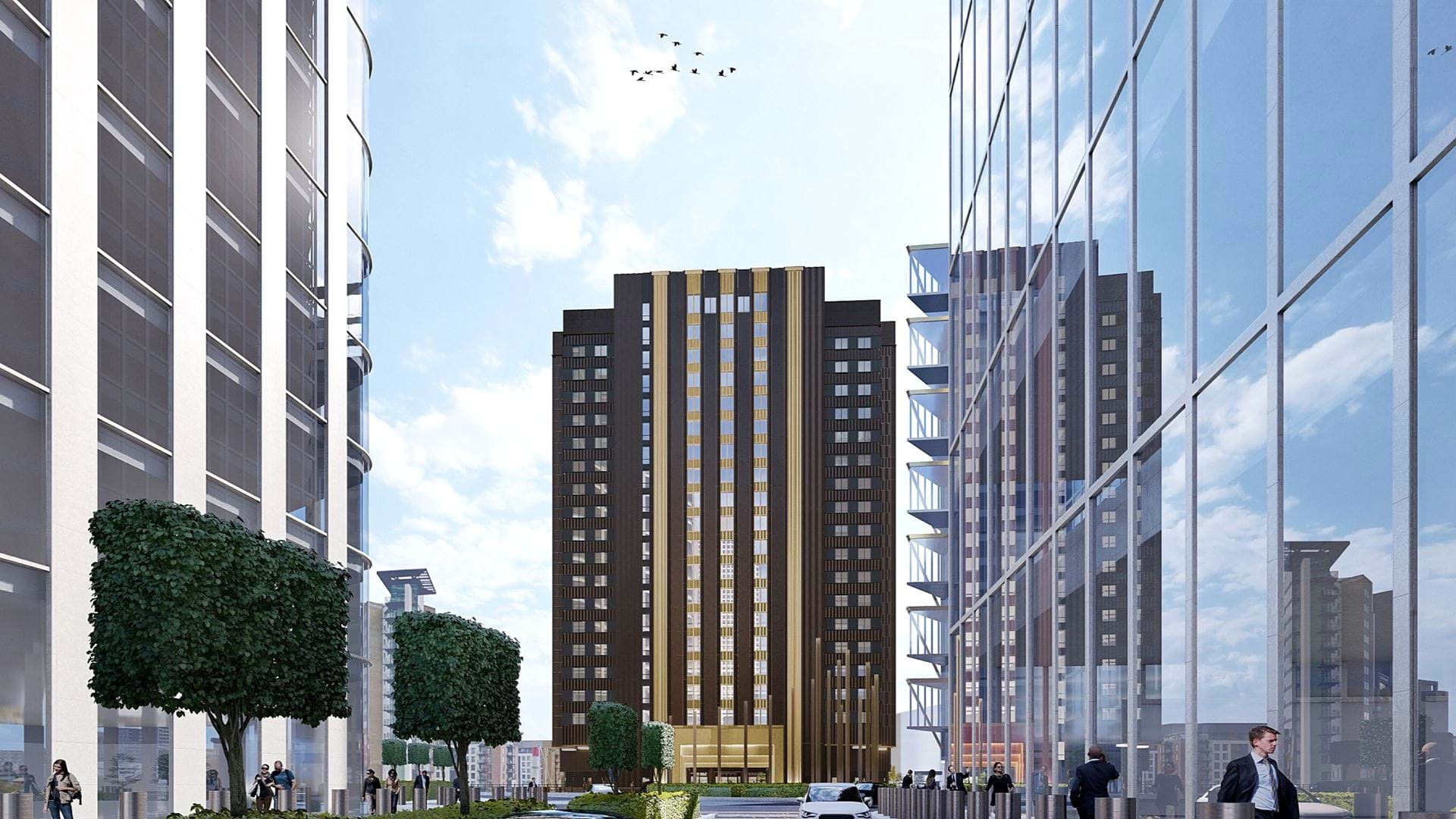
The Locke is the exact opposite. It is not a converted home but a hospitality product designed from scratch to be what it is. Two hundred and seventy-nine rooms in a twenty-storey tower, built with a 74-million-pound loan underwritten jointly with Canary Wharf Group, in prefabricated steel modules manufactured at a plant in Newark, Nottinghamshire, where each room leaves the factory complete with furniture, bathroom and kitchen and is then stacked on site like a box. The twenty-five-centimetre wardrobe, the SMEG in the shop window, the split bathroom were not decided by looking at a space. They were designed once, inside a standard box, and replicated two hundred and seventy-nine times.
The standardisation you feel on your skin while living there is precisely that of the assembly line, because an assembly line is what it is. It is not that the Locke was built worse; it was simply built for something else. The Cove inherits the proportions of luxury residential almost by accident, because that shell was not drawn by the operator. The Locke expresses the logic of yield in its pure form, because that shell was drawn by the operator together with the developer, and drawn to yield. More keys in the same volume means more revenue per square metre, and to sustain that density the flat shrinks until the wardrobe reaches twenty-five centimetres and the bathroom becomes a corridor. Density is not an architectural detail; it is the yield thesis made visible. And wherever you look, upstream, there is a capital allocator. The Cove inside a Chalegrove tower, the Locke out of a partnership between Edyn and Canary Wharf Group, beneath Brookfield, one of the largest capital managers on the planet.
Before a single bricklayer arrived, someone had already decided the use to which the place would be put, and that use was not your back resting against the sofa. There is an honest qualification that must be made, because I have no wish to sell a conspiracy where there is a structure. The Cove costs less and lives better partly for an accounting reason: buying a slice of a finished building weighs differently from repaying seventy-four million in fresh development, and different cost structures produce different prices without any need to imagine malice. But that is exactly the point. Malice is not required. Two different models of capital, applied to two different segments, are enough for the same group to end up building one place where you live and one place where you pose, and to charge more for the second.
Strip away the aesthetics and a young, adaptable guest who books by looking at the images and stays a few nights is structurally more profitable than someone who lives there for months. You can read it off the staff too, all of them around twenty-five, because the service is calibrated for that public, not for the demanding resident. The photograph-guest pays the premium for the scenery and leaves before the irritation accumulates, while the one who stays compares, complains, demands the wardrobe a coat will hang in. From that asymmetry everything follows, and none of the choices requires malice, only optimisation. The twenty-five-centimetre wardrobe is not a mistake; it is capital not worth immobilising for someone staying three nights. The SMEG in the window converts into bookings; the hidden washing machine is a cost trimmed from a function that guest will barely use. The mini bin is consistent with a short stay. Every single detail is perfectly rational within the logic of yield per segment. It is only the sum of them that produces a place where no one lives.
And the perfect segment, for this logic, is precisely the one that does not know better exists. Someone who has never stayed at the Cove for less, who has no point of comparison, pays the premium for the scenery without the bargaining power of those who know. He is not deceived. He is served exactly what he showed he wanted, a photogenic place for a few nights, and pays more for it convinced he has chosen the superior product.
This is not the lament of a man who finds everything was better before; homes have always been built badly, in the past too. The difference is that now it is done well, with intention, optimising one precise variable that is not your back against the sofa. The next time you walk into a space that is beautiful and faultless, before you photograph it try sitting on that sofa two at a time, and ask yourself who was really designed: the room, or you.
Cover photo (C) Edyn Group Services Ltd.