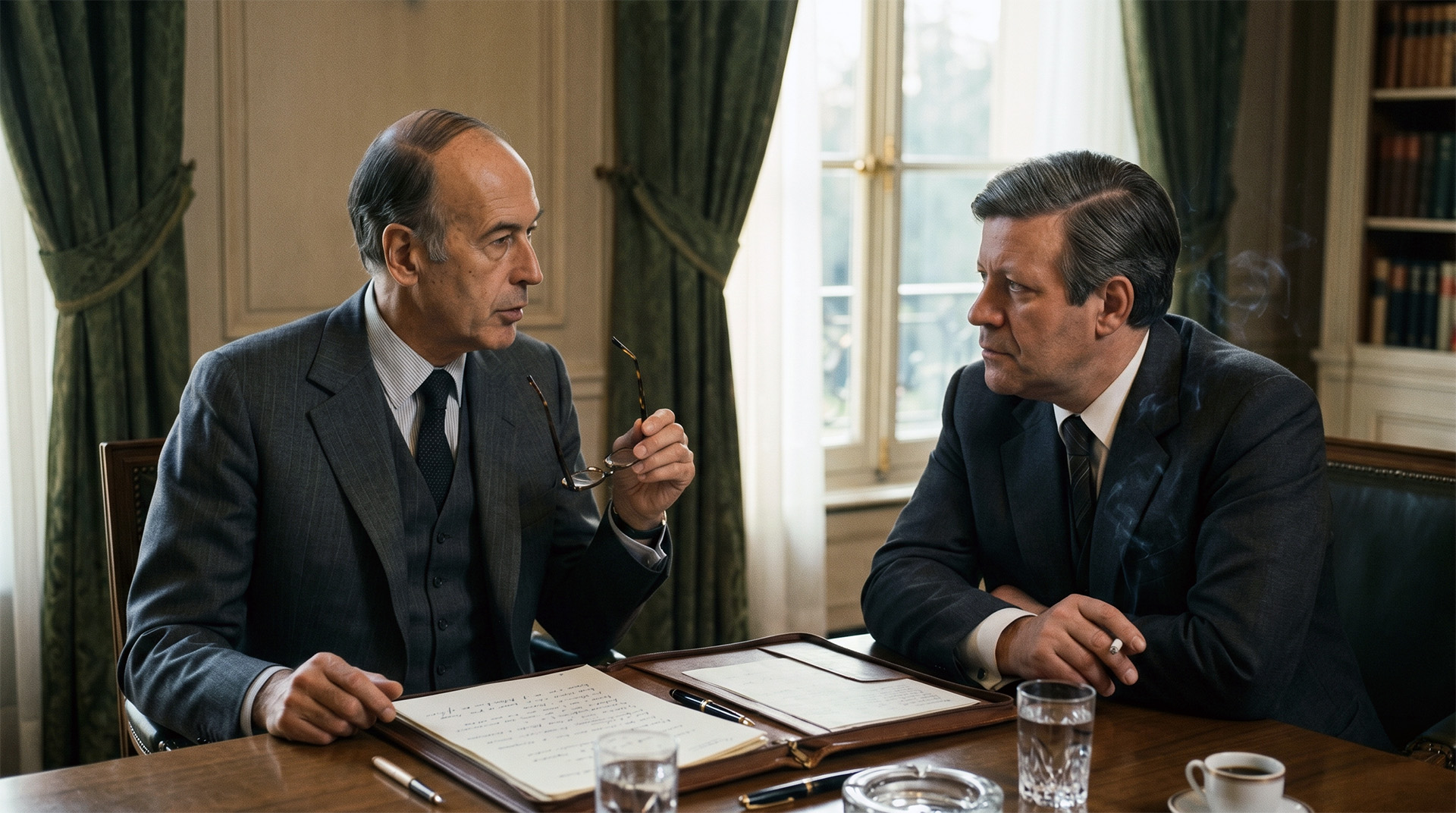
When europe had two leaders
Posted on: 18 May 2026
A pattern recurs in Europe roughly every half-century, and it serves little purpose to interpret it through the political categories of the moment. Five years of overlapping crises, national governments under structural strain, populist waves rising at both extremes, a perceived loss of American centrality, monetary turmoil, energy shocks, terrorism. The first cycle ran from 1973 to 1979; the current one began in 2022 with Russia's invasion of Ukraine and is now in its fourth year. The grammar is almost identical, and the temptation to dismiss the comparison as mechanical analogy fades quickly when one looks at what the configurations actually produced, and at what they failed to produce.
What emerged at the end of the first cycle as the structural response, the European Monetary System launched at Bremen in July 1978 and operational from March 1979, was not a technical insight from the Commission nor a market-driven necessity, but the contingent fact that two capitals simultaneously contained leaders with solid political mandates, personal technical authority on monetary matters, and a bilateral relationship constructed before their ascent to power. Valéry Giscard d'Estaing had occupied the Élysée since 1974 with a renewed parliamentary majority in 1978; Helmut Schmidt had been Chancellor in Bonn since the same year, leading a stable SPD-FDP coalition whose authority had been reinforced by his handling of the Mogadishu hijacking the previous October. They had known each other since both served as finance ministers, Giscard d'Estaing under Pompidou and Schmidt under Brandt, between 1970 and 1974. They had already worked together technically on monetary matters before either became head of state or government, and when at Bremen in July 1978 they decided to launch the EMS, they decided it alone. The Bundesbank, historic guardian of the Deutsche Mark's stability and constitutionally autonomous, had not been consulted in the preparatory phases. National parliaments were presented with a fait accompli. The Commission under Roy Jenkins played a role of technical facilitation, not political construction. It worked because both leaders possessed sufficient internal legitimacy to close the dossier over the heads of their own bureaucracies and central banks, and because the technical trust accumulated between them in the preceding years made bilateral decision possible without intermediaries.
This is the point that standard readings of 1979 tend to miss, because they are accustomed to telling history through ideas rather than through the human configurations that allow ideas to become operational. The EMS was not the fruit of an idea long maturing; the idea already existed, articulated in the Werner Plan of 1970 and attempted through the European currency snake of 1972, both of which had failed. What was new in 1978 was the political configuration that allowed that idea to move from technical agenda to operational reality, and the configuration was specifically two men, not an institutional framework or a doctrinal consensus.
The present matters here precisely because the geometry is the symmetric opposite of that which obtained in 1978. The structural crisis is undeniable, and it resembles its half-century predecessor too closely to ignore. Energy shock, with Russia in 2022 and the closure of the Strait of Hormuz since February 2026 reproducing the double oil shock of 1973-1979 with disconcerting fidelity. Technical stagflation and a cost-of-living crisis. A dollar crisis as global reserve currency, with Trump attacking the Fed and the BRICS developing alternative payment systems, much as the end of Bretton Woods in 1971 had opened the monetary decade. A perceived collapse of American centrality, with Trump's National Security Strategy reclassifying Europe from partner to potential adversary, in precisely the way Schmidt regarded Carter as inadequate to the moment in 1978. A populist wave at both extremes, Rassemblement National in France, Reform in Britain, AfD in Germany, structurally replicating the 34.4 per cent obtained by Berlinguer's PCI in 1976 and the broader Italian compromesso storico. Terrorism structurally different but comparable in its effect on perceived security, jihadism and North African instability in the place of the Italian Anni di Piombo and the Baader-Meinhof Group.
I remember that decade well because I read the newspapers, and because at home the television was on in the evenings tuned to the news bulletins and to the political programmes that discussed the EMS with a mixture of interest and apprehension. I was seventeen in 1979, the age at which front pages cease to feel like distant noise and begin to register as matters concerning the world one is about to enter, and there were dozens of broadcasts explaining what was happening, from the Italian RAI political tribunes to the economic features of the main evening news, from the Swiss TSI broadcasts that we could receive across the border and that covered European integration from the lateral perspective of a non-member state to the special reports on the Bremen summit. My parents watched them with the awareness of those who understand that something was being decided whose consequences would unfold for years. I remember the sense that something was changing structurally in Europe, I remember the EMS discussions as front-page news, I remember Berlinguer speaking of compromesso storico and Andreotti holding the Italian system together with his impenetrable codes while across the Channel Callaghan was failing to do the same and Thatcher was preparing the rupture that would arrive that May. What I remember most clearly, however, is the perception that the 1973-1978 quinquennium had been something different from the single crises of preceding years, something systemic that required a systemic response. The EMS arrived precisely at the moment when that perception had become unsustainable.
That perception exists today, but the human precondition that permitted the response in 1979 does not. Macron, at fifteen per cent approval, with two years remaining on his mandate and constitutionally barred from re-election, is a lame duck who cannot commit France to any structural treaty of magnitude comparable to the EMS. Merz has been in office only a few months, leads a fragile coalition, and faces the structural problem of keeping the AfD out at the price of internal decisional paralysis. The two have not constructed any technical relationship before reaching the summit, they come from different political trajectories, they did not meet as finance ministers before assuming governmental responsibility. Starmer's situation is worse still: ninety-seven members of his own parliamentary party signalled their wish for his departure last week, and Wes Streeting resigned from the Department of Health and Social Care on 14 May citing his loss of confidence in the Prime Minister. The human geometry that permitted the EMS in 1979 is not present, and this, more than any technical or ideological consideration, is the structural reason why the 2022-2026 quinquennium will not produce anything comparable, and probably will not produce it in the subsequent five years either.
Much is being said, in these months, about what would be required. Mario Draghi in the report he presented in September 2024 articulated the necessary instruments with precision: common European debt for strategic investment in defence and technological transition, partial fiscal integration, completion of the capital markets union, reform of economic governance. All these instruments are technically available, intellectually articulated, politically discussed. Yet they are not moving, and they will not move under delegitimised governments, because every one of them requires someone capable of imposing it over national bureaucracies and hostile public opinions, in precisely the way Giscard and Schmidt imposed the EMS over the Bundesbank and the parliaments in the months between July 1978 and March 1979. The distinction between possessing an instrument and possessing it operationally is the same as the distinction between owning a weapon and finding someone willing to use it. The EMS of 1979 worked because Giscard and Schmidt were prepared to pay the internal political cost of imposing it. Common European debt in 2026, whatever form it might assume, will require two or three national leaders prepared to pay the same kind of cost, and no leader of any major European country currently commands the political capital to do so.
An apparent exception presents itself, and it is the NextGenerationEU instrument of 2020. That was indeed common European debt, and it was approved. Macron at fifty-six per cent approval in 2020, Merkel at sixty-eight per cent in her fifteenth year as Chancellor, possessed the political capital to impose it over the resistance of the "frugals" and of their own national bureaucracies. The configuration was precisely Giscard-Schmidt: two popular leaders, technical authority constructed over preceding years, a structured bilateral relationship. It worked for the same identical reason. It should be added that NextGenerationEU was constructed in the acute emergency of the pandemic, whereas the EMS emerged at the end of a chronic crisis cycle. The structural parallelism is less precise, but the human precondition is the same. No leader of comparable standing is in place today in any of the three large European countries, and while commentators discuss whether Meloni is "gaining ground in Europe" or whether Draghi might return, the structural question is not articulated. It is not a question of who will manage the next acute crisis; it is a question of who will possess the political capital to impose the structural instrument required to escape it, and that reserve of legitimacy simply does not exist in any capital of the major European countries today.
There remains the question of how 1979 produced its Giscard and Schmidt, and what lesson might be drawn from the process. Both had emerged from the experience of finance ministers during the first phase of the crisis, between 1969 and 1974. They had handled monetary matters technically before assuming general political responsibility. When they reached the summit they already possessed the technical competence to understand what was required, and they already possessed the bilateral relationship through which to construct it together. They did not come from pure political careers; they came from trajectories of technical responsibility on the specific dossiers of the crisis. In Europe in 2026, who fits this profile? Few. Mario Draghi did, and he served as Italian Prime Minister between 2021 and 2022, but he has left active politics. Christine Lagarde is at the ECB and cannot assume a national political role. Roberta Metsola is young, but she comes from Malta, a country structurally too small to produce that kind of bilateral leadership. Mark Rutte is at NATO. Every profile that would combine technical competence on structural dossiers with a bilateral relationship constructed over time is currently outside the national politics of the major countries.
What is striking, looking back at 1979, is that Giscard and Schmidt were produced by the crisis itself. They were not traditional figures of French and German politics; they had emerged through the technical dossiers of the 1969-1974 crisis and had built their political authority precisely on the competence the moment demanded. The crisis itself selected the leaders capable of managing it. The question worth posing is whether the 2022-2026 cycle is producing, beneath the surface of visible politics, equivalent figures who will emerge in a few years. The answer is not knowable in advance. Presumably such people exist, somewhere, currently managing energy, fiscal, or defensive dossiers technically, and who in five or seven years will have built the political authority to do what Giscard and Schmidt did in 1978. They are out of sight, however, and the moment of their emergence will coincide with a crisis worse than the present one, because that is the historical pattern: structural leaders emerge when the crisis has grown grave enough to leave no alternative.
What does this mean for Europe in the next three or four years? It probably means that the simultaneous political transition window of the three major countries will continue to produce paralysis on structural dossiers, and that instruments of the NextGenerationEU type will remain available as concept but will not become operational. It means that the responses to current crises, Hormuz, Greenland, Ukraine, sanctions, will be tactical rather than structural. It means that external actors with leverage will continue to impose prices that delegitimised governments cannot refuse. And it means also, however, that the crisis will continue to generate the conditions to produce new Giscards and Schmidts, in some capital or institution that no one is currently watching. We will not recognise them at once. They will probably be managing something that today seems a secondary dossier, and in a few years it will become apparent that this was the genuine apprenticeship.
The question with which I close has no certain answer, but it is the question worth posing. In 1979 it worked because Giscard and Schmidt were there. What are we doing to produce the two or three equivalent names for 2030?