What happened to the linen napkin
Posted on: 6 August 2026
There was a point, somewhere in the last quarter of the twentieth century, when the word laundry stopped meaning a place and started meaning a basket. Britain once had a commercial laundry trade of real scale, thousands of premises handling the weekly wash of households that had neither the machinery nor the staff to do it themselves, and the trade collapsed within a generation of the domestic washing machine becoming affordable. That collapse is usually filed under progress, which it largely was. What tends to go unrecorded is the list of ordinary objects that quietly stopped being usable once it happened, and the linen napkin sits near the top of that list.
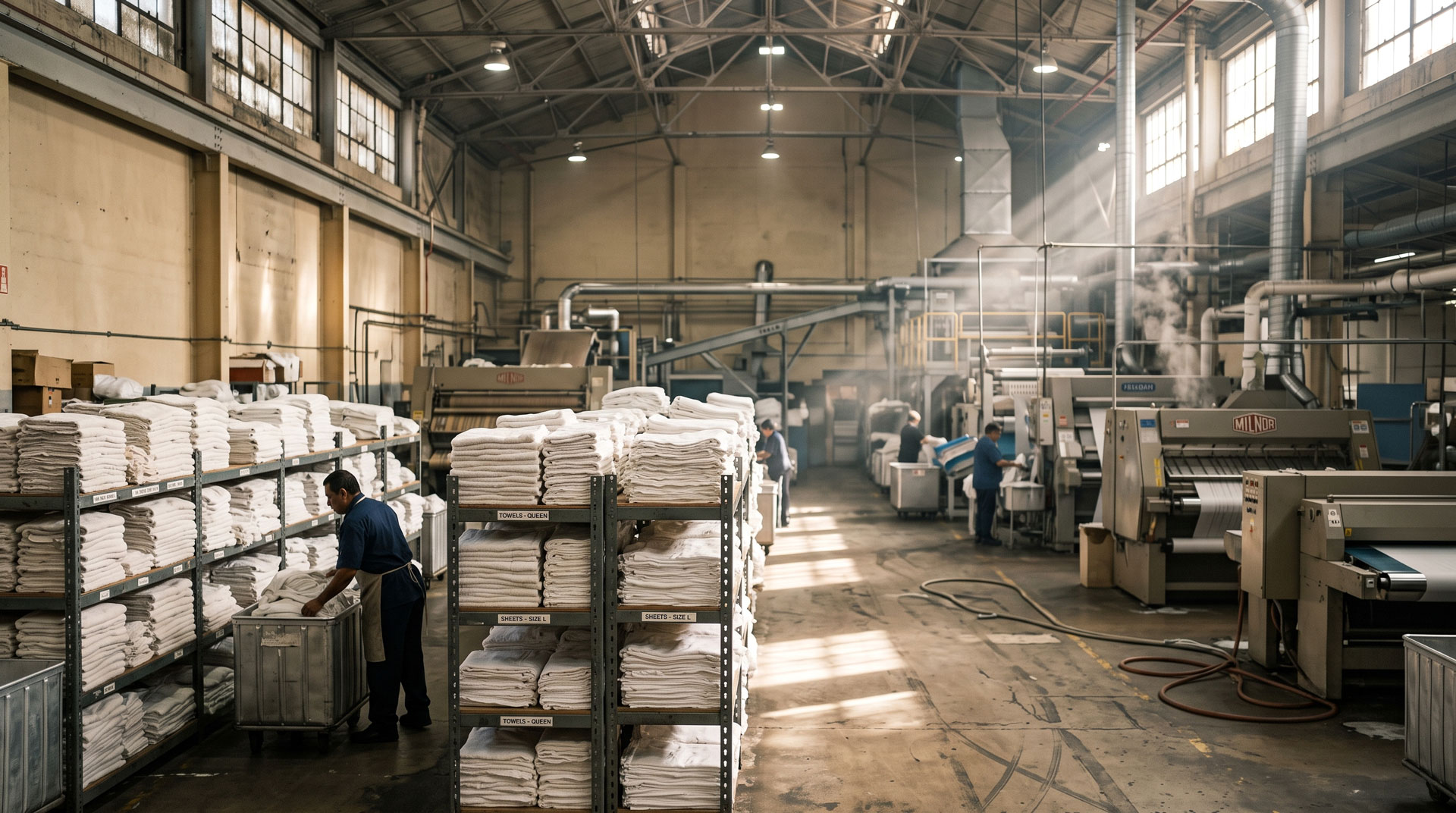
I noticed this recently in the most banal way possible, which is to say by trying to buy some. Decent cloth napkins are no longer sold through the channels that sell things for houses. They are sold through the catalogues that supply restaurants, the same firms that sell chargers and napkin rings to the catering trade, in packs of twenty five, photographed against a warehouse backdrop with a trade price list attached. The consumer channel still carries something called a napkin, but it measures forty or forty five centimetres across, it is usually a cotton blend or the material that catalogues describe with remarkable nerve as linen effect, and it comes twelve to a pack for rather less than the price of a decent lunch. Proper linen with a hemstitched edge lives on the other side of the wall, where industrial laundries wash it, press it, fold it into shape on dedicated machinery and return it to the restaurant ready for service. Historically the dinner napkin ran to seventy centimetres a side. The upper end of general retail now stops at fifty and the lower end has slipped beneath forty, which is the size of what used to be called a dessert napkin and was never intended to do the main work.
The explanation that presents itself immediately is that people have lost their taste for these things and gone over to paper because paper is easier. It is a comfortable explanation for whoever advances it, since it places them automatically on the right side of the argument, and it is also rather weak, because it fails to account for the most interesting fact in the whole business. The object has not disappeared. It is manufactured, sold, catalogued and priced. It has simply stopped being sold to me. When a thing survives in one channel and dies in another, the variable that has changed is not the taste of the buyer. It is something in the structure that made the thing usable in the first place.
A cloth napkin has a life cycle of four steps. It is used, washed, pressed and put away. Three of those four were automated over the course of the twentieth century and one was not. The washing machine settled the washing question decades ago, and if washing had been the constraint the napkin would have come back into every house rather than leaving it. Pressing stayed exactly where it was: an hour of human labour that cannot be delegated to a device, tedious in the doing and invisible in the result to anyone except the person who did it. This is the whole of the mechanism and everything else follows from it.
Which is the point at which the argument stops being about napkins. The household that kept two dozen monogrammed napkins in the bottom drawer did not press them. It had them pressed, first by domestic staff paid a wage that would now be illegal, then, once staff moved beyond the reach of the professional middle class, by the commercial laundry that called weekly and returned the basket flat. The linen napkin was never an object a family maintained on its own. It was the visible terminal of a supply chain of cheap labour standing upstream of it, a supply chain nobody ever mentioned, because working infrastructure is by definition the kind nobody talks about. It becomes visible only in its absence, which is the same reason we now discuss water in the Thames Valley and did not in 1958.
When that labour became expensive, the napkin became expensive. Not in purchase price, which remains trivial, but in running cost, which is the only figure that matters and the one nobody calculates because it never appears on a receipt. A dozen linen napkins cost twenty five pounds and will cost you, across a decade, several hundred hours of your life in front of an ironing board. A restaurant does the same arithmetic and reaches the opposite conclusion, because a restaurant does not press anything: it signs a contract with a laundry that presses on industrial equipment and amortises the cost across tens of thousands of pieces. This is outsourcing in precisely the sense the word is normally used, and it is the same arrangement the Edwardian household had, with a commercial contract standing where a social hierarchy used to stand.
What actually happened, then, is not that an aesthetic preference changed. An infrastructure of maintenance dissolved, the preference became inexercisable, and it fell away as a consequence, without anybody ever having taken a decision. No family sat down one evening in 1974 and resolved to move to paper. The laundry that had called on Thursdays stopped calling, or doubled its price, or one fewer person was employed to deal with such things, and the drawer that had been opened daily became the drawer that gets opened at Christmas. The choice was never made, which is why it cannot be reversed by exhortation.
The pattern generalises, and it is worth looking at properly, because it accounts for perhaps half of the objects we assume vanished through some decay of taste. When the maintenance chain around an object thins out, the object does not die. It does one of two things. It migrates to the two extremes of the market, surviving in the trade channel where the service still exists for industrial reasons and in the decorative luxury channel where running cost is irrelevant because use is occasional. Or it degrades technically until it no longer requires the service at all, keeping its name and losing its substance.
The shirt is the textbook case of the second route. It needs pressing exactly as the napkin does, laundry costs exactly what laundry costs, and yet the shirt has not left a single house in Britain. It survived by transforming: non-iron finishes, blended fibres, chemical treatments applied to cotton that take away the hand and leave the shape. Nobody called this a retreat. It was called product innovation, and in a sense it was, since it solved a real problem for real people. It solved it by lowering the object to the level of the surviving infrastructure rather than by rebuilding the infrastructure, which is a different thing and produces different consequences twenty years downstream.
The paper napkin is the same manoeuvre. It is the non-iron shirt of the dinner table, the version of the object recalibrated for a house with nobody upstream of it. Calling it barbarism is an elegant way of avoiding the mechanism. It did not displace cloth because anyone preferred it. It arrived because it was the only form in which that function could continue to exist inside the labour available.
There is an honest qualification here, and it is the part that persuades me the reading is right rather than the part that troubles it. Restaurants are going over to paper as well, not the good ones, but the middle of the market has been doing it for years. That undermines any claim that the trade channel protects the standard, and confirms that what protects it is only ever the laundry, which is to say the service. Where the laundry contract still works economically the linen stays. Where it stops working, the restaurant does exactly what the household did thirty years earlier, with the same absence of deliberation. The channel is not the cause. It is merely the last place where the cause is still operating.
Once the shape is visible it turns up everywhere. Resoleable shoes survived where the cobbler survived, and the cobbler survived where there was volume enough to keep him in business; elsewhere the shoe degraded into a cemented object that cannot be repaired by construction rather than by neglect, and nobody decided that either. Tailoring lives where tailors live, which in this country now means a few streets in Mayfair and very little between there and the high street. The mechanical watch made the upward migration and became jewellery, while the function it once performed passed to an object that requires no maintenance because it is discarded.
Seen from here, moralising about the decline of manners is the weakest available reading, and I say that as somebody who finds a paper napkin at dinner physically irritating. It is weak because it attributes to a collective choice what is the aggregate of thousands of small individual surrenders to a constraint that was tightening, and it is weak above all because it offers no leverage. If the problem is that people have become coarse, there is nothing to be done except complain with style. If the problem is that a supply chain died, then the question becomes a different one: which chains are thinning now, underneath which objects we currently take for granted, and what will have quietly degraded in twenty years while keeping the name it has today.
Meanwhile I buy from the restaurant supplier and send the things out to be washed and pressed, which means I am doing nothing whatsoever that a restaurant does not do, merely on an absurd scale. I am not buying taste. I am buying the last surviving stretch of the chain, at the full price of something that used to be distributed across an entire social structure. It works for as long as that laundry stays open.