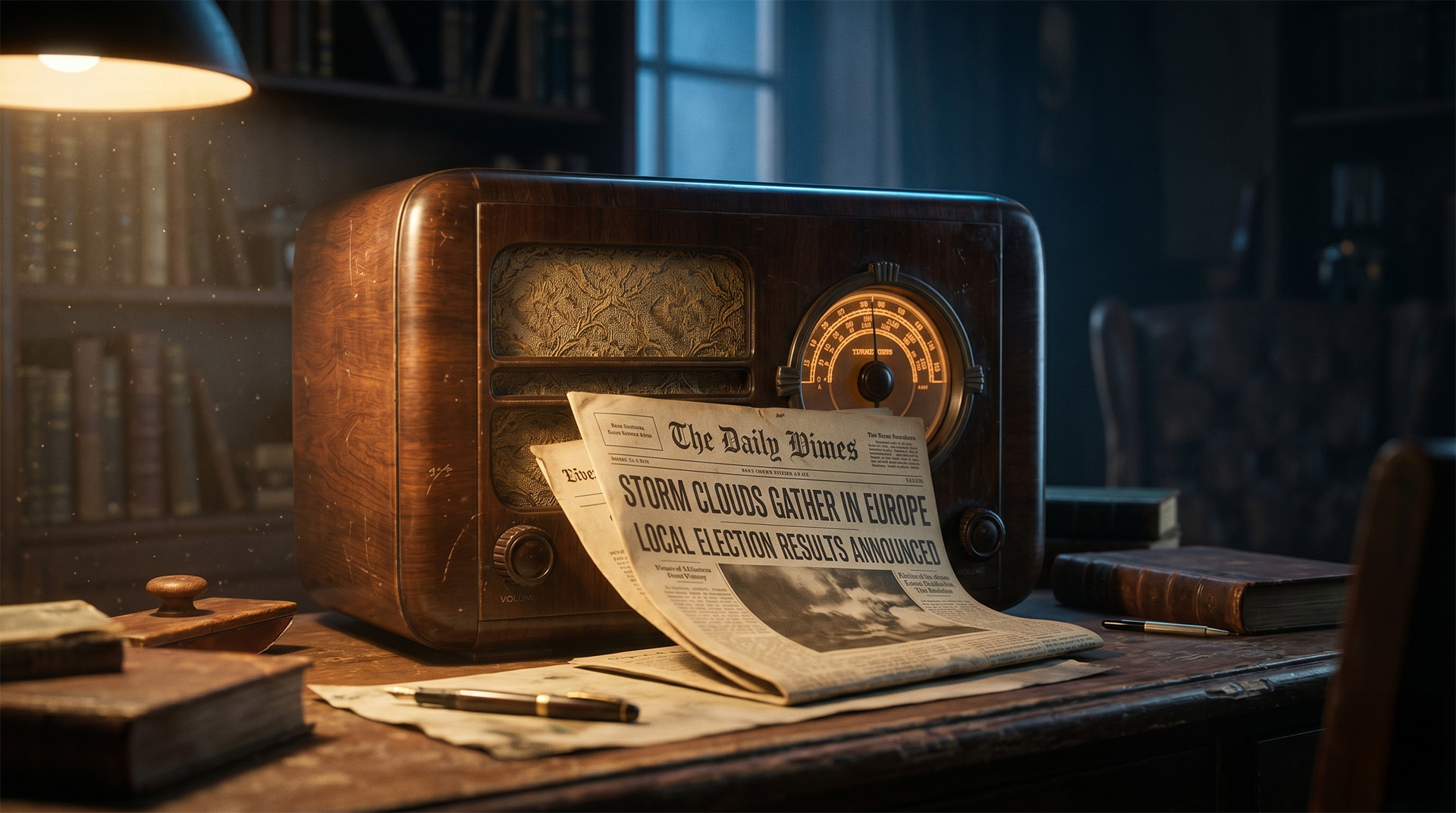
The wireless that read the newspaper
Posted on: 27 June 2026
When the BBC began broadcasting news in the nineteen twenties, the news was simply the newspaper read aloud. Two editors and two sub-editors sat with the tape coming in from Reuters and the Press Association, chose a handful of items, and an announcer in a dinner jacket read them out in received pronunciation. The wireless, the most transformative communications technology of its century, spent its first years doing what print already did, only through a different aperture. On Good Friday in 1930 the announcer went so far as to declare that there was no news at all, and filled the slot with fifteen minutes of piano. The medium that would go on to remake politics, war and the national imagination opened its career as a man reading you the paper.
I have been thinking about that announcer while reading the Guardian's investigation into the synthetic influencers now quietly filling our feeds: computer generated faces that review cosmetics and furniture in the voice of a contented customer, deployed by brands that see no reason to mention the people in the pictures are not people. The reflex response has been a moral one, that this is deception, that authenticity is finished. The moral response is the least interesting available. That the faces are artificial is not the scandal. Artificial is merely another medium, worth no more and no less than a human photographer. The scandal is what we have decided to do with it.
Because nothing of substance is new here. A powerful instrument has arrived and the first use we have found for it is to reproduce, automatically and more cheaply, a model that was mediocre to begin with. The influencer was never an elegant piece of machinery. It was a fragile arrangement, costly, hostage to the moods and scandals of a single person, its returns concentrated in a handful of names while the long tail beneath them earned too little to cover the rent. Artificial intelligence does not rethink that arrangement, it traces over it. It does not repair the defect, it automates it, photocopying the inefficiency at speed.
This is the oldest reflex in the history of technology and it repeats at every turn. The wireless read the newspaper. Television, decades later, contented itself with pointing a fixed camera at the proscenium and calling it an evening's entertainment. The early web, which I watched arrive, was the company brochure retyped onto a screen without the alteration of a single comma. Each time the new power is squandered on cloning the old form, because cloning is easy and understanding is hard, and only much later, once the imitation has worn thin, does someone notice that the medium permitted a function which had not existed before. That is the moment the real thing is born. The artificial influencer is the man reading the paper on the wireless, still in his dinner jacket.
The right question, then, is not whether the face is authentic, which is a question for the moralists of the digital age, but why, holding an instrument capable of genuinely new architectures, the market's first move was to rebuild the old advertising puppet. Such a tool could sustain something no person could: a living relationship with thousands at once, a conversation that differs for each of them and learns as it goes, a form of mediation between seller and buyer that resembles nothing currently in existence. Instead it does the influencer, only at a lower price.
The answer is structural and unflattering. Copying the existing model does not require you to understand what the thing is for. Replication can be performed in total ignorance of function. The advertising industry does not know what an influencer is; it knows only that until yesterday the format produced money, so when a new instrument arrives it aims it at the single thing it understands, redoing what it already monetised with the human cost stripped out. This is not malice. It is cognitive laziness with a spreadsheet open.
There is a second turn, bleaker than the first. The influencer format had already lost its value on its own, before any of this, through simple saturation. When being an influencer becomes free and everyone is one, the signal empties out like a currency printed until it buys nothing. Artificial intelligence does not therefore kill a healthy signal; it arrives as the cheaper supplier of a good already dead, and its promise to perform better is measured in engagement, precisely the number saturation had already hollowed. It does not win on value. It wins because it can fake, more convincingly, a metric that was already a corpse. We are automating an inefficient model in order to optimise a measure that no longer means anything, and we call it progress.
Having lived through the death of the physical record and the arrival of satellite film distribution, I recognise the movement with my eyes closed. Each time the market defends or reproduces the old object, the disc, the reel of film, the bought page, until it discovers years too late that the medium was for something else. From the second of August the European Union's AI Act will require synthetic content to carry a visible label. Britain, where the investigation was reported, has no equivalent rule. The labelling is minimal hygiene and entirely right, but it polices the disguise, not the waste. It will tell us the face is false. It will not tell us that, holding something which might have redrawn the relationship between people and the things they buy, we used it to print mannequins at a discount.
The real waste, the one nobody is scandalised by, is not the invented faces. It is the architectures never built, the forms the instrument allowed and which no one had the patience to imagine, because copying paid at once. The medium is still sitting there, intact, waiting for the question we keep declining to put to it, and while it waits we busy ourselves making it capable of doing, a little better and a great deal more cheaply, exactly what we did before.