The wardrobe with the doors shut
Posted on: 8 October 2026
The doormat at my front door does not touch the door. I keep it the same distance from the threshold as from the two walls of the hall, because pushed up against the door it looks like something left there by a person in a hurry. The lamp sits in the middle of the sideboard and the rug lies exactly halfway between the sofa and the television unit, and I want the bed made so that the cover drops by the same amount on either side. I know what the textbooks call this and I take no offence.
Until this week I explained it to myself as aesthetics, the idea being that the eye wants to rest and a composed room lets it while a random one puts it to work. The explanation has some dignity, since anyone who has hung a picture four inches too high knows how much that mistake weighs every time they walk past it. Then there is the wardrobe.
In other people's wardrobes, when I happen to see one open, I often find clothes thrown in as they came. The door closes and no eye suffers any longer, yet the irritation I feel is the same as with a crooked doormat, possibly worse, so the comfort of the eye explains very little.
A clarification is owed, because every example so far has been centred and this could pass for a taste for symmetry. What I am after is balance, of which the centre is only the simplest case, since an arrangement can sit entirely to one side provided the weights answer each other. The difference between a composition and a heap shows when you move one piece. In a composed room, shift the lamp a hand's width and something no longer adds up, whereas in a random room you can move anything at all and nothing changes. Nothing depended on anything. A lamp three fingers from the edge with nothing to counterweight it is ambiguous, because it may have been put there or it may have arrived there with a duster. What I cannot stand is the object of which I cannot tell whether anybody thought about it.
Everything in a house is somewhere, and there are only two ways it got there, because either somebody put it there or it stayed. Sloppiness is the sum of what stayed, the decisions nobody took. The wardrobe is the cleanest evidence precisely because it has no audience.
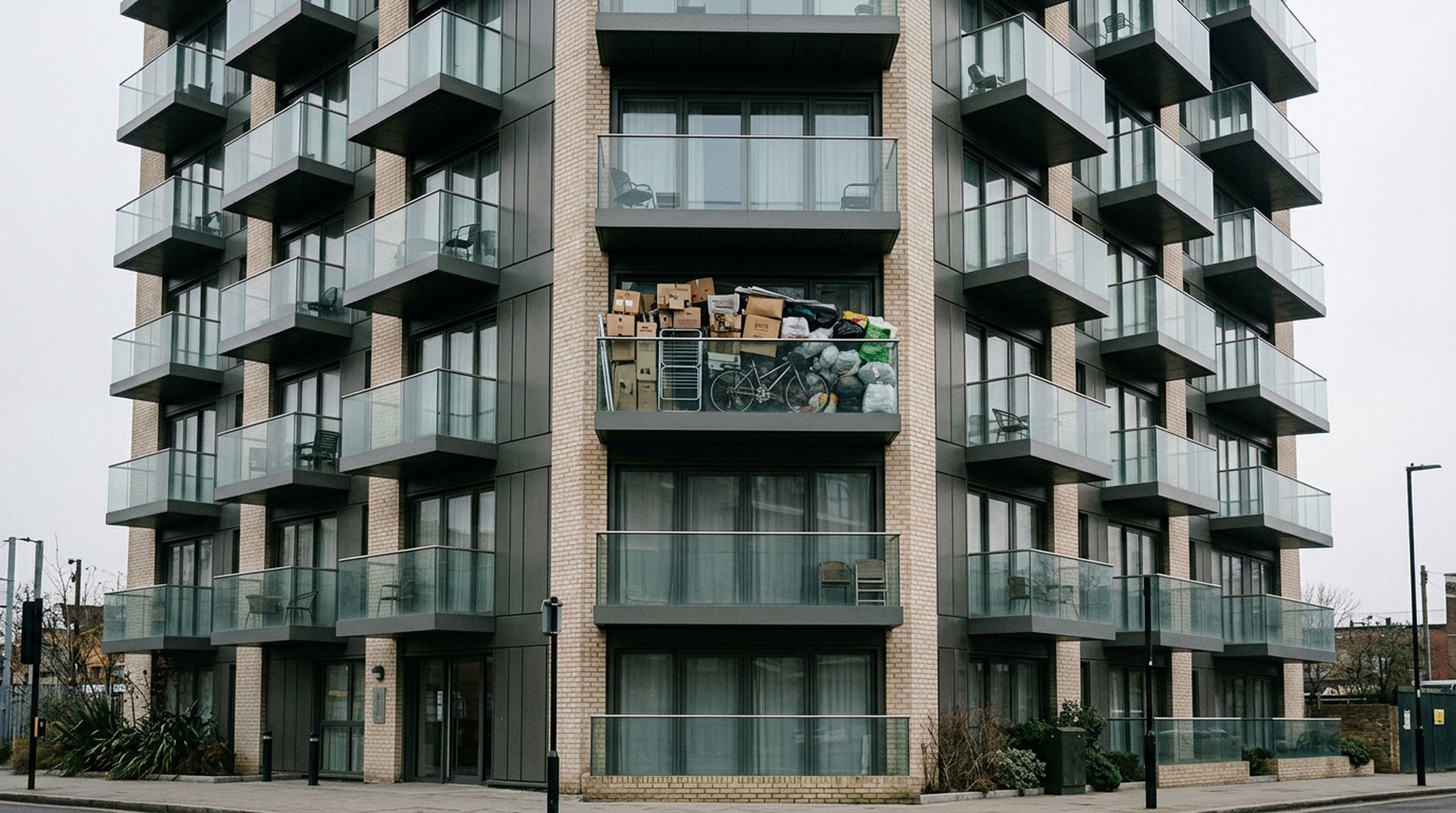
In London the wardrobe is often on the balcony. I spend about two weeks of every month in Canary Wharf, where a fair number of balconies on towers that cost what they cost serve as small storage depots, and the balconies and some of the back yards look much the same a short walk north in Poplar, down Westferry Road and in the houses that follow the edge of the Isle of Dogs. The price of the flat makes no difference to what ends up out there, which rules out money as the explanation. What I cannot tell from the pavement is whether I am looking at indifference or at a flat built without a single cupboard, because someone with nowhere to hide the mess has not chosen to show it either.
I have to be careful here, because the next sentence writes itself and it would be false. Untidy people are not sloppy. In 2013 Kathleen Vohs at the University of Minnesota put some people to work in a tidy room and others in a room strewn with papers. Those who came out of the tidy room gave more to charity and more often picked the apple over the chocolate, while those who had worked in the mess produced the same number of ideas but independent judges rated them as more original. Order pushes us towards what is expected of us, which ought to take some of the smugness out of those of us who centre the fruit bowl.
There are workbenches and desks where a stranger could not find a screwdriver in half an hour and the owner picks it up without looking. That is order with a private criterion, unreadable from outside but there, and one question identifies it. Where is it? If the answer comes at once I am looking at an order I cannot read; if what comes is "it must be here somewhere" I am looking at indifference.
My own order, for that matter, is unreadable to the woman who keeps my house in order, who puts the doormat back against the door every time with a regularity I have come to regard as a form of consistency, since she has a criterion too and it is to finish sooner.
Taken out of the house the distinction earns its keep, since a company is usually judged on what it has prepared to be judged on, meaning the boardroom and the deck. David Lee Roth recounts in his autobiography that Van Halen buried in the middle of their technical rider, at article 126, a ban on brown M&M's backstage. It passed for rock-star caprice, but the stage weighed more than many smaller arenas had ever carried and the bowl was the quickest way to find out whether the promoter had read the pages on loads. In Pueblo, Colorado, the brown ones were there, and by Roth's account so was a new floor into which the staging sank, at a cost of eighty thousand dollars.
The bowl worked because it sat where nobody thought they were being watched. It was the promoter's wardrobe.
Then there is a case the wardrobe does not cover and which interests me more, the shower screen. A doormat that has been moved stays moved and that is all. Limescale settles by itself with every shower, as anyone living on London water learns from the kettle, so a clean screen is a decision that has to be taken again each day and having taken it once counts for nothing. That is why I treat it as the harshest indicator, since putting things in order is a gesture whereas keeping them clean is a habit, and habits are far harder to fake the day before a visit. In a company the equivalent is whatever gets worse without anyone doing anything, such as the customer database going stale or the documentation stuck two versions back. Nobody decided to let them go, which is exactly the definition I started from.
The opposite risk remains and I know it from the inside, because an immaculate sitting room with a wardrobe fit to burst is theatre, and whoever has learnt that others look at details soon learns to look after the details others look at. I imagine more than one promoter, once the story got about, took out the brown M&M's without reading another line of the contract, since an indicator that is known stops indicating. So the place to look changes every time and the only rule I have found is to look for whatever was not prepared for me.
That goes for my house too.