The measure that was withdrawn
Posted on: 3 September 2026
Institutions that measure things almost never stop measuring. A scale is an asset, and whoever owns one has every incentive to apply it as widely as possible, which is why the Gemological Institute of America's announcement of 2 June 2025 repays a second reading. From 1 October, it said, laboratory-grown diamonds would no longer receive the colour grades from D to Z or the clarity grades from FL to I3. They would instead be placed in one of two categories, Premium or Standard, and stones falling below the lower threshold would receive nothing at all. Natural diamonds would continue to be graded exactly as before. Tom Moses, the Institute's executive vice president and head of its laboratories, gave the reason on the record: more than ninety-five per cent of the laboratory-grown stones entering the market sit within a very narrow band of colour and clarity. The interesting question is not what had changed about the stones. It is what had changed about the scale.
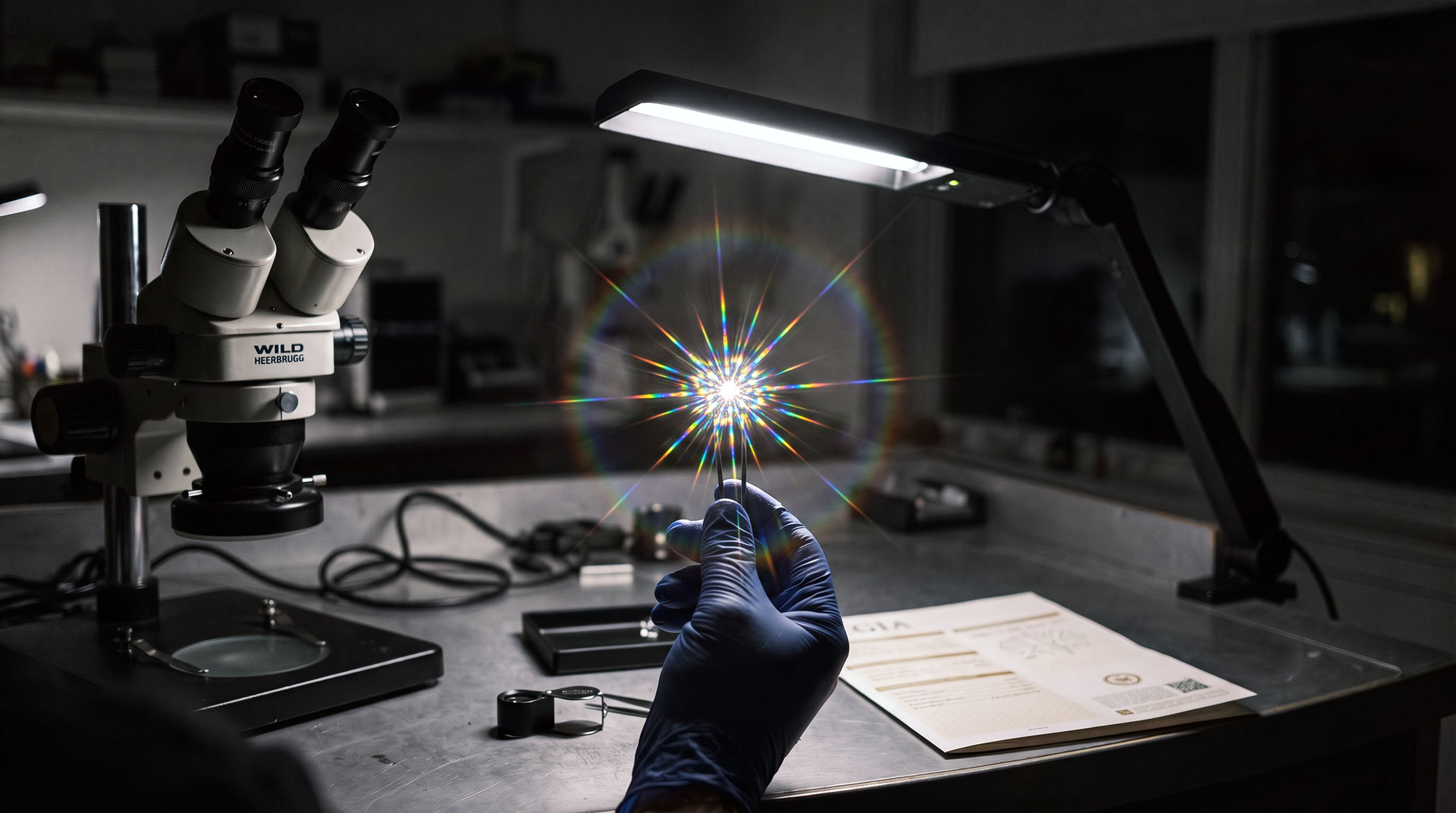
The GIA is the laboratory where diamonds go to be told what they are. It is a non-profit founded in 1931 by Robert Shipley, a Kansas jeweller who wanted to move the stone trade off the ground of a man's word, and it now sits in Carlsbad, California, examining millions of gems a year and issuing for each one a report that travels with the stone for the rest of its commercial life. That document is what the buyer actually reads, since nobody distinguishes a D from an F by eye, and those two letters carry a substantial part of the price. Because the Institute neither buys nor sells, its verdict is accepted on both sides of the table. The scale itself was built by Richard Liddicoat in 1953, and what it does, beneath the vocabulary, is rank defects. Colour records how much yellow found its way into the lattice. Clarity records the inclusions the stone carried up with it. The system works for as long as defects are distributed across a population, which is to say for as long as there are good stones and mediocre ones and a buyer who needs to know where his own sits.
An industrial product does not have that distribution. Synthetic stones have inclusions too, but anyone growing them pushes the process towards the upper end of the scale because there is no price premium waiting at the lower end, and what comes out below the threshold goes into technical uses without ever reaching a window display. At that point the instrument stops sorting and starts certifying, which is where it becomes awkward for the people who rely on it, because the same certificate in the same language now describes a stone worth ninety dollars a carat and a stone worth nine thousand, both D, both VVS. A tool built to protect the buyer from the seller had begun working against the seller. It was withdrawn where it did damage and kept where it did not.
Britain has been at this longer than anyone. Hallmarking has been a statutory obligation here since 1300, and the assay offices exist for precisely the situation in which the eye cannot verify what the hand is holding, which is why a punch mark applied at Goldsmiths' Hall has for seven centuries been worth more to a purchaser than any assurance from the man selling the plate. The principle is stable. What is unstable is the position of the line the mark defends, and a trade discovers this only when a new product turns up on the wrong side of it and refuses to look wrong.
De Beers understood the mechanism well enough to try to manage it first. In May 2018, at the JCK show in Las Vegas, the group launched Lightbox, its own brand of jewellery made from synthetic stones, sold online in the United States and positioned for the lesser occasions, a sixteenth birthday or a graduation, explicitly not for an engagement. A company that had spent a century defending the mined stone was now selling the grown one, and the move was in the price list, which was flat: eight hundred dollars a carat for everything, with no distinction of colour or clarity. A natural diamond works the other way round, since two stones of identical weight can differ tenfold in value according to where they land on the GIA scale. Setting a single price by weight is a way of announcing that the scale does not apply to this product, and of teaching the customer that synthetic stones are bought the way cloth is bought. The lesson took. So did everything that followed it.
The first retreat came in June 2024, when De Beers stopped growing jewellery stones at the factory it had built for the purpose, a ninety-four million dollar plant at Gresham outside Portland, opened in October 2020 and operated by Element Six, the subsidiary through which the group has made industrial diamonds for decades. Those furnaces now produce stones for technical use. The brand itself was closed on 8 May 2025, and the announcement conceded two things: that wholesale prices for synthetic stones had fallen by ninety per cent since the launch, from eight hundred dollars a carat to eighty, and that the product had moved to cost-plus pricing, meaning a price assembled from production cost and margin in the manner of a machined component rather than from what a buyer is willing to attribute to it in the manner of a jewel. For eighty years the value of the mined diamond had rested on a single condition, which was that nobody knew what it costs to produce one. Lightbox published that number, and the subsequent collapse showed the public that the number fell every year. De Beers funded for seven years the experiment that falsified its own thesis, then published the result in a press release.
The bill arrives first with American consumers and afterwards in the accounts. In the United States, where the diamond engagement ring as a social norm is substantially a product of the N.W. Ayer campaign of 1947, synthetic stones have passed forty per cent of engagement rings sold according to The Knot's Real Weddings Study, and they were able to do so precisely because the scale no longer separates the two categories in front of the person paying. When the premium on the mined stone stops being defensible at the counter, the owner of the mine finds it written into the balance sheet, which is what has happened at Anglo American, the London-listed miner that holds eighty-five per cent of De Beers against the Botswanan government's fifteen. Impairments of 2.6 billion dollars in 2023, another 2.9 billion in 2024 and a further 2.3 billion on 20 February 2026 have halved the carrying value to 2.3 billion and carried the group to a 3.7 billion dollar loss, while the loss at De Beers alone widened from 25 million to 511 million in twelve months. In 2001 Anglo and the Oppenheimers took the company off the market on a valuation of 17.6 billion.
Anglo has now decided to leave, and in July it named the Global Diamond Consortium led by Gareth Penny, once chief executive of De Beers, as its preferred bidder at around one billion dollars, 750 million on completion and 250 million later with further payments tied to performance. It is worth looking at who is inside that consortium, because alongside Namibia and Angola sit Antwerp sightholders such as Diarough and Pluczenik, the wholesalers who have bought rough at De Beers' periodic sales for decades, while Botswana retains pre-emption rights over any change of control. The buyer is the customer, and the customer is paying that price because it knows from the inside how difficult selling has become. The August sale was cancelled and folded into September. In July De Beers softened its book prices on sub-carat rough, which had been running twenty to thirty per cent above the market. Output in the first half rose forty-six per cent to 14.9 million carats while the average realised price fell to 105 dollars. That gap between what leaves the ground and what anyone will pay for it is the measure of what happens when nobody is holding supply discipline any more.
What remains to be sold is origin, which is where the Origins strategy of May 2024 points, tracing the stone from deposit to display case as the one attribute a factory cannot reproduce. Origin, though, is invisible to the person buying, so it is worth whatever the institution certifying it is worth.
Natural diamonds continue to receive the full four Cs. Since 1 October 2025 the same object, with the same chemistry and the same hardness, has been measured by two different instruments according to where it was formed. A measure that varies with provenance is measuring provenance.