The hidden geography of spending
Posted on: 17 May 2026
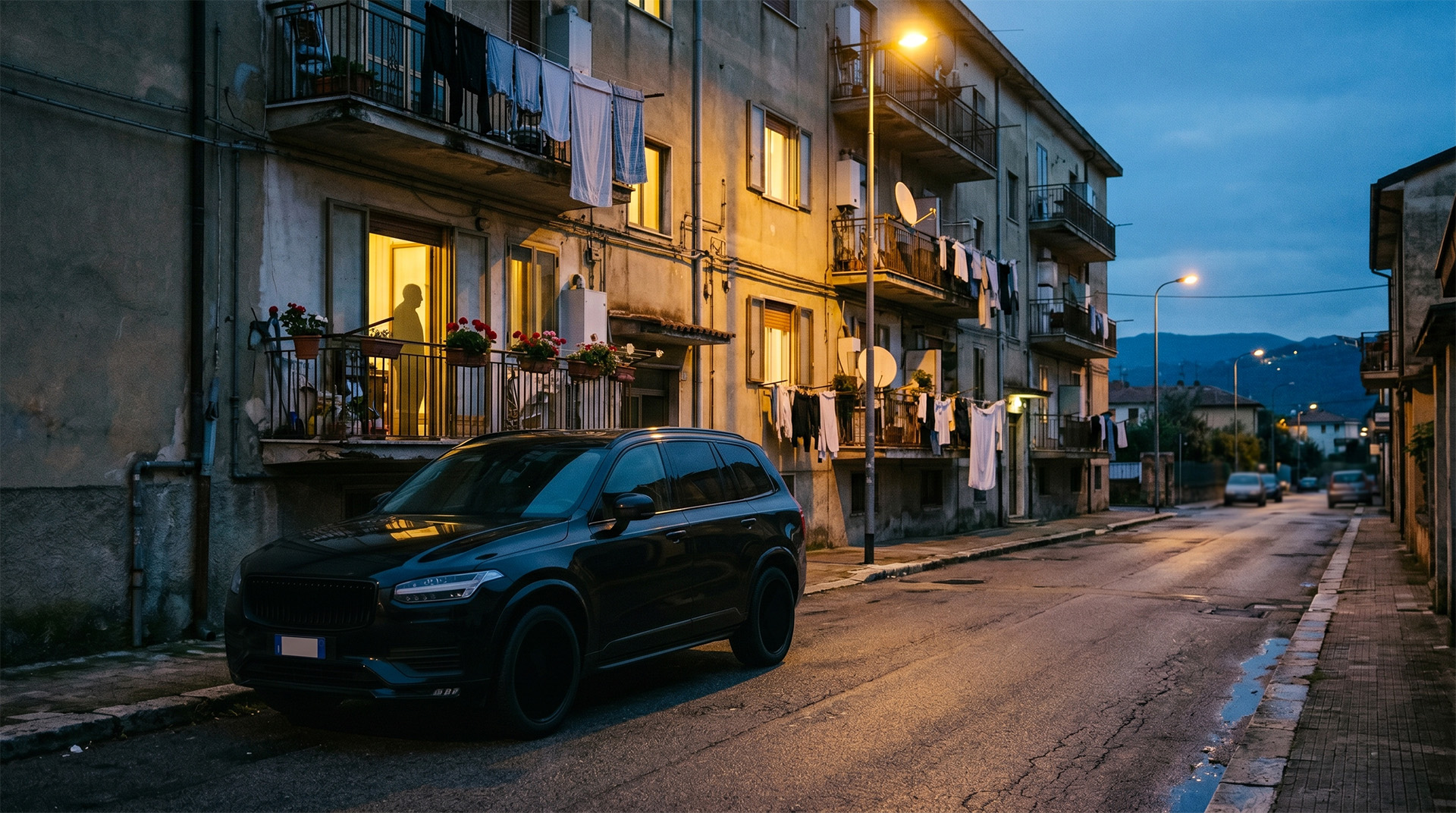
There is a scene that has been repeating itself across Britain for the last forty years, and it looks the same in Surrey and in Yorkshire, in Cheltenham and in Bolton. A family walks into a children's shoe shop. The father looks at the price tag, pulls a face, asks whether they can do anything on it. The same family, on Saturday night, climbs into a Range Rover Evoque taken on a four-year PCP and drives to a restaurant where no one ever asks for a discount, because asking for a discount over dinner with friends is simply not done. On Monday the father walks into Mulberry to buy a handbag for his wife's birthday, and there too the price is not discussed, because anyone walking into Mulberry knows you do not ask for a discount, and so does he.
The apparently naive question is: where is the coherence? The honest answer, the one nobody quite says aloud, is that the coherence is there and is more rigid than it seems, even if it is a specifically anthropological coherence. The discount is requested where one is not seen, and the full price is paid, and occasionally displayed, where one is seen. The line item in the household budget that gets squeezed without dignity is the invisible one, and the line item that expands without discussion is the visible one. This is not disorder, this is not incoherence, and it is certainly not economic ignorance. It is a class script executed with admirable discipline.
Veblen worked this out in 1899 when he wrote about conspicuous consumption as a marker of status, but the mechanism was simpler then, because the leisured class displayed its position through expensive objects that the working class simply could not afford, and the whole system functioned because the boundary between accessible and inaccessible was sharp. That boundary has now evaporated. A shop assistant in London can buy a Mulberry handbag on Klarna in three instalments. An office worker in Wolverhampton can drive a Range Rover Evoque thanks to a PCP deal. A couple from Leicester can take their holiday in Dubai and post it as if they had been to the Maldives. The democratisation of conspicuous consumption has destroyed its original signalling function and produced a structural effect that deserves careful observation, because it explains almost everything about the economic behaviour of the contemporary British middle class.
An American sociologist, Elizabeth Currid-Halkett, analysed the Consumer Expenditure Survey data between 1996 and 2014 and found a figure that turns the whole mental schema upside down: the top 1% in the United States, during that period, spent less than the national average on luxury clothing and branded accessories, while the median quintile, which is to say the middle class, spent 35% more than the national average. This is not a statistical error, it is a structural repositioning. The wealthy classes have grasped that displaying wealth through handbags and cars has become ridiculous, because anyone can afford them on credit, and they have moved their investment to where objects cannot be seen but produce real effects over time. Currid-Halkett calls it inconspicuous consumption. Private schools for the children, premium private healthcare, nannies and au pairs, robust pension contributions, organic and free-range food, specific cultural pursuits, music lessons, formative travel that does not get posted. The kind of thing that social media has no interest in, but which produces generational social mobility.
What the Currid-Halkett data illuminates, but does not fully explain, is the underlying epistemological difference: the radically different way in which old money and the middle class look at the same object. For the wealthy with genuine financial education, an object is evaluated first in its intrinsic value, which is to say in the quality of its making, in its durability, in its reparability, in the stability of its value over time, and only afterwards is the price evaluated as a function of that value. For the middle class the process is reversed. The price comes first, because the price is the status signal the object will release in public, and only afterwards is a narrative about intrinsic value constructed retrospectively, to justify the spend to oneself as well. The same object, identical in both cases, is in fact two completely different objects. An Hermès Birkin bought by someone who understands what it is lasts thirty years, gets passed down to the daughter, gets sent back to Paris for repair when needed, and is in essence a piece of long-life craftsmanship that costs a great deal because it is worth a great deal. The same bag, bought to be photographed at a restaurant, lasts two seasons because the season after that the signal will have moved on and the object will have stopped doing its job. The difference is not in the object. It is in the mental operation that precedes it.
From this one understands also why the famous PCP theory that circulates on social media, the one according to which "wealthy people buy cars on finance because the interest on their investments outperforms the interest on the lease", is a middle-class rationalisation dressed up as financial wisdom. On paper the calculation holds, if your capital yields 7% per year and the finance costs you 4%, it makes sense to keep the capital invested and pay the instalments, but the problem is the buried assumption that the tweet never quite declares. The calculation only holds if you replace the car recursively at the end of each lease, because only that way does the financial exposure renew itself perpetually and remain in a meaningful comparison with the expected return on capital. Old money does not replace the car every four years. They buy it cash, once, and they keep it for twelve or fifteen years, and a Range Rover bought outright and used until it falls apart has a laughably low annualised cost, because the price spreads across a duration that PCP does not even contemplate as a hypothesis. Meanwhile the financially literate Twitter user, over the same period, has rolled over the lease three times and has paid for three cars instead of one. The opportunity-cost mathematics only works if you accept recursive replacement as a given, except recursive replacement is not a given, it is an anxious middle-class behaviour, and once that assumption is dismantled the arithmetic flips completely.
The middle class, meanwhile, does the exact opposite of old money along both axes. It spends on visible goods that have lost their original signalling function and it cuts on invisible goods that actually produce future. The Range Rover Evoque on PCP, the latest iPhone, the holiday posted on Instagram, the designer outfit, the Apple Watch, the convincing replica watch worn at the office, and at the same time the cheapest dentist available or no dentist at all, no private health insurance, the local comprehensive that everyone knows is struggling because surely it cannot make that much difference, frozen fish from the supermarket discount aisle, the specialist appointment postponed for years because it is expensive, the pension contribution deferred because there is still time. It is a household budget engineered with surgical precision to finance appearance through the systematic sacrifice of substance.
At this point the easy moral question would be: why do they do it? And the easy answer would be: because they are ignorant, because they cannot do the maths, because they are taken in by marketing. But that is the wrong answer, and it is wrong in a specific way. It is not economic ignorance, because the person buying a Range Rover on a four-year PCP knows perfectly well they are paying for it twice over, and it is not an inability to calculate, because the person skipping the dentist to pay for a holiday is making a calculation that is perfectly coherent with their actual priorities. The point is that the actual priorities are not economic, they are anthropological. The British middle class, like much of the European one, is managing a belonging budget, not a wellbeing budget. The visible line item is the price one pays not to be expelled from the group one believes one belongs to, and the invisible line item is the release valve where everything that can be compressed gets compressed to finance the first one.
The most uncomfortable element, and the one that makes the phenomenon structurally unsolvable at the individual level, is that the mechanism reinforces itself through social media. Forty years ago, the neighbour saw your new car and that was it. Today, three thousand contacts see your holiday, your dinner, your birthday present, your new phone, your Friday-night drinks with colleagues at the right place. The signalling pressure has shifted from a neighbourhood scale to a network scale, and the cost of standing outside the performance has become social before it is economic. Whoever does not post becomes invisible, whoever is invisible does not exist, and whoever does not exist loses concrete professional and relational opportunities. The visible spend has become, in effect, a form of reputational investment, and in an economy where reputation does the work that references once did, it is not necessarily irrational. It is, however, very, very expensive.
There remain those who ask for a discount as a matter of principle, and here the picture becomes more subtle. They are not the poor, because the poor often do not ask for discounts, they absorb them by other means. They are not the ignorant, because asking for a discount is an active exercise in negotiation that requires a tactical intelligence of its own. They are, more often than not, simply people formed in an era in which asking for a discount was a sign of shrewdness, of not being taken for a fool, of respect for the money one had earned. That cultural code made sense in an economy of scarcity and of informational asymmetry between seller and buyer, where the one who did not haggle was, by definition, the one being fleeced. It survives today as an automatism, dissociated from the context that made it useful, and it is applied everywhere except where it actually matters, which is to say where the price is ostentation and where asking for a discount would mean giving up the performance of belonging.
The clinically most interesting observation, and the one worth saving for the end so that one can sit with it for a moment, is that the only real class distinction in the contemporary moment, at least for now, is the one between those who can read this map and those who execute it without realising. The invisible affluent class reads it well and invests in its children. The visible middle class executes it without knowing and finances its own anxious old age. The poor are out of the game because they have no margin to play with. And in the middle of all this sits the word thrift, one of the most ambiguous words in the English language, which now covers opposing and contradictory behaviours with the same serenity with which it once covered the wartime good sense of make do and mend.