The crowd is designed from the other side of the barrier
Posted on: 21 October 2026
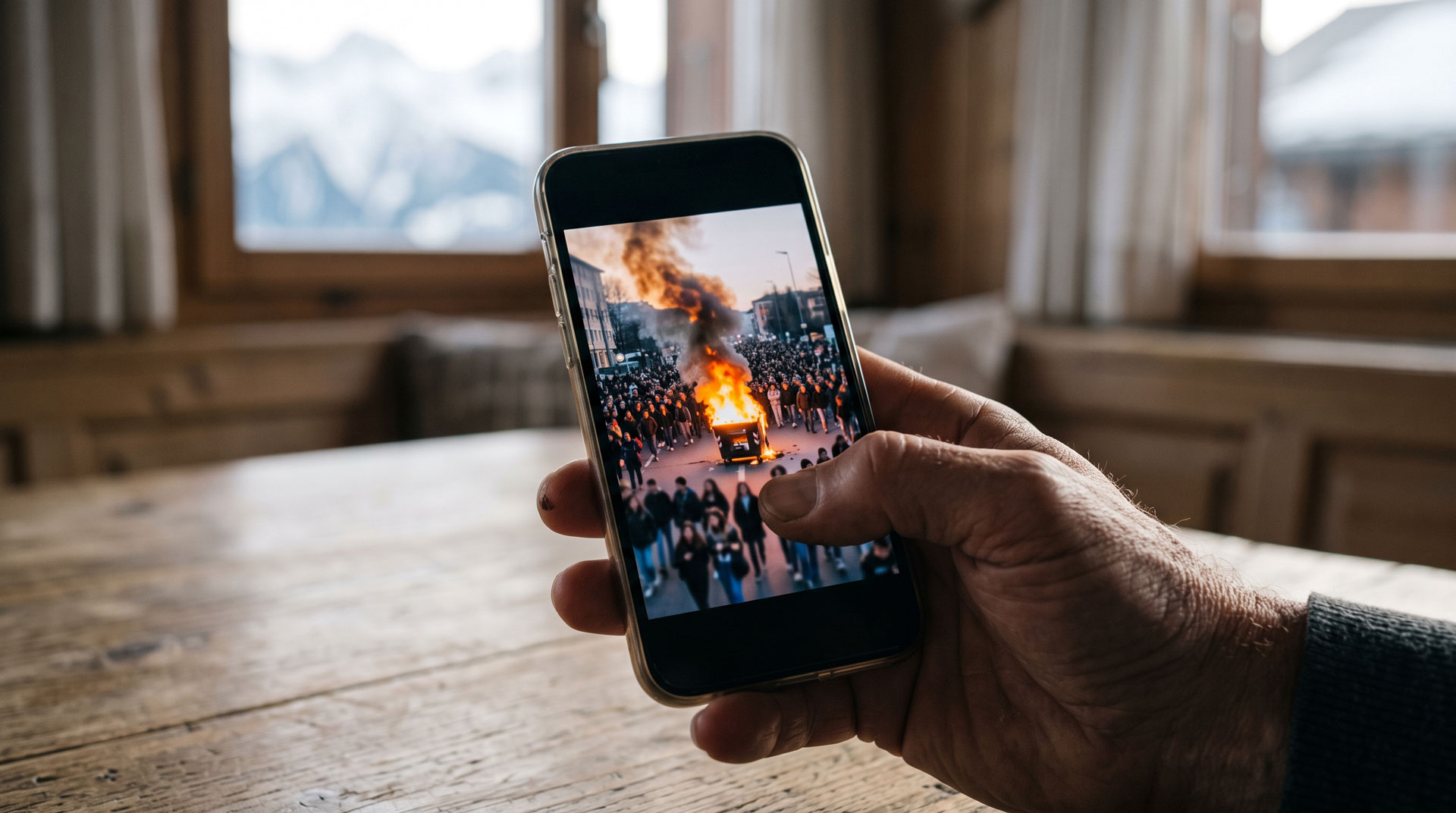
Ask a British reader what they remember of the student protests of November 2010 and the answer is almost always the same image: a window going in at 30 Millbank, the building that housed Conservative headquarters, and a fire extinguisher dropped from the roof. Around fifty thousand people marched against the trebling of tuition fees that day, ten times what the police had expected, and almost none of them broke anything. The fees were trebled anyway a month later. The lesson most people drew was that students are idealists who smash things and lose, which is roughly the thought I had on Saturday, scrolling from the quiet of the Bernese Oberland through footage of a cost-of-living march in Milan turning into a street fight, while the same scene played out in Turin and Bologna. Young people who want to change everything by breaking windows, without understanding that real change is negotiated from the inside by people who know how to use power patiently. I waited a few days before writing about it, because the thought came too easily. What reaches a screen a few hundred kilometres away is never the march but its most photogenic fragment, the burning bin and the masked teenager, while the thousands walking past without touching anything never stop anyone's thumb. Looked at properly, that reflex contains precisely the mistake that can turn a movement about classrooms into something far harder to govern.
The facts first. The wave began in mid-September at a lycée in Créteil, in the suburbs of Paris, where pupils walked out over overcrowded classrooms and teachers who never arrived. Within weeks it had crossed France and reached Liège and Brussels, and on 17 October it merged with a national cost-of-living mobilisation that brought out the remnants of the gilets jaunes, the yellow-vest movement that shook Emmanuel Macron's first term. Italy caught it by open imitation: in Udine three teenagers called a demonstration on the simple question of why Italians do not protest the way the French do. Those who reach for 1968 see the shape correctly, the contagion from one country to the next and the temptation to fuse with organised labour, but they get the arithmetic wrong. In 1968 the young were numerous and the economy was growing, so that generation was always going to end up running things. Today they are a minority in ageing societies, they are asking for desks and affordable rents rather than a new meaning of life, and the movement started in secondary schools where many of them cannot yet vote. It is no accident that Jean-Luc Mélenchon, the 75-year-old leader of the French radical left, now on his fourth presidential run, has already proposed lowering the voting age to sixteen.
The idea that a crowd is stupid has a precise author. Gustave Le Bon, a French physician and amateur sociologist, set it down in 1895 in The Crowd, arguing that the individual inside the mass regresses until he stops reasoning, and his book has been the unspoken manual of anyone who has had to manage a square ever since. British public order policing knows better than most where that leads, because it had to unlearn it. After the death of Ian Tomlinson, a newspaper seller who collapsed after being struck by a police officer during the G20 protests in London in 2009, Her Majesty's Inspectorate of Constabulary published a review of protest policing that drew on the work of three British psychologists, Steve Reicher, Clifford Stott and John Drury. Their finding, built over two decades of watching riots form, is that most people in a crowd are peaceful and become willing to fight only when they feel treated as a single hostile block, because at that point even those who came for something else start to see confrontation as legitimate. The cleanest test came at the 2004 European Championship in Portugal, where two different police forces shared the tournament. One adopted Stott's approach of low-key presence and targeted intervention against individuals, the other stuck to traditional riot tactics. There were no riots in the first force's areas and two in the second's, with the same English fans who four years earlier had been at the centre of the disorder in Belgium.
The violent minority therefore stays a minority until the majority feels punished alongside it. There is a second mechanism, described in 1984 by the American sociologist Herbert Haines in his study of the civil rights movement, when he noticed that moderate black organisations received more funding, not less, as the radical wing emerged. He called it the radical flank effect, and later research has shown that it can cut both ways. Broken windows can make the people asking for supply teachers and decent classrooms look reasonable to everyone, or they can drag them down too. Which of the two happens is not decided in the street. It is decided by whoever sits on the other side, and by how quickly they open a door to the moderates before the radicals become the face of the whole movement.
The textbook case is May 1968 itself, provided you read it from the side of power. Between 25 and 27 May, with France paralysed by a general strike, the prime minister Georges Pompidou brought unions and employers together at the Ministry of Social Affairs on the rue de Grenelle and put on the table a 35% rise in the minimum wage and a 10% rise in wages by the autumn. He did not negotiate with the students, who had nothing he could give them, but with people who had a payslip to defend and therefore a demand that could be met. The Grenelle accords were never even signed and were received coldly in many factories, yet the alliance between workers and students, which was the real threat to the government, began to come apart from that moment. On 30 May Charles de Gaulle dissolved the National Assembly, and at the end of June the voters handed him a landslide.
That is what my reflex on Saturday could not see. The corridor where power is exercised exists and it works, but at Grenelle it worked because there was a street outside setting its price. The street sets the price and the corridor collects it, which means a crowd is never beaten by confronting it but by taking it apart, giving what can be delivered to those able to accept it and leaving the total demand to those who will never know what to do with it. Students are wrong when they believe the street is where change happens, while those watching from above are just as wrong when they believe the corridor can work without any pressure from outside.
Lost causes deserve the same lens. On Friday the Italian marches were against war and the cost of living, for the right to study and for the climate, which is a demand no minister on earth can satisfy and which will therefore stay lost whatever happens. In France, where the movement began with something concrete, the government has already ordered emergency hiring of supply teachers and rearranged school timetables. The difference between a lost cause and a won one rarely lies in how violent the methods are. Much more often it lies in whether someone on the other side of the table can say yes without losing face, which is also why 2010 is not the counterexample it seems. The demand was concrete, but meeting it would have unpicked the coalition's entire spending settlement, so nobody on the other side could say yes without losing face.
The coming weeks will test all of this. On Saturday students of the Italian right will march in Rome under the slogan "Sblocchiamo tutto", unblock everything, and two crowds facing each other are exactly the setting in which identities harden and each becomes for the other the single block from which violence grows. Then come two general strikes, called by the grassroots unions for 30 October and by the CGIL, Italy's largest union federation, for 20 November. The second is the one that matters, because convergence with the main union is the thing that most resembles May 1968, and between the two dates lies a full month in which those in government can choose whether to take the crowd apart or weld it together.
None of this is confined to politics. It applies to a vice-chancellor facing an occupied campus as much as to a chief executive facing a workforce in revolt. The first thing not to do is make the moderates pay the radicals' bill, treating the three thousand students who marched peacefully through Milan on Friday as if they were the same people fighting in the streets on Saturday. The second is to respond in the same hours in which the crowd is responding to you, because from that moment it sets the tempo. To the students, if any of them were reading, I would say only this: your best demand must never become hostage to your worst element, because that is always the one the cameras, and power, will choose to frame.
On Saturday, scrolling through those images, the most dangerous reflex was perhaps not in the hand throwing the stone but in the thumb of someone like me, watching from far away and putting everyone in the same bag.