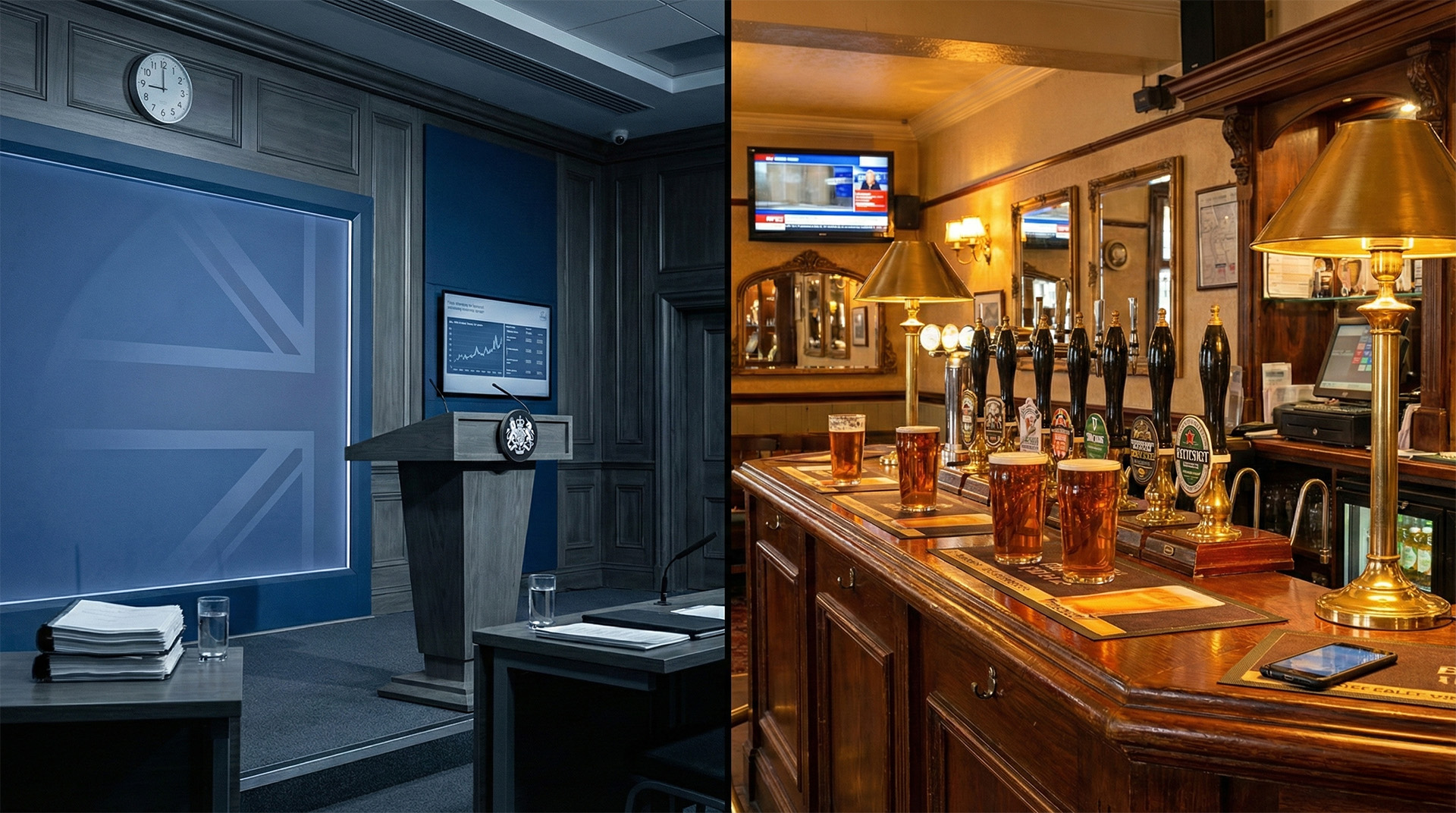
The communication paradox in british politics
Posted on: 2 February 2026
There is a number that should keep Labour strategists awake at night: fourteen. That is how many times more engagement Reform UK achieves per post on TikTok compared to Labour, the Conservatives or the Liberal Democrats. Not fourteen percent more. Fourteen times more. According to a Guardian analysis of over 12,000 posts, Nigel Farage has as many followers on TikTok as every other MP combined. The five most-viewed political videos by any MP in 2025 were all posted by Farage. One video from January, titled "Isn't it about time we started looking after our own people?", reached 4.9 million views.
Meanwhile, Keir Starmer joined TikTok in December 2025, eighteen months into his premiership. His first post was a thirteen-second clip of him turning on the Downing Street Christmas tree lights. The reaction was a deluge of negative comments. Farage's response was instant and predictable: "The world's most boring prime minister has just joined TikTok." The engagement on that single mocking post likely exceeded Starmer's entire TikTok output to date.
The numbers tell a story that goes beyond social media metrics. Starmer's net favourability rating hit -54 in December 2025 according to YouGov, virtually identical to Boris Johnson's rating on the day he resigned as prime minister. Farage sits at -31, a full 23 points higher. Perhaps most damning: 53% of people who voted Labour in July 2024 now have an unfavourable opinion of Starmer. The man who won a landslide has managed to alienate the majority of his own voters in less than eighteen months. Reform UK has overtaken Labour in the polls, sitting at 28% against Labour's 18%.
The temptation is to attribute this collapse to policy failures, to the Budget, to broken promises, to the general difficulties of governing. All of these factors matter. But they do not explain why Farage, who holds no ministerial responsibility and leads a party with five MPs, commands more attention and generates more engagement than the entire machinery of government. The answer lies in how these two men communicate, and what that communication reveals about their understanding of the current moment.
Starmer communicates like what he is: a former Director of Public Prosecutions who spent his career constructing careful legal arguments. His sentences are structured, his reasoning is sequential, his conclusions are hedged with appropriate caveats. This approach works brilliantly in a courtroom. It works reasonably well in Parliament. It fails catastrophically on platforms where attention spans are measured in seconds and authenticity is valued above accuracy. As one commentator put it, Starmer specialises in "the carefully focus-grouped banality beloved by politicians of the pre-digital era."
Farage communicates like what he is: a former City trader who understands that markets, like voters, respond to confidence and simplicity. His style is colloquial, his slogans are memorable, his manner suggests a man who has wandered in from the pub to tell you what he really thinks. "Take Back Control" won the Brexit referendum with three words. Try to remember a single memorable phrase from Starmer's 2024 election campaign. The comparison is instructive not because Farage is more honest, but because he understands that modern political communication is about cutting through noise, not adding to it.
The structural gap between the two camps is staggering. Twenty-four out of twenty-eight ministers in Starmer's cabinet have no TikTok presence whatsoever. Fourteen ministers, half the cabinet, do not even have a LinkedIn account. The average age of cabinet ministers is 53.7, nearly fourteen years older than the UK population median. This is a government that has outsourced its digital communication to a "New Media Unit" that pays influencers to ask soft questions, while traditional lobby journalists complain that real scrutiny is being bypassed. The strategy satisfies no one: journalists resent the lack of access, influencers are accused of being government mouthpieces, and the public sees through the artifice.
Farage, by contrast, is the content. He does not need intermediaries because his personality is the message. When he posts a video complaining about the milk options at a hotel breakfast, it feels authentic because it probably is. When he mocks Starmer's TikTok debut, he is not following a communications strategy; he is doing what comes naturally. This is the fundamental asymmetry that Labour cannot solve by hiring more digital staff or hosting more influencer breakfasts at Downing Street. You cannot manufacture authenticity. You can only be authentic or fail to be.
The pattern repeats across Western democracies. In Italy, Giorgia Meloni dominates social media with 12 million followers while the opposition leader Elly Schlein barely cracks one million. In the United States, Trump's communication style, for all its chaos, generates engagement that conventional politicians cannot match. In France, the rise of the Rassemblement National has been accompanied by a sophisticated social media operation. The populist right has understood something that the centre-left consistently fails to grasp: in an attention economy, being interesting matters more than being correct.
This is not to suggest that Farage's policies are sound or that his influence is benign. It is to observe that the left's consistent failure to compete in digital spaces has real political consequences. Reform UK's growth is not happening despite Labour's incumbency; it is happening partly because Labour's communication style makes the government appear distant, technocratic and out of touch. When Starmer finally joined TikTok, he did so with the enthusiasm of a man filling out a tax return. When Farage posts, he does so with the energy of someone who genuinely enjoys the fight.
The deeper problem for Starmer is that authenticity cannot be faked, and his authentic self is not suited to the medium. He is, by all accounts, a decent and serious man who cares about policy detail and proper process. These are admirable qualities in a prime minister. They are death in an algorithm that rewards emotional engagement and punishes caution. Every carefully worded statement, every refusal to be drawn into controversy, every "I'm not going to comment on that" reinforces the perception that he has nothing interesting to say. Farage's willingness to say outrageous things makes him dangerous, but it also makes him watchable.
Labour's response has been to throw money and staff at the problem. The New Media Unit employs approximately twenty people dedicated to building relationships with content creators. The government has spent over half a million pounds on influencer partnerships. Ministers have been photographed with TikTok personalities and podcast hosts. None of this has arrested the slide in the polls or the collapse in Starmer's personal ratings. The reason is simple: you cannot buy your way to authenticity, and audiences can smell inauthenticity instantly.
The question is whether this matters beyond the world of social media metrics. The evidence suggests it does. TikTok is where political commentary, policy explainers and real-time reactions happen for voters under thirty. It is the fastest-growing platform in the UK. A government that cannot communicate effectively on these platforms is a government that cannot reach a significant portion of the electorate. The fact that Farage dominates this space despite leading a minor party with minimal parliamentary representation tells us something important about where political power is shifting.
None of this means Reform UK will win the next election or that Starmer's government is doomed. Electoral politics involves many factors beyond social media engagement, and the British public has a history of separating entertainment from governance. But the communication gap between Farage and Starmer is a symptom of a deeper problem: the centre-left's inability to connect emotionally with voters who feel ignored by the political establishment. Farage offers simple answers to complex problems. Starmer offers complex answers that few people have the patience to hear. In a world of infinite content and finite attention, simplicity wins.
The irony is that Starmer's legal training should have taught him the importance of persuasion. The best barristers do not merely present evidence; they tell stories that juries can understand and remember. Somewhere between the courtroom and Downing Street, Starmer forgot this lesson. He presents evidence methodically and expects the public to reach the correct verdict. Farage tells stories, and the public remembers them. Until Labour understands this distinction, the man with the pint will continue to beat the man with the policy paper.