The biggest placement machine ever built
Posted on: 16 June 2026
The market delivered its verdict on Friday 12 June, and the verdict bears the mechanism out more than it undoes it. Priced at $135 a share the previous evening, SpaceX closed its first session at $160.95, up 19 per cent, after touching a high of $176.52 and a low of $149.34. It raised some $75bn on more than 555 million shares, the largest flotation in history, and ended the day worth above $2tn. It was Gwynne Shotwell who rang the opening bell at the Nasdaq, not Musk, and that too says something: with control sealed by a dual-class structure, the founder has no need to stand on the rostrum.
That first-day leap is not enthusiasm but arithmetic. A 19 per cent gap between the offer price and the close means more than $14bn left on the table, value that SpaceX did not collect and that went instead to whoever held the stock at $135 from the allocation. It is the classic mark of underpricing, and on $75bn it is the largest ever seen. Britain knows the smaller version of this story. Royal Mail was floated in 2013 at a price set deliberately low, jumped sharply on its first day, and the gap was value the public purse never collected, gathered instead by the institutions handed stock at the offer. But the pop is not the story. It is only its most conspicuous symptom, a sign of something happening elsewhere, at a point of the stage almost no one watches.
A flotation is always told as a story of two parties: the company that sells and the public that buys. It is a story of two that conceals the third, and the third is the one that counts. Between the seller and the buyer sits a layer of intermediaries, in this case a syndicate of 21 banks, which is not a pipe through which the money passes but an actor with an interest of its own, distinct from the company's and from the saver's. The underwriter does not work to match the two parties well; it works to extract the most from the transaction, and the structure of the deal is built around that interest, not around the other two.
The company would want the highest possible price, since every dollar of underpricing is a dollar it does not collect. The saver would want the lowest possible price, to buy value rather than air. The underwriter wants neither: it wants the placement that secures its fee and the relationship with the large institutions to which it allocates the underpriced stock, plus the first-day jump that makes the headlines and prepares the next mandate. The underpricing that harms SpaceX is precisely the gift that binds the allocated. It is not a pricing error. It is the pricing that was wanted.
And here one sees why I call it a machine rather than an event. The free float was kept tight, so that demand would press the price upward. The Nasdaq's fast-entry rules will force index funds to buy at prices they do not choose, because they replicate a basket and do not judge a value. The retail allocation was tripled against the norm, from the usual 5 or 10 per cent to around 30. That is not generosity but the spreading of risk across a wide and fragmented base. The insiders' lock-up is staggered and tied to earnings and price thresholds, so that those inside can leave precisely when the stock is strong. Every piece is designed and none is illegal, yet the whole works in a single direction.
Two different small investors must be told apart, or the market will refute us on its own. Whoever secured the allocation at $135 and watched the stock leap has gained, and that leap is exactly the value handed to him at the seller's expense. That investor is not squeezed. He is rewarded. The squeezed one is the other: the one who got no allocation and chases the stock above $160 on the open market, or who will buy at the unlock windows when the insiders need a buyer. The real question is not how many small investors received the allocation. It is how many will come in afterwards, on the market, at the inflated price. That is the marginal buyer.
The constant that survives both the rise and the fall is not the loss but the transfer of risk. At the end of 2025, on the private secondary market, SpaceX was worth around $800bn. In six months the valuation has more than doubled, to the $1.77tn of the offer. Those inside at $800bn have watched their position convert into the peak, and the public has absorbed that peak. The insider turns an illiquid position into certainty; the forced demand of the index funds and the unlock tied to the strength of the stock manufacture the exit for him; the small holder inherits the residual risk at the highest point of the curve. Whether the stock then rises or falls, the risk has already changed hands.
The most uncomfortable point is that none of this requires a culprit. No one cheats. The bank prices for whoever guarantees its next mandate; the index fund buys because its mandate compels it to replicate the basket; the allocated institution sells on the first day, which is when it banks the gift. Each performs its role diligently and the harm emerges from the whole, not from a single hand. It is a structural pressure that grows with the stakes, and on $75bn it is the greatest ever seen. There is no villain to point at, and it is precisely for that reason that it is harder to see and impossible to prosecute.
One thing the first day cannot prove, and it must be said. Whether the unlock is an engineered exit rather than genuine conviction we will know only at the year's end, when the filings show how much the insiders actually sell at the unlock windows. If they hold, if they sell little against what they could, then this reading was mood dressed as mechanism and it will have to be corrected. Friday's pop reinforces the first leg of the argument, the underpricing; on the second, the risk that changes hands, we wait for the data. I write what I see, not what I would like to see.
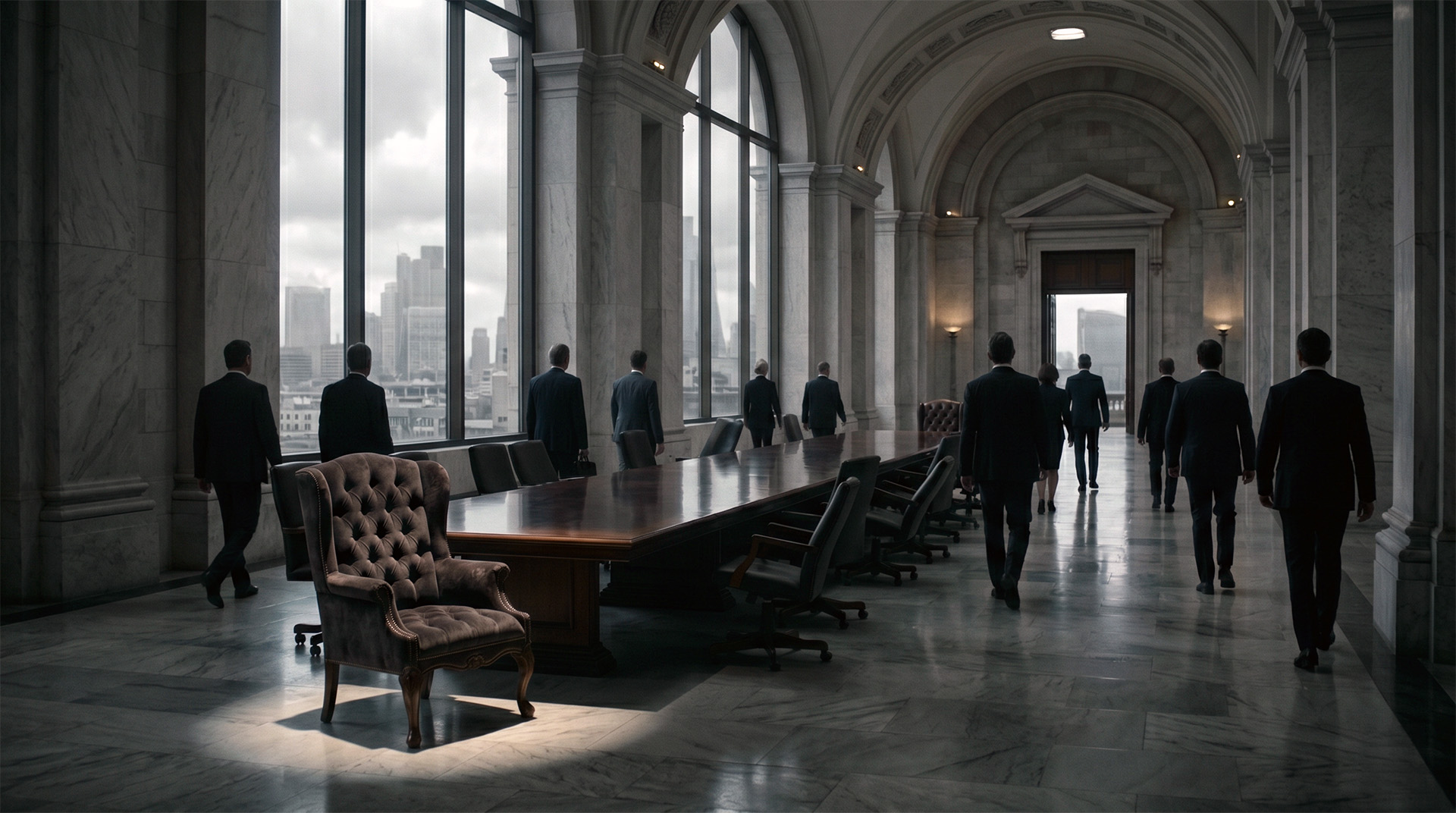
Picture the long table when the meeting has ended. The chairs are pushed back, the others have risen and gone. One chair remains, finer than the rest and set a little apart, the one held out to whoever arrives last, on the market, at the inflated price; it is built to carry the risk the others have just set down. On its arm there is a label that calls it the best seat in the room. Most of those who take it read the label only once they are already seated.