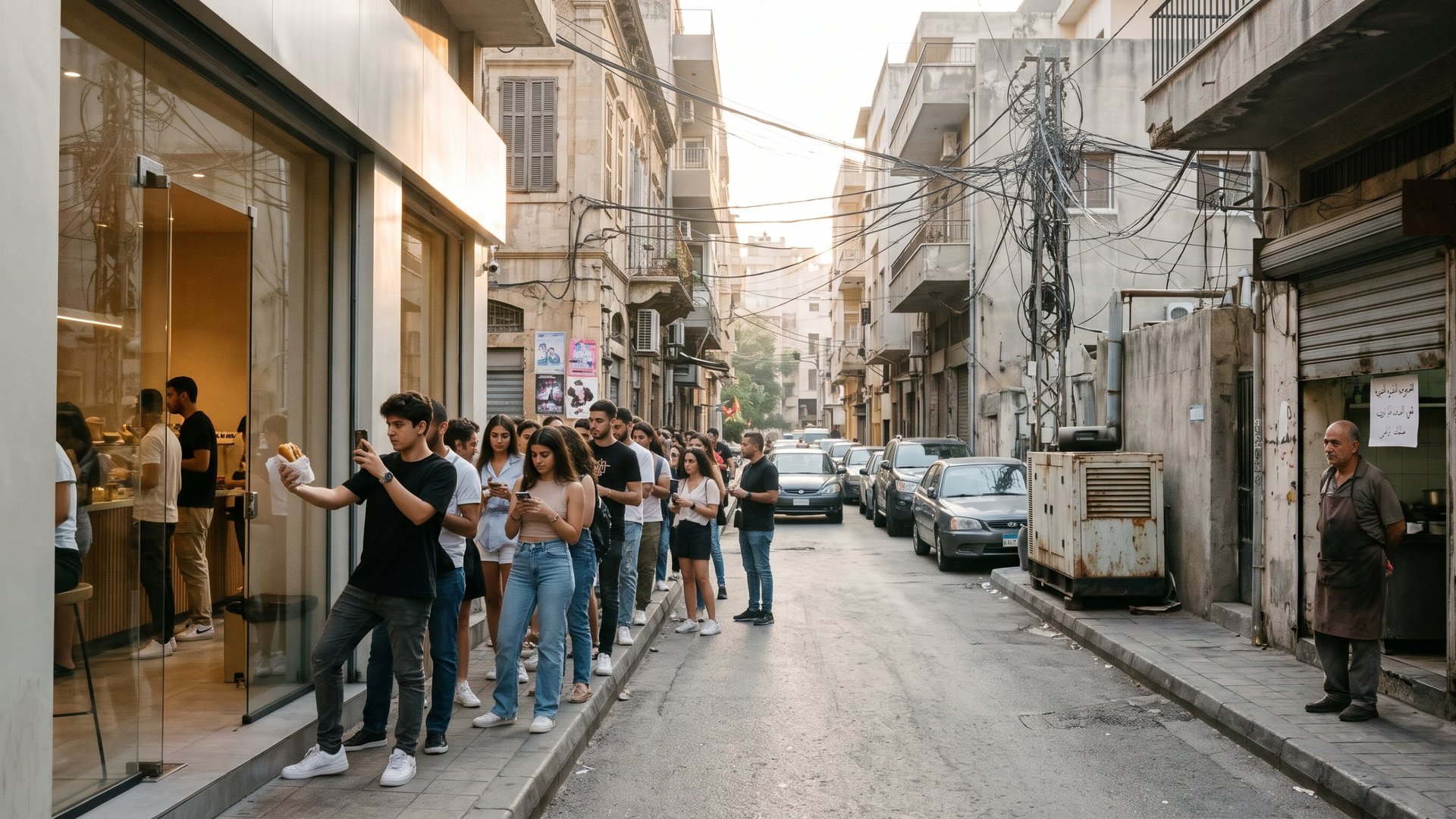
The $13 sandwich does not divide Lebanon, it measures it
Posted on: 27 October 2026
A health food restaurant in Beirut called The Glow Paradise has put a "chic" version of the shish taouk on its menu, the marinated chicken wrap that costs about as much as a coffee anywhere in the Levant. The price is around $13, double the going rate. Instagram was outraged for days, with accusations of theft and indecency in a country where four households out of five, according to UNICEF, struggle to afford basic necessities. Meanwhile, according to Hrag Jeghalian, the restaurant's managing partner, they sold more than 20,000 of them in eleven days. In the same month, according to Sami Nader, an economist at Saint Joseph University in Beirut, 22 restaurants closed.
Reuters tells it as a story about inequality. What interests me is the mechanism, because I have watched it repeat in every downturn I have been through while running a business, with different numbers but always the same shape.
A little context first. Lebanon collapsed in 2019, when the banks stopped returning deposits and the lira lost almost all its value. GDP has fallen by roughly 40% since then, according to the World Bank, which expects inflation at 17.5% this year. In between came the Beirut port explosion of 2020 and two wars with Israel in under two years. The minimum wage is set at $400 a month. The state grid supplies power for a few hours a day and the rest comes from private neighbourhood generators, whose tariffs have risen by 60% since February, to the point where round the clock electricity now costs several hundred dollars a month. More than the minimum wage, in many homes. Inside that picture the sandwich is not the anomaly, it is the thermometer.
When an economy collapses demand does not vanish, it concentrates. The market "for everyone" dies first because it is priced against everyone's wages, and those wages are stuck at $400 while everything else is now priced in hard currency. Whoever sold to the average customer has discovered that the average customer has left the market, not because their tastes changed but because their money no longer holds. Whoever sells to the 20% who still have real dollars is running flat out, with a queue outside. The 22 closed restaurants and the 20,000 sandwiches are not two contradictory stories, they are one story seen from two sides.
Nor is this a Lebanese oddity. In Argentina, when the state cut off access to dollars and the official exchange rate became a fiction, the "blue dollar" appeared, the parallel rate at which anyone holding hard currency bought everything at prices that were science fiction to anyone earning pesos. In Venezuela during the hyperinflation the ordinary supermarkets stood empty while "bodegones" flourished, shops stocked with imported goods payable only in dollars, fifty yards from people queuing for bread. Russia after the 1998 default saw the same fork: mass consumption in roubles evaporated, consumption in hard currency held. Same game, different pieces, every time.
There is a second mechanism, subtler and less comfortable. The outrage was the product's distribution channel. The managing partner says so without embarrassment, calling the row "natural marketing". The people shouting theft acted as an unpaid press office for the people selling, because in a shrunken market visibility is worth far more than being liked. Collective moralising paid the bill for the publicity, and the campaign's real audience, the 20% who could afford the sandwich, learned where to go precisely from those who wanted to boycott it. Anyone who has run a product through a crisis knows that the worst thing is not being criticised, it is being ignored.
And there is a third mechanism, the hardest of all. The sandwich makes news because it can be seen, photographed, shared. The generator bill, priced in dollars against a wage in dead lira, makes no news because nobody puts it on Instagram. Public debate fastens on the visible symbol and leaves alone the mechanism that is actually crushing families, and that is not a Lebanese failing, it is how human attention works everywhere. People argue about the price of a sandwich while quietly paying electricity tariffs nobody voted for.
If you find yourself running a business in an economy that is coming apart, the things not to do are clearer than the things to do.
Do not price for the average customer once the average customer has gone. The average is a statistical fiction that, in these conditions, buys nothing, because the distribution has split into two humps and there is nobody in the middle.
Do not read outrage as a signal of demand. The people who are outraged were not your customers before either, while the people who buy have no interest in saying so in public.
Do not confuse what is visible with what matters. The sandwich is the thermometer, the fever is in the bills, the rents in dollars, the wages that do not move.
The niche outlasts the mass market not because it is smarter or more elegant, but because it serves whoever still holds money that is worth something. It is an unpleasant observation, especially for anyone who would like the economy to work like a public meeting. It stays true even when nobody likes it.