Ten minutes from Monte Carlo
Posted on: 12 August 2026
Anyone who has looked at property listings in London knows the phrase "Chelsea borders". It is not a fraud and it is not even a stretch, because a flat in Fulham or on the wrong side of Battersea genuinely does sit near the boundary of a postcode that carries forty years of accumulated meaning, and the agent who writes those two words is describing something geographically true. The same instrument produces London Luton, which is in Bedfordshire, and London Southend, which is in Essex, and London Oxford, which is in Oxfordshire and roughly sixty miles from the capital whose name it carries. In each case the seller has borrowed a name that belongs to somewhere adjacent and has done nothing that any regulator could object to. What interests me is not the practice, which is universal and well understood, but the point at which it stops being a discount on the promise and becomes the removal of the promise, because that boundary is invisible in the language and the language is identical on either side of it.
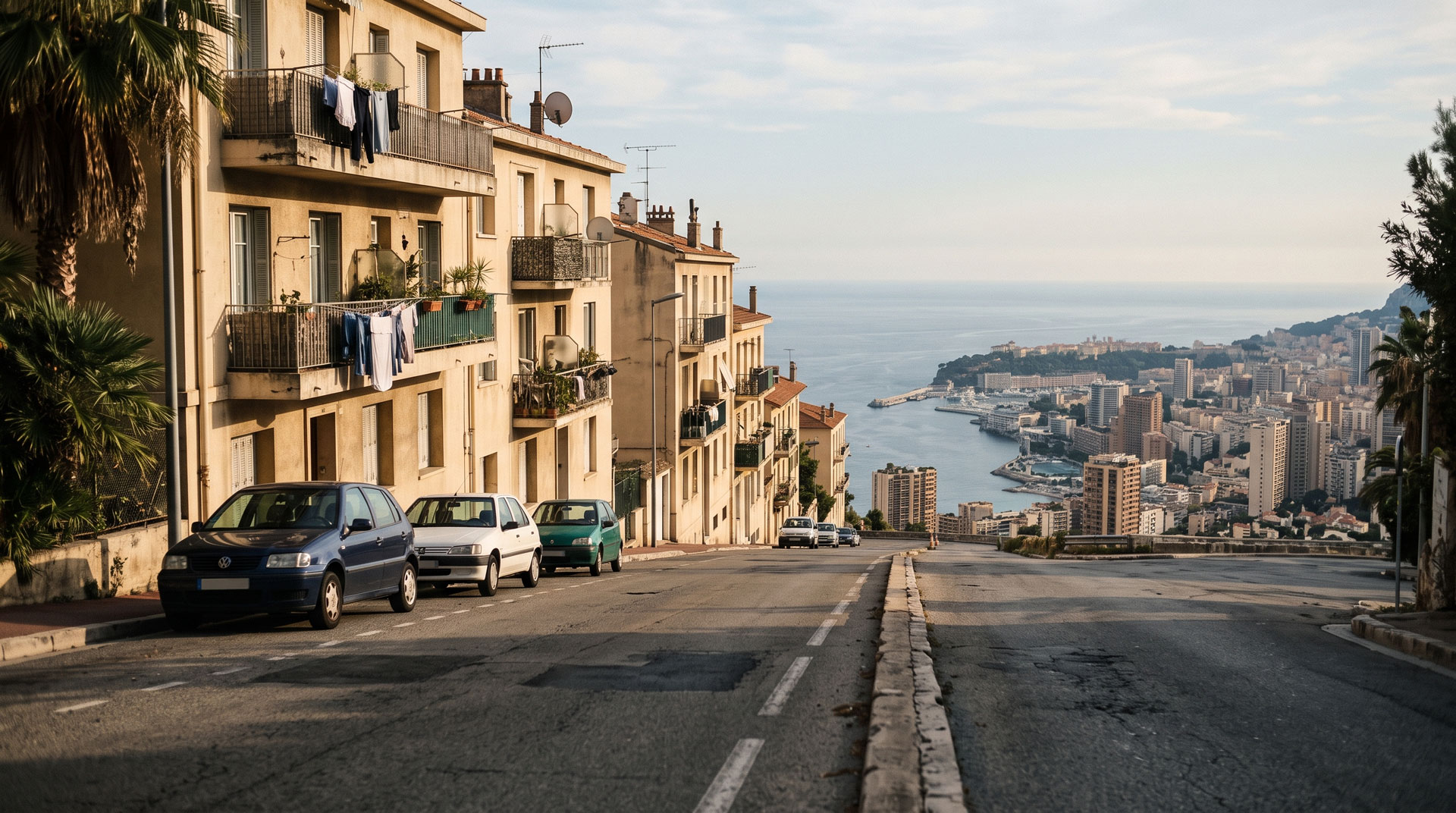
The clearest case I know sits on a hillside above the Mediterranean. Beausoleil is a French commune in the Alpes-Maritimes, pressed directly against the border of Monaco, and the streets of the Moneghetti quarter run so close to the frontier that in places one side of the road is French and the other is not. Search for a flat there today and Italian agencies will list it under a heading that reads, in capitals, BEAUSOLEIL MONTE CARLO. One listing describes a thirty-seven square metre flat on the first floor of a building with no lift, and explains that the centre of Monte Carlo is a comfortable ten minute walk away. Every word of that is accurate.
Forty years ago the same proposition arrived through the television. I remember Italian estate agencies buying an hour of airtime on regional stations, the sort that were only watchable across half a province, selling flats on the Côte d'Azur at a price that always sat in the same band, which was the price of a second home somewhere ordinary in Italy. The details have gone and I am not going to reconstruct them, but the price band is the part that survives and it is also the only part that matters, because the gap between the name being spoken on screen and the figure being asked was already the whole of the necessary information. Monte Carlo at the price of a seaside flat in the Marche is not a bargain, it is a contradiction. That gap was read as an opportunity rather than as a warning, and the inversion is the mechanism worth writing about.
Two reasons to buy were offered together. The first was fiscal. Monaco does not levy income tax, so buy there and move your residence. The second was capital appreciation. The Principality was filling up, it had no room left, expansion would spill onto exactly that hillside and values would rise accordingly.
The first was false. Not ambiguous, not optimistic, false. Beausoleil is French territory under the full French tax code, and Monegasque residence has always required accommodation inside the Principality, whether owned or rented. Buying in Beausoleil in order to become resident in Monaco is buying a season ticket for the wrong ground. The benefit is not diminished, it is absent. What makes the case worth examining is that the information required to establish this was entirely public. A French notary would have said so in one telephone call, before signature, at no cost.
The second came true. Beausoleil today carries high Côte d'Azur prices, Monaco did saturate, and the pressure did push values up across everything adjoining it. Buyers who purchased for that reason were, four decades later, correct.
This is where the story stops behaving like the story we normally tell. The standard version has a credulous buyer, a vanishing seller and a moral about things that are too good to be true. That version does not apply here, because a great many of those buyers made money. Which makes it impossible to call the arrangement a fraud, and makes it considerably harder to explain what was wrong with it, and that difficulty is precisely why the structure has survived intact into the present.
What was wrong is that the two promises were of opposite kinds and were sold in a single breath. One was immediately checkable and untrue. The other was unfalsifiable by construction, since it concerned what might happen over the following decades, and it came good on its own, through planning dynamics the seller neither controlled nor in all likelihood understood. The buyer took the package without separating them, because the second covered the first. If the thing appreciates anyway, the business about the tax becomes a detail. Anyone with real money and no interest in pretending to be Monegasque would have bought inside the Principality with professional advice that was not available on regional television. I have watched the same movement in markets with no connection to property at all, and it ends the same way each time, with the checkable claim absorbed into the uncheckable one and thereby never checked.
The obvious objection is that this is ordinary marketing and that everyone accepts London Luton for what it is. That objection is worth taking seriously, and taking it seriously is what produces the distinction. From Luton you do reach London. It takes an hour, the train costs money, the benefit is degraded but it survives, and you booked a flight to London and to London you went. Ryanair built an industrial model on this principle, with Paris Beauvais some fifty miles from the capital and Frankfurt Hahn sitting in an entirely different Land, and the model holds because the passenger flies anyway and knows what is being traded away. The gap is tolerable for as long as a residual benefit exists.
Beausoleil sold as an instrument of Monegasque residence belongs to a different category. The benefit is not degraded, it is zero, and yet the sales phrase has exactly the same grammar. "Ten minutes from Monte Carlo" and "fifty minutes from London" are twin constructions, and one of them costs you an hour while the other removes the sole reason you reached for the chequebook. The physical distance appears in both sentences. The legal boundary appears in neither, and the legal boundary is the entire transaction.
Once the instrument is visible it turns up everywhere. A Cornish pasty under protected designation must be prepared in Cornwall, though it may lawfully be baked elsewhere, which is a distinction almost no purchaser holds in mind while buying one at a station. Melton Mowbray sits inside a defined production zone whose boundaries were argued over precisely because the name was doing commercial work that the geography alone could not do. Swiss watchmaking rests on a percentage threshold in production costs which determines who may print two words on a dial. And there are business schools trading on the name of a capital city in which they teach very little, which is perhaps the case where the gap between name and substance reaches its widest, and which is almost never discussed, since everyone who bought has an interest in not discussing it.
Always the same instrument. A place name lent to something standing next to it, carrying a weight of meaning that other people built up over decades. The seller does not manufacture that meaning, he collects it, which is why the operation costs so little and returns so much.
Dubai works identically, with one variation worth looking at closely. The young man selling a method for getting rich has a real company, registered in a real free zone, under a real licence that anyone can verify, and he films from a real flat on the fortieth floor. Each of those elements withstands inspection. None of those elements says anything whatever about the method, which is the only thing being purchased. A commercial licence certifies that a registration fee was paid, not that its holder can make anyone money. The package nonetheless arrives as one object, with the verifiable component standing surety for the unverifiable one, exactly as the accurate prediction about property values stood surety for the nonsense about tax.
Which leaves the operative question, and it is not whether something is too good to be true. That test is useless, since good things are sometimes true and the buyers of 1986 are the proof. The question is whether what you are buying depends on the name, or whether the name is decoration.
Buy in Beausoleil for the view and the light and the name Monte Carlo in the listing is decoration, because the view is there regardless. Buy it for fiscal residence and everything rests on an administrative line drawn two hundred metres away, and those two hundred metres are the whole of the deal. The property has not changed between the two cases. What has changed is the use I intended to make of it, and no seller is under any obligation to ask.
A curiosity, wholly beside the point. Beausoleil contains the Riviera Palace, an early twentieth century hotel converted to apartments and classified as a French historic monument. It is the most distinguished building in the commune and it is French in every fibre, from the heritage protection down to the paperwork required to change a window. Whoever lives there owns a piece of the national patrimony of the French Republic, with a view of the place they thought they were buying.
The information needed to dismantle the tax promise was public in 1986 and it is public now, and it costs one call to a notary or four minutes on an official website. Information asymmetry was never quite the problem, or at least never the whole of it. The problem is that verification has to happen before the decision, and by then nobody wants to do it.
The listings headed BEAUSOLEIL MONTE CARLO are online as I write. You can open them now. They are entirely within the rules.