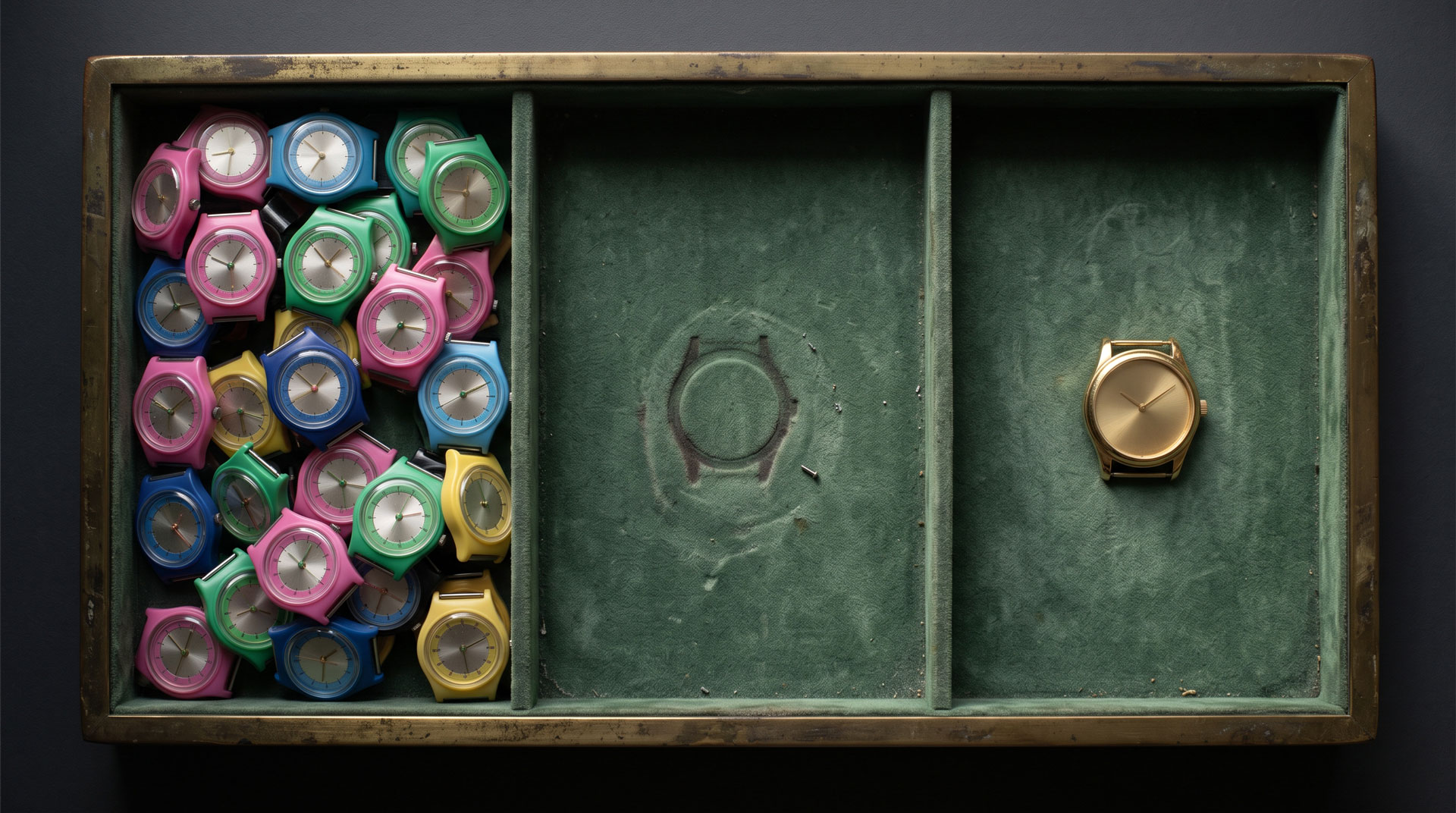
Swiss watch exports are recovering everywhere except the middle
Posted on: 17 September 2026
On 20 August the Federation of the Swiss Watch Industry (FH) published its July figures, with exports of 2.63 billion francs and growth of ten per cent on the year before, the third positive month in a row after an April that closed down 16.6. Inside the release, though, is a line that has been repeating since June, because watches with an export price between 200 and 500 francs rose 26.1 per cent and those above 3,000 rose 12, while those between 500 and 3,000 fell 3.9. June had exactly the same shape with wider numbers, up 54.1 at the bottom and 14.2 at the top against a fall of 4.7 in the middle. Over the half year the middle band has lost 5.7 per cent of its value and the FH names it as the main drag on the overall result.
Set against last year, the figure turns odd. In 2025 exports fell 1.7 per cent and the middle band was the only one not to decline, while watches above 3,000 francs lost 1.9 and those below 500 lost 4.5. Luxury Tribune worked out the balance for the middle band, which went from 3.604 to 3.609 billion. In the bad year only the middle held up and now that things are recovering only the middle is falling.
It is worth pausing on what these bands actually measure, because the label is misleading. The price is the export price, the price at which a watch leaves Switzerland, while the same piece reaches the public multiplied by a factor that varies from brand to brand and from channel to channel. The 500 to 3,000 band should therefore be read higher up than its label suggests, in the part of a price list where a watch stops being an impulse purchase.
At the bottom, the growth has a name and a date. On 16 May Swatch and Audemars Piguet put the Royal Pop on sale, eight bioceramic pocket watches carrying the octagonal silhouette of the Royal Oak and a hand-wound version of the Sistem51, at 350 to 375 francs and one per customer. There were queues from Tokyo to New York and some shops closed to manage the crowds, while the group later claimed more than twenty-five billion views on social media. For the half year the FH attributes the growth in volumes to mechanical watches with an export price below 500 francs, up 23.8 per cent. The federation does not connect the two facts, and the public data do not show which statistical band a Royal Pop falls into, although the calendar is what it is, with the launch in mid-May and the 54 per cent jump in the 200 to 500 band in June.
The Royal Pop sells something very specific, the mark of the summit at the price of the base, because whoever buys one carries in a pocket the most recognisable octagon in contemporary watchmaking for the cost of dinner for two, while above 3,000 francs people buy the summit itself, with the same mark and no translation needed. What is left in the middle is the watch that asks something of whoever looks at it before it makes sense, knowing who built the movement, say, and why that brand is not the one next to it in the window. It is a watch that does not explain itself. Since May the numbers have rewarded the two ways of buying that need no explanation at all.
A thesis like this is quick to write, so it should be attacked before it goes out. The first weak point sits in the Swatch Group half-year report of 21 July, where Longines, Tissot and Hamilton all show double-digit growth. Tissot and Hamilton work mostly in the lower bands, whereas Longines, going by its price list, ought to fall largely within the middle one, so if the middle were emptying out for reasons of taste a brand like that would not be growing at double digits. Swatch's figures are sales at constant exchange rates rather than exports, so the comparison is not clean. The fact remains that the band is losing value in the same half year in which one of its most visible names is gaining share. That leaves two possibilities. Either the decline is concentrated elsewhere, among mid-range brands with no group behind them and no shops of their own, or it is partly an accounting effect.
The second weak point is more mundane and may well weigh more, since the FH bands are fixed thresholds while price lists move. When a brand raises its prices, a model that last year left the factory at, say, 2,900 francs can leave this year at 3,100 and switch column without a single customer having changed their mind. In the first half gold reached record prices and the FH says this affected both selling prices and production costs. In July steel and gold watches grew 23.8 per cent by value, the same percentage as the cheap mechanical watches over the half year, a coincidence worth pointing out before anyone takes it for a typo. Part of the shrinking middle may therefore be middle that has moved up a band through pricing alone, and the public releases do not separate the two.
In Ticino the watch industry employs around three thousand people in some forty companies, according to the cantonal trade association, but for anyone working upstream in the supply chain, wherever they are, the difference between statistical bands arrives in another form, since a supplier sees orders and volumes and only rarely the price at which the finished watch will leave the country. In its half-year release the FH notes that some suppliers are approaching the end of short-time working, while others have already cut staff. Twenty-three per cent more cheap mechanical watches and five per cent less value in the middle, seen from a supplier's bench, can mean more pieces at lower margins.
For anyone who buys one step below the most quoted name, these numbers have a practical consequence. That step has always been protected by its own discretion, because nobody queued outside a shop for it and nobody had any interest in discounting it. If demand keeps moving towards the extremes, the brands that live there face two routes, raising prices towards the band that is growing or lending their name downwards to whoever sells the volume. Either one changes the object people are buying today.
The test will not take long, as the August figures are due any day now. If the middle band turns positive again, June and July were the wake of a single launch and little more. If instead it keeps falling while the band above 3,000 francs grows, the place to look will be the price lists many brands update at the start of the year, because that is where it will show which of them chose to climb.