Selection happens upstream
Posted on: 17 August 2026
The figures published last Friday show that car sales in China are falling hard. Domestic sales in the first half of 2026 were down by 2.3 million units on the previous year, a drop of twenty per cent which in absolute volume is equivalent to every new car registered in Japan over the same six months. Exports across the same half year rose by seventy-one per cent.
The comforting reading has already settled into place. The Chinese model is meeting its limits, domestic demand is faltering, the giant is slowing and the rest of us have bought a little time. I read it the other way round, and I suspect this particular misreading will prove more expensive than the tariffs the European Union imposed on the wrong target.
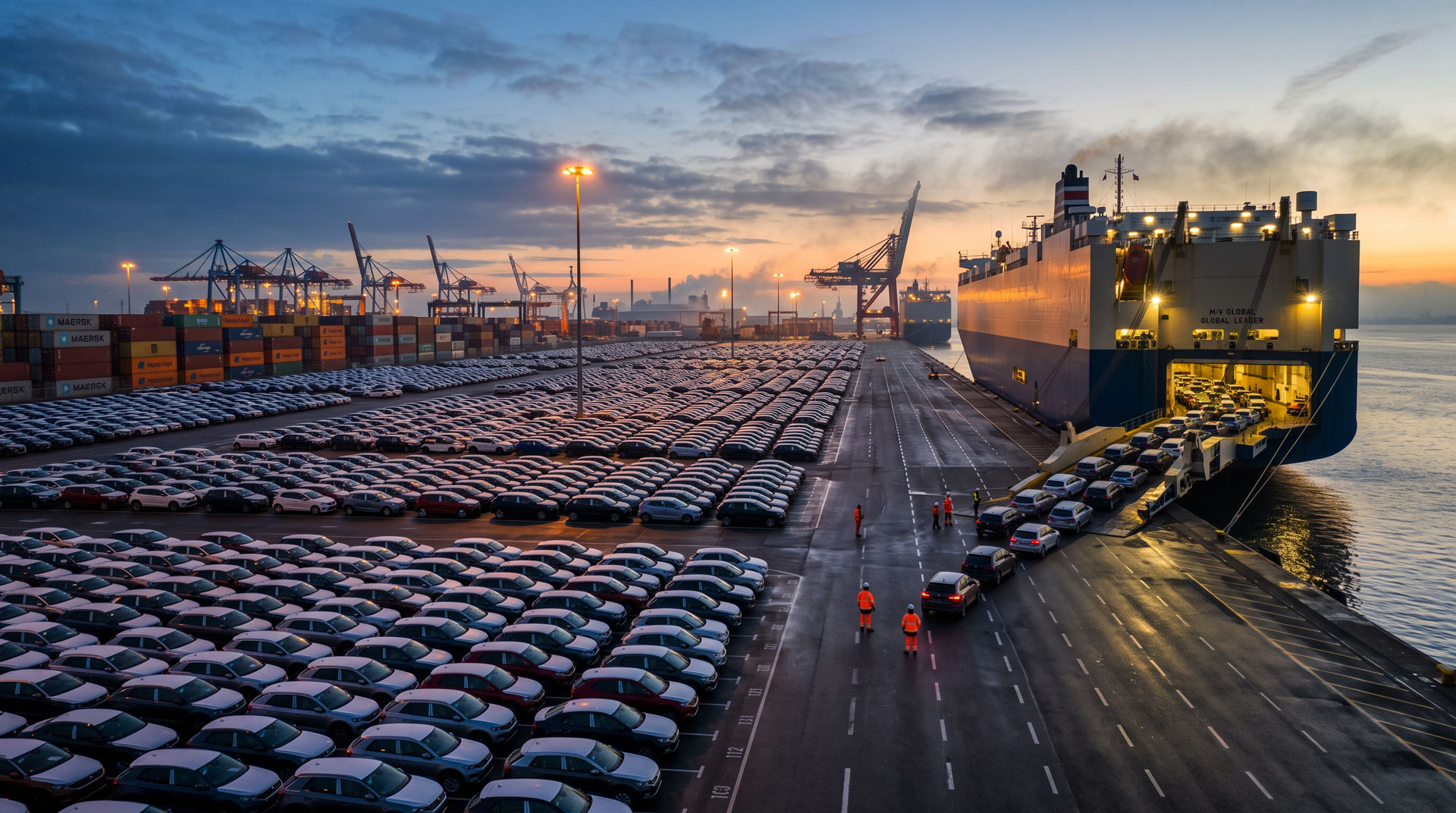
Take BYD, which is the most legible case because it publishes numbers. Domestic sales over the first seven months of 2026 fell by thirty-five per cent while overseas sales rose by seventy-nine. In February, for the first time in the company's history, deliveries outside China exceeded deliveries inside it, 100,600 against 89,590. Between January and April, 59.8 per cent of everything the company sold went beyond its own borders. The two largest single markets outside China in 2026 are Brazil and Britain. Not Lagos, not Jakarta, not the markets that in 2024 we filed away as the dumping ground for Chinese combustion engines. Britain.
What changes the nature of the phenomenon is the margin. In the 2025 accounts BYD's overseas automotive business records a gross margin of 28.11 per cent against 17.21 per cent achieved at home. Citigroup, in a note at the end of March, went as far as suggesting that in the first quarter of 2026 domestic Chinese sales risked falling below the threshold of profitability altogether, leaving exports as the group's only real source of margin. Which means that exporting has stopped being the disposal of surplus capacity and has become the profit centre, while the home market has become the cost.
This inverts the mental category under which the West has been filing the matter for three years. Dumping is a loss-making practice undertaken to buy share, and it carries the assumption that whoever practises it must eventually stop because the bleeding is expensive. Here the bleeding happens at home and the profit happens abroad, which means there is no internal mechanism of self-limitation at all. The more the Chinese market compresses, the more indispensable the outside world becomes.
Compression is not the same thing as weakness. In 2018 China had 487 manufacturers of electric vehicles. By 2024 there were around 130. AlixPartners estimates that fewer than fifteen will be financially sound in 2030. Hozon, the parent company of the Neta brand, entered bankruptcy proceedings in June 2025 having sold close to half a million vehicles in six years, WM Motor and HiPhi and Ji Yue and Aiways and Byton have gone, and William Li of Nio wrote to his staff describing 2026 as the final battle. That is not corporate rhetoric. It is an accurate description of what is happening inside that market.
The Chinese domestic market, in other words, is not a market in crisis. It is a filter. A price war, withdrawn subsidies, a purchase tax on electric vehicles reintroduced at five per cent from January 2026, and the conditions have been assembled, whether by design or by accident, to kill anything without scale, capital and product cycle. What arrives in Europe is not the surplus of that system. It is the selection of that system.
I watched this happen on an infinitely smaller scale in an industry with no connection to any of it, which is precisely why I recognise it. In Soho in the late 1990s, when I worked inside that trade, the number of facilities offering colour grading and digital finishing was wildly out of proportion to real demand. A war over hourly rates, margins scraped to the bone, a mortality rate nobody reported because the closures happened quietly at the end of the summer. When the dust settled, the handful of survivors were not weakened by the fight. They were the only ones who had learned to work at those prices, and they went abroad to take markets where nobody had been forced to learn the same lesson. Firms that had lived inside a protected market discovered they were at a disadvantage precisely because they had never suffered.
Which brings the argument to Britain, where the arithmetic is now unusually stark. Chinese-owned brands including BYD, MG and Jaecoo accounted for close to twenty per cent of new vehicle registrations in the first seven months of 2026, with the SMMT putting Chinese manufacturers at fifteen per cent of total sales over the first half depending on where the definitional line falls. The Jaecoo 7 is the third best-selling car in the country this year. Britain absorbs eight per cent of all Chinese battery electric vehicle exports, and in early 2025 overtook Germany as the largest BEV market in Europe. None of this happened against government policy. It happened along the grain of it.
The divergence in trade policy is the first half of the explanation. The United States imposed a hundred per cent tariff on Chinese electric vehicles. The European Union settled on duties of up to 35.3 per cent, calibrated by manufacturer. In October 2024 the British government confirmed it would not follow, and the market stayed open. That was a defensible choice on consumer grounds and it has held prices down, which is a real benefit and should be said plainly.
The second half is less defensible and almost nobody outside the trade press is discussing it. Under the ZEV Mandate, established manufacturers can earn credits by selling vehicles with lower emissions than their own pre-2021 average, while manufacturers that entered the market after that point are set a target derived from industry-wide emissions in the year before they arrived. The consequence is that the newer entrant carries a lower effective obligation than the incumbent it is competing against, in the same showrooms, in the same week. Non-compliance costs £12,000 per car. Volkswagen Group and Stellantis are struggling against the targets while BYD, SAIC, Chery, Geely and XPeng are all comfortably compliant. Ben Nelmes of New AutoMotive, whose firm produced the analysis, calls it a mistake in the design of the regulations, and the government confirmed in June that it will consult on reform.
So Britain has not simply declined to protect its market, which would be a coherent liberal position with coherent liberal consequences. It has kept the market open and simultaneously written a compliance rule whose cost falls more heavily on the incumbent than on the entrant. Free entry is one policy. Free entry with an asymmetric handicap applied to the domestic side is a different policy, and it is not obvious that anyone chose it deliberately. We will discuss Chinese plants in Hungary and Spain within five years with the same equanimity we brought to the Japanese at Sunderland in 1986, with the difference that Sunderland brought in a technology we did not have, and this time it is a technology we legislated into existence ourselves.
There is a marginal detail here that has amused me and serves no argumentative purpose. The premium SUV with which BYD is attempting to defend its home market is called the Da Tang, after the Tang dynasty. Naming a car built for the domestic market after the most cosmopolitan period in Chinese history, while the bulk of the fleet sails, has an unintended quality no European marketing department could manufacture on purpose.
Japan is the piece of evidence nobody dwells on for long enough. It is the country that invented the model of the unbeatable automotive exporter, built on manufacturing efficiency and quality and fuel economy, and that advantage still exists and is still measurable and has not decayed. It simply no longer defends a share, because the axis of competition has moved to electrification, batteries, software, intelligent features and the speed at which a product can be developed. Japanese manufacturers have held around twelve per cent of the European passenger car market for four years while Chinese manufacturers went from three per cent to sixteen. In electric vehicles Japanese brands account for under five per cent of European registrations against nearly a quarter for the Chinese. Thirty years of accumulated advantage stopped compounding and became ballast inside four.
The two variables capable of interrupting any of this are not European and are worth watching because they are the only ones testable in the short run. The first is the anti-involution policy with which Beijing is attempting to halt the domestic price war. If it succeeds, home margins recover and the hunger for exports softens. The second is the exchange rate. The yuan strengthened by 4.6 per cent against the dollar in the first quarter of 2026 and that alone eroded the local currency value of BYD's foreign revenue, contributing to a halving of net profit. A profit centre built entirely outside the home market is exposed to a variable the people running it do not control.
Neither of them is settled in London. Which is, I suspect, the part we find hardest to accept.