Ownership is the cheap part
Posted on: 21 September 2026
The Treasury's announcement of 7 May 1999 set out a plan to reduce the United Kingdom's gold holdings from around 715 tonnes to around 300 in the medium term, through a programme of auctions to be run by the Bank of England. The first auction was held in July. By then the price had already done what prices do when a large seller publishes its timetable, falling by roughly a tenth in the weeks after the announcement as traders positioned themselves ahead of the supply. Seventeen auctions later, in March 2002, some 395 tonnes had gone at an average of about $275 an ounce, raising around $3.5 billion. The City remembers the episode as Brown's Bottom and usually tells it as a story about timing, which it partly is. It reads better as a story about disclosure. The Treasury chose uniform-price auctions announced in advance because they were transparent and fair, and in a market of that depth transparency meant handing the other side of the trade a free option on the seller's schedule.
Set that beside what the Banque de France did between July 2025 and January 2026. It withdrew 129 tonnes from the Federal Reserve Bank of New York by selling the bars where they sat and buying equivalent ones in Europe, so that not a single bar crossed the Atlantic. The operation was described as bringing the reserves up to current quality standards, a phrase no trader could front-run, and it produced a gain of more than eleven billion euros because metal in the United States was trading at a premium linked to tariffs. Brown announced a sale and paid for the announcement. Paris executed a sale and a purchase and announced, if that is the word, an upgrade in bar specifications. What the French had understood is what a market actually charges for, which is information about your intentions.
The other European answers sit on either side of those two. The Bundesbank moved metal the expensive way, completing in 2017 a programme that brought 674 tonnes home to Frankfurt, 300 from New York and 374 from Paris, at a cost of around seven million euros. It still keeps more than 1,200 tonnes in New York, about 36 per cent of its reserves, and at the start of this year Joachim Nagel dismissed calls to repatriate the rest, arguing that the bars enjoy a special legal status there and that the United States would be the first to suffer if it ever touched them. The Dutch took the middle road. In 2026 De Nederlandsche Bank moved more than 78 tonnes from New York to London, citing a more disorderly geopolitical environment, and some of that metal was likewise sold in America and bought back elsewhere. Which brings the question to Threadneedle Street, and to a precedent that anyone choosing London as the safer vault ought to have read.
The Banco Central de Venezuela has kept 31 tonnes of gold at the Bank of England since 2008. Nobody in the long litigation that followed disputed that the gold belonged to the Venezuelan central bank. The dispute was about who was entitled to instruct the Bank of England on its behalf, since two rival boards had been appointed, one by Nicolás Maduro and one by Juan Guaidó, and they gave contradictory orders. On 20 December 2021 the Supreme Court held that English courts were bound by the government's recognition of Guaidó as interim president, applying what Lord Lloyd-Jones's judgment treats as the principle that the state speaks with one voice on the recognition of foreign governments. The owner remained the owner throughout. Who counted as the owner, for the purpose of getting the gold out, was settled by a decision taken in Whitehall.
I spend half of every month a few miles east of that vault, and I have never quite got over the detail, repeated in every account of the place, that its keys are around three feet long. It says nothing about the argument. It says a good deal about how physical an institution likes its reassurance to look.
Italy has 2,452 tonnes of gold, the third largest official holding in the world, and 43.29 per cent of it, 1,061 tonnes, sits in the United States, against 44.86 per cent in Rome and the remainder split between Switzerland and the United Kingdom, which holds just under six per cent. At current prices the whole is worth 289.2 billion euros. Last December, in the budget law for 2026, Parliament passed an amendment first signed by Senator Lucio Malan which in its original version of 20 November 2025 declared that the reserves belong to the State on behalf of the Italian people. The European Central Bank asked for clarification and then for the amendment's withdrawal. It was reworded twice and approved with a preamble which, in translation, opens "Without prejudice to Articles 123, 127 and 130 of the Treaty on the Functioning of the European Union" and goes on to state that the gold reserves managed and held by the Banca d'Italia "belong to the Italian People". Article 130 prohibits national central banks from seeking or taking instructions from governments. The law therefore assigns ownership to the people and leaves control precisely where it was, with an institution that the same sentence places beyond the government's reach. The Banca d'Italia has since confirmed that it has made no transfers.
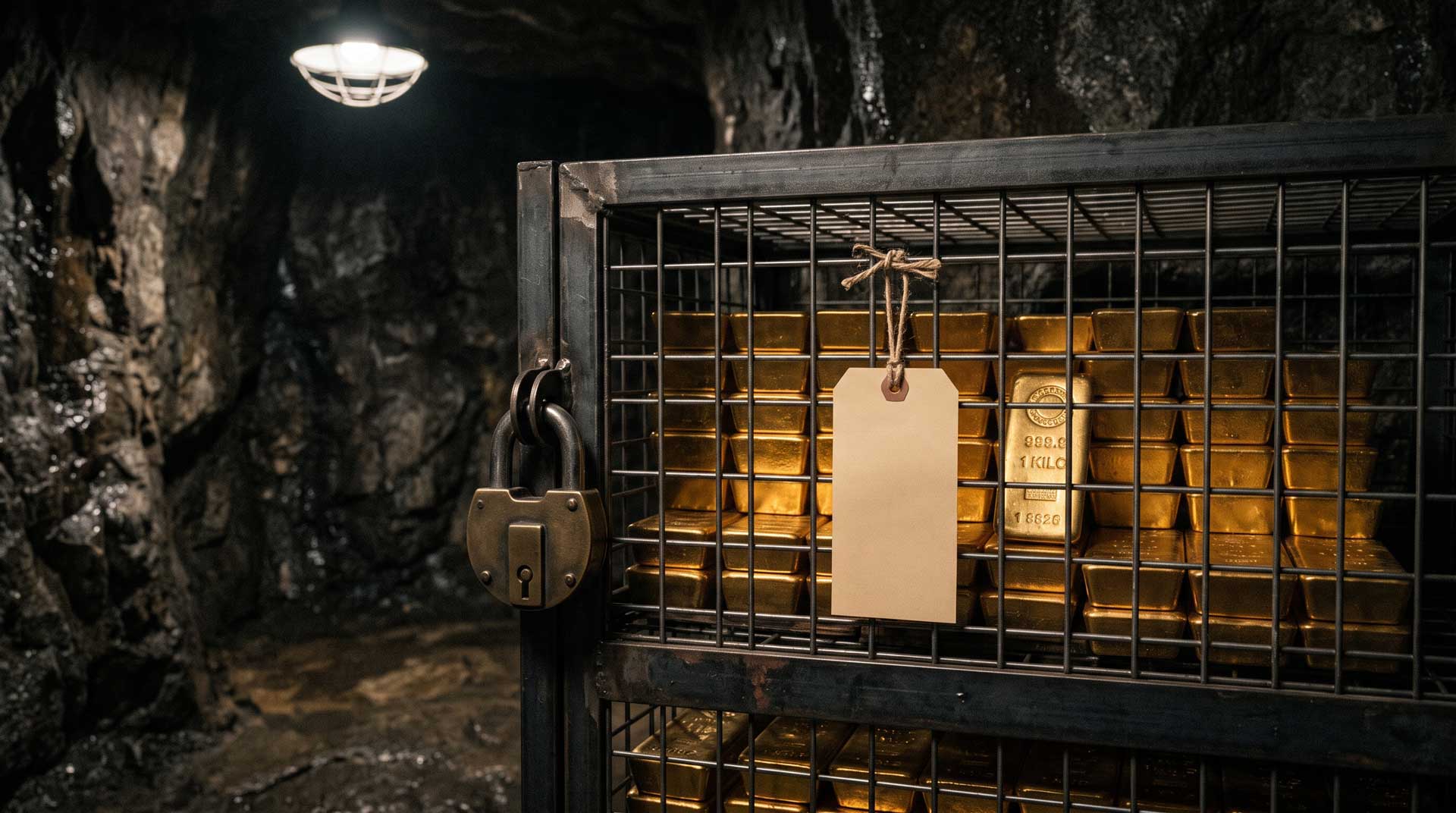
Put the four cases next to each other and the pattern is hard to miss. Berlin spent seven million euros to have its metal nearby, while Paris made eleven billion by changing its location without changing anything anyone could see. London sold more than half its gold near the bottom of a twenty-year market, largely because it told everyone first. Rome passed a declaration that cost nothing, and nothing is what it moved. In none of these cases did ownership decide anything. What decided outcomes was the capacity to convert the asset when needed, at a price set by someone who owes you nothing, and the one reliable way to damage that capacity is to announce what you mean to do with it.
When I raised this in Italian on LinkedIn, someone replied that any government in Rome attempting the French manoeuvre would fall within weeks, and that the notice alone would be enough. The mechanism is right and the actor is wrong. The gold sits on the Banca d'Italia's balance sheet and Article 130 prevents the government from instructing it, so the government cannot execute the operation at all. It can only ask for it out loud, which is exactly the moment the cost appears, since an announcement turns a technical operation into a sovereignty signal and Italian government bonds would price that signal long before any parliamentary majority felt it. The amendment on ownership passed over the ECB's objection and nobody fell, because it was declaratory. France moved 129 tonnes while its governments were falling over the budget and nobody fell over the gold either, because nobody had presented it as a gesture.
None of this makes the case for bringing Italy's gold home. The Banca d'Italia's own defence is that the distribution reflects where the gold was originally bought, combined with a deliberate policy of diversification, and that holding it in the main financial centres allows faster use in case of need while saving the cost and time of transport. That argument holds. So does the opposing one, now that 2022 has shown that a central bank's reserves can be frozen by a political decision of the host country, and the data point in one direction: gold held by the Federal Reserve on behalf of foreign official institutions fell by 2 per cent between the end of 2024 and April 2026, while the Reserve Bank of India cut the share of its gold held abroad from 55 per cent in March 2023 to 22 per cent in March this year. Each choice exchanges one risk for another. Declaring moves neither, and it is the only choice Italy has made.
For a board the lesson has nothing to do with bullion. A value carried on the balance sheet that has never met an independent buyer is a declaration of ownership, and it behaves like one, holding up admirably in the annual report and evaporating in the week the bank calls. The discipline Paris showed is to act first and describe afterwards, and Brown's error survives in corporate form every time a disposal programme is announced before the buyers have been found.
Two things are worth watching over the coming months. The notes to the Banca d'Italia's next annual accounts will show whether the geographical split has stayed where it was or moved quietly, as it did in Paris. The other is the spread between the price of gold in New York and in London, because for as long as it stays open a repatriation carried out by selling and rebuying keeps paying, and somebody collects the difference while Rome argues about title.