One tanker for Riyadh and the Typhoon order still on the table
Posted on: 25 September 2026
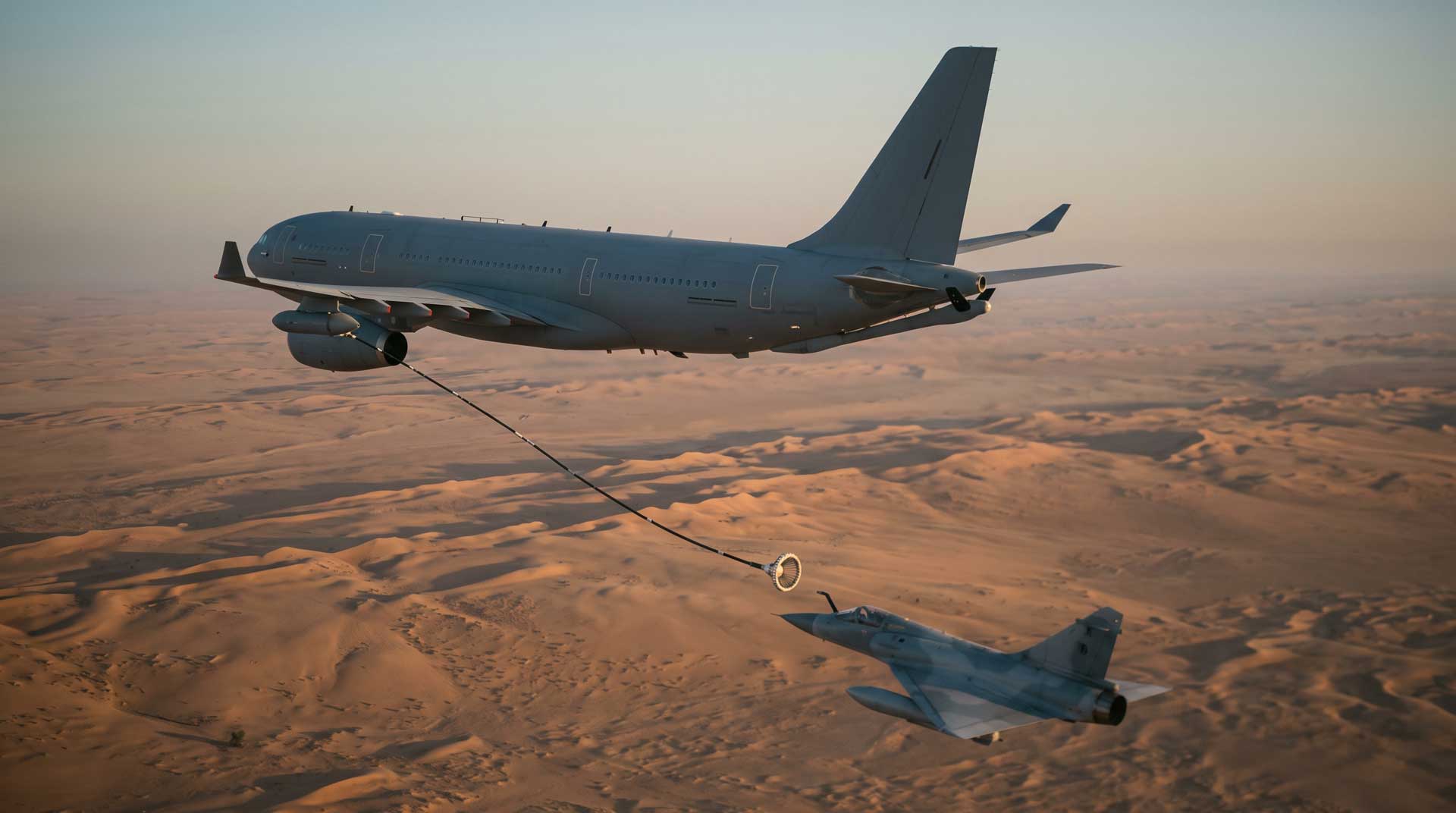
The aircraft is an RAF Voyager, the A330 tanker that will fly out of Akrotiri for an initial period of a few weeks to keep Saudi Typhoons in the air for longer. The mission is limited to supporting the jets defending the kingdom against drones and missiles, so it does not extend to strikes on the Houthis. Burnham justified it on cost of living grounds and on British and regional interests, after the Houthis had claimed drone and ballistic missile attacks on Riyadh.
Most of the British coverage dismissed it quickly. Tim Ripley called the added capacity marginal and the Telegraph read the deployment as a political signal. On the military side they are right, although the reason they are right is worth spelling out, because it leads somewhere else.
There are two ways to refuel a jet in flight. One is the rigid boom, which the tanker operator flies into a receptacle on the fighter's spine, and it is the American system used by aircraft designed around it, such as the F-15. The other is a flexible hose ending in a basket, into which the fighter pilot pushes the probe sticking out of his nose, and it is the one European fighters use. Since the RAF Voyager has no boom, it can in practice serve roughly a third of the Saudi fighter fleet, and that third is the Typhoon. Luke Pollard made no secret of it when he said the request had been accepted to keep British-built Typhoons flying for longer.
Then there is a detail I did not find in two days of commentary, namely that the Royal Saudi Air Force already has tankers of its own. Its A330s of the same type carry both hoses and a boom, 24 Squadron operates six of them from Prince Sultan Air Base at Al Kharj, and four more are in conversion with deliveries due from 2027. There is a sensible operational reading all the same, because a British Voyager looking after the Typhoons frees the Saudi booms for the F-15s, and in a long campaign tanker hours run out before fighter hours do. It is still one extra aircraft on top of six.
To see what it is really for you have to look at a file that has nothing military about it.
Riyadh has flown Typhoons since 2008, when the Salam contract signed in 2007 for £4.43 billion delivered 72 aircraft. In March 2018, during Mohammed bin Salman's visit to London, BAE Systems announced a provisional sale of 48 more inside an arrangement worth over ten billion pounds, which never closed. For years Germany blocked deliveries to Saudi Arabia over the war in Yemen and the murder of Jamal Khashoggi, so that in 2023 Riyadh asked Dassault for a bid on 54 Rafales and Berlin only changed its position in January 2024. The Saudi requirement now stands at 54 fighters, with the Boeing F-15EX and the Rafale evaluated alongside the Typhoon, and by the summer of 2026 there was still no firm order.
On the other side of the negotiation there is an assembly line. Before Qatar's 2017 order, final assembly at Warton had been expected to close in 2022, and the unions now fear it will run out of work in the 2030s without new export orders. Warton sits on the Fylde coast between Preston and Blackpool, some sixty kilometres from the Manchester that Burnham ran as mayor for the better part of a decade, before telling Trump he wants to give Britain back its self-belief through a clear direction and reindustrialisation.
In June something happened that points the other way. On 21 June 2026 BAE Systems Saudi Arabia announced that a 2,500 flying hour major scheduled service on a Typhoon had been completed in the kingdom, the first time outside the manufacturing nations, since Riyadh is bringing heavy maintenance in-house to depend less on its suppliers, as every customer of complex systems tries to do as soon as it can. Three months later, with drones over the capital, it still had to ask London for a piece of logistics it could not cover alone.
In a competition between three fighters the customer buys the aircraft and also buys the behaviour of the seller's government on the day it is needed. Since Washington has so far turned down Saudi requests to intervene directly against the Houthis, the only British military asset flying for Riyadh in September 2026 works only with the British fighter. Nobody had to put that in a brochure.
There is no need to imagine anyone in Downing Street running this calculation, because the structure runs it on its own: the declared interest, energy and shipping lanes, and the industrial one point the same way, while the decision costs little to whoever takes it, one aircraft for a few weeks against a contract valued at ten billion in 2018. The cost is not zero for the people flying it, given that after sorties of six hours or more crews are normally stood down the following day, and in March six American airmen died when a KC-135 tanker came down in western Iraq, in circumstances not attributed to enemy action. Tankers are big, slow aircraft that always fly close to where things are happening.
The argument has a flaw and it should be stated, because it can only be disproved in one direction. If over the coming months the 54 fighters go to the F-15EX or the Rafale, the Voyager was what Pollard said it was and nothing more. If they go to the Typhoon, nobody will be able to show the tanker mattered, since the Typhoon starts with the advantage of infrastructure, training and support already in the kingdom. A well-built signal works that way: when it succeeds it leaves no evidence.
The rest of Burnham's week needs little comment. The man who once said he would refuse to meet Trump spent their meeting on Hormuz and trade, declined to rule out a commitment to rejoin the European Union in Labour's next manifesto and chose a service call for a customer as his first military act, so that two months into Downing Street every move he makes keeps more options open than it closes.
The Voyager has a declared duration of a few weeks, under review, while the Saudi requirement for 54 fighters has no public deadline at all.