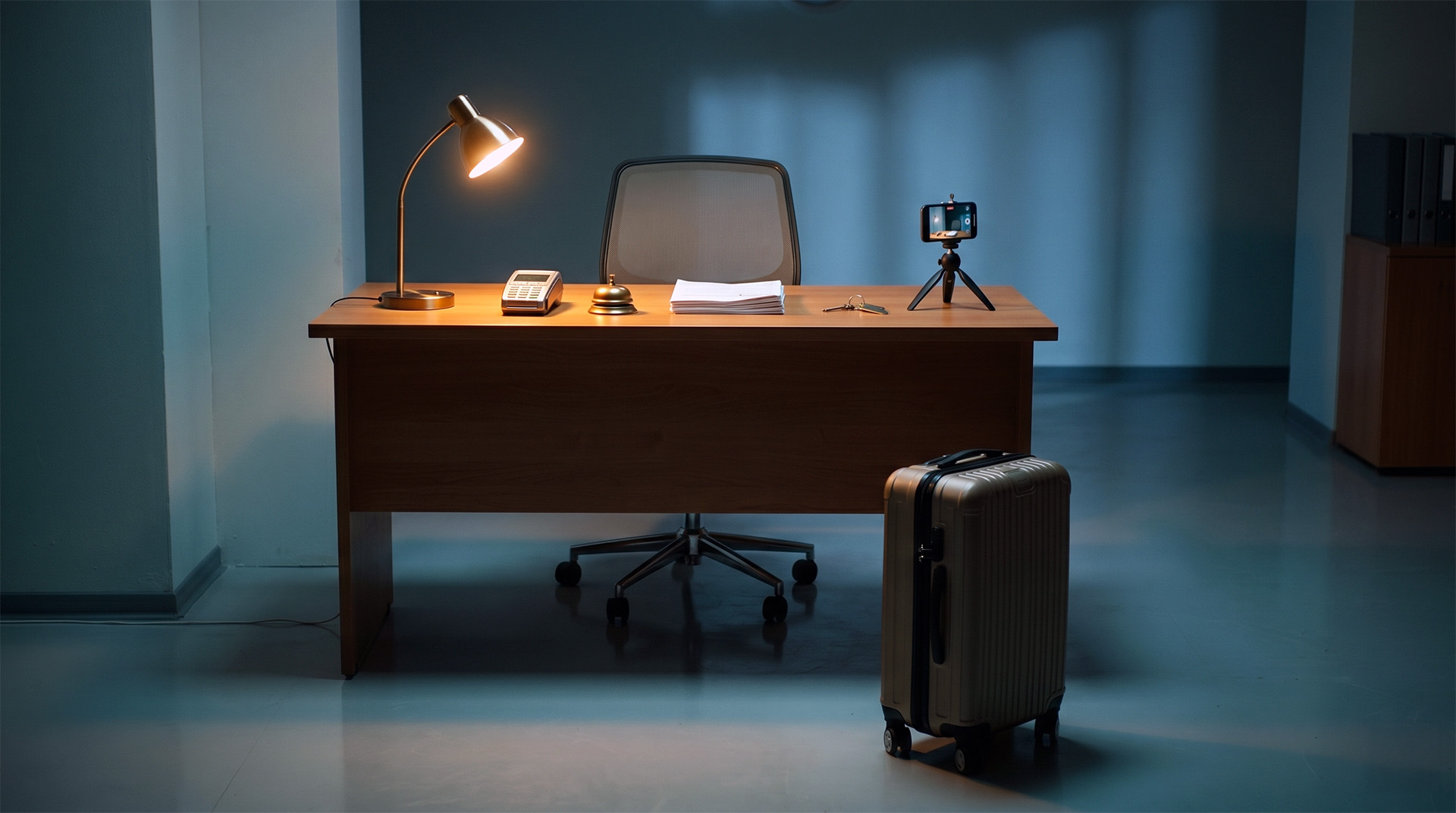
Nobody is in charge
Posted on: 18 June 2026
We have been told, for a decade now, that the friction is going out of everything. Passports uploaded from the sofa, payments reduced to a tap. Whole check-ins are completed somewhere over the Alps, before the plane has even landed. The promise is seductive and mostly true, right up to the moment you arrive somewhere and discover that it is not.
I arrived in Italy this summer after one of those journeys that hollow you out, wanting nothing but a shower, and met instead a check-in of remarkable length: documents to be handed over in person because the online version did not count, a form to complete and at the end the tourist tax, which the owner would much prefer in cash. I had none. The shower receded by another quarter of an hour.
Begin with the tax, because it is the smallest piece and the most instructive. The host is legally responsible for paying the levy. He collects it from the guest and passes the whole of it to the municipality. Pay by card, though, and the card scheme takes its commission on the entire sum, including the slice of tax the host never keeps, so he pays to move money that does not stop with him. Hence the wholly rational nudge towards cash, and hence my embarrassment, since cash is a thing I have not carried in years.
The easy reflex is to blame the legislator and ask how whoever wrote this failed to notice. It feels like the obvious question and it is the wrong one, because it assumes there is a whoever. There is not. The municipality sets the levy inside a national framework from 2011. The national legislator, in 2020, solved a problem of its own by pushing the collection risk onto the private operator, making the host responsible for payment with a right of recovery against the guest, without granting him the clean status of withholding agent that would let him handle the thing properly. The card networks fix their commissions in a world that does not speak to municipal taxation. And the same state, through another of its arms, has spent years building the machinery of traceability, to the point of fining the shopkeeper who refuses a card.
Different rule-makers, each coherent within its own logic, none of whom has ever seen the whole, because the whole is nobody's brief. The contradiction sits in none of the rules taken singly. It appears at the point where they touch, and that point is the counter of a reception desk. The state that fines a merchant for refusing a card is the same state that, by designing the tax this way, manufactures a demand for cash; the hand that mandates the card reader and the hand that makes the card reader a loss belong to the same body and do not see one another.
Before the British reader settles into the comfortable posture of watching continental administration trip over itself, a word. From 24 July 2026 Edinburgh levies its own visitor charge, five per cent of the room rate, collected by the accommodation provider and remitted to the council exactly as in Italy. The Scottish host becomes the same unpaid frontier of collection, and the same questions about who absorbs the cost of taking the money are already being argued over. Britain has, in any case, long been the world's quiet monument to the permanence of the temporary. Income tax arrived in 1842 as an emergency measure, to be reviewed and abandoned shortly, and it is still, technically, renewed afresh every year, with no sign of leaving. Edinburgh's levy, for its part, is written to apply indefinitely from the day it begins. Nothing born is more lasting than the provisional.
Which brings me back to the first act of the same scene, the documents, where the word oversight stops working altogether. To hand those documents over, in 2026, I must be identified in person. It is not enough to have uploaded the passport before leaving home, because the law requires that someone look at my face and check it against the document, live, in the flesh or at most by video call. The Council of State settled the matter at the end of November 2025, reviving a 2024 circular from the interior ministry that the regional court had struck down. The basis is article 109 of the public security code, a provision from 1931, and the judge was explicit that the duty had never lapsed, the circular merely reminded everyone of it.
Here the thing turns comic. The barrier raised to keep out the terrorist, duly invoked in the circular alongside the Jubilee and public order, is cleared by a video call, and no one checks it. What reaches the police is not proof that the call took place but a form of typed data on a police portal, identical whether the host looked me in the eye or trusted a scan I sent from my sofa. Recording is optional, nothing is attached to anything, and the ministry, more than a year on, has still not published the list of technologies it considers adequate. A duty confirmed, its method undefined and its enforcement absent. Compliance and breach produce the very same sheet of paper.
So why, in 2026, with the Jubilee over, has no one tidied this up? Because there was nothing to expire. The duty was never a Jubilee measure; it was a 1931 law to which the Jubilee merely lent an occasion. And the trade bodies, since that is the natural next question, are present in force and on opposite sides. The hoteliers are delighted and call it an essential safeguard rather than a burden, because an obligation that weighs on short lets weighs on their competitors. The short-let operators protest and want recognition by video accepted, warning of chaos. The ministry split the difference: in-person identification required, satisfied by a video that no one verifies. The absurdity is not a vacuum left by people asleep at their desks. It is the settlement between two lobbies pulling in opposite directions. The hotels took the principle, the operators the loophole; the minister was content with the announcement. For them the rule works perfectly. It is broken only for the two parties who were not at the table, the traveller with a suitcase still in hand and the security the rule swore to protect.
We go on picturing the state as a single subject, possessed of intentions, that now and then errs through carelessness or bad faith. It is a consoling image, because it always leaves someone to blame. The reality is duller and far harder to mend. Sometimes the contradiction comes from rules no one ever thought about together, sometimes from the balance struck between interests that were thought about extremely well and in opposite directions; in either case the result has no author. The citizen is the one node on the network that meets all of them in turn, at the same counter. The state never feels them, because the state, as something capable of feeling, does not exist.
Looking for the author of these small absurdities is wasted effort. There is no author, and that is exactly why they will not be corrected: they have no parent to acknowledge them. They will go on living there, between a law of 1931, a framework of 2011, a decree of 2020 and a duty of traceability that never spoke to the others, until someone decides to look at the system from where the person who suffers it stands, suitcase still in hand. Which is to say, almost never.