Ninety targets hit not a drop of oil spilled
Posted on: 15 March 2026
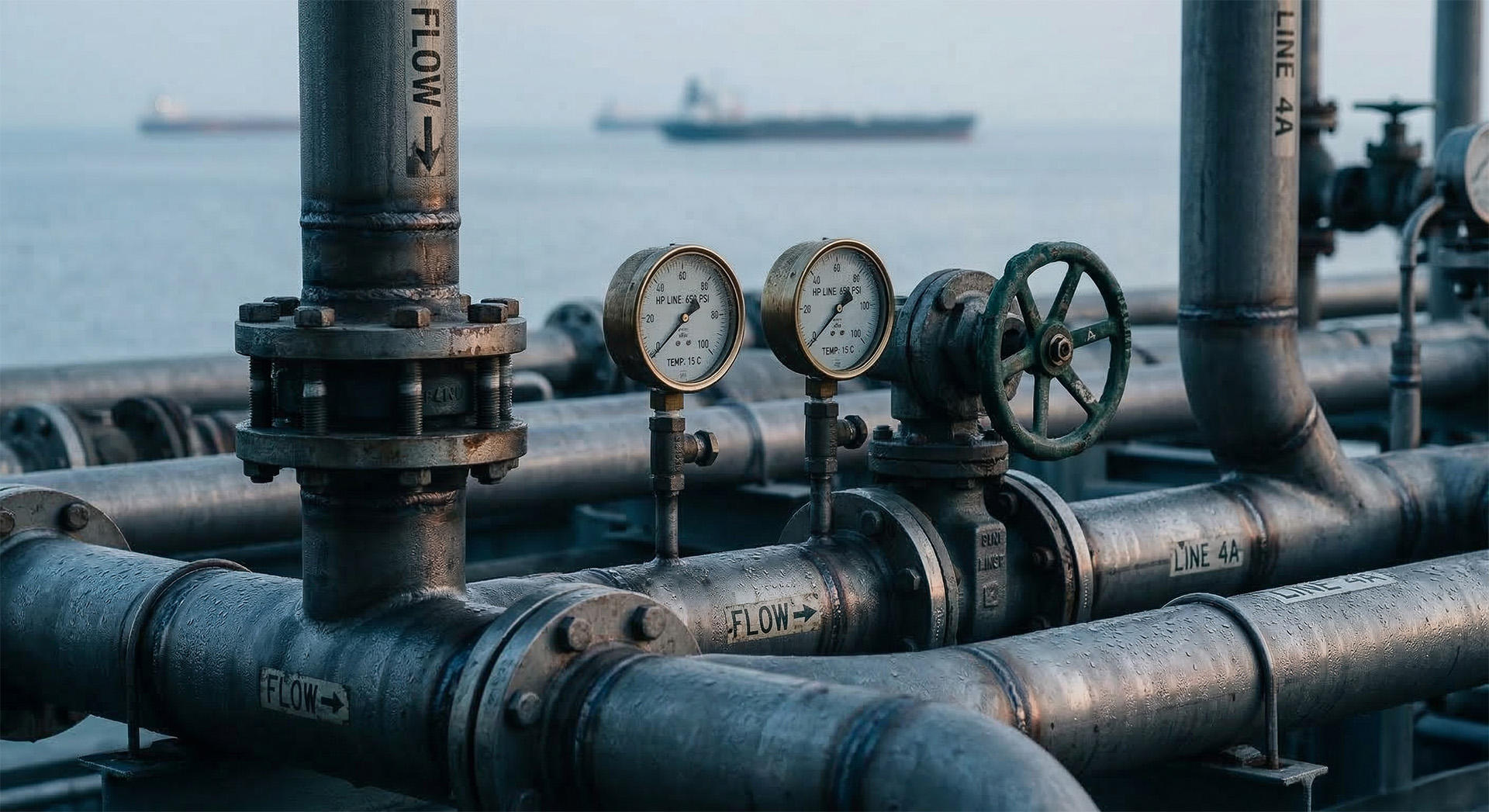
In the early hours of 14 March, the United States struck more than ninety military targets on Kharg Island in the Persian Gulf. Missile bunkers, naval mine storage facilities, Revolutionary Guard installations. Nothing touching the oil. Not a valve, not a loading terminal, not a metre of pipeline. The island that processes ninety per cent of Iran's crude exports, the one that generates fifty-three billion dollars a year for Tehran, roughly eleven per cent of its GDP, emerged from the night operationally intact where it matters most.
Trump commented on Truth Social in his customary grammar of hyperbole: "for reasons of decency" he had chosen not to destroy the oil infrastructure, but reserved the right to "immediately reconsider" should anyone interfere with free passage through the Strait of Hormuz.
Set aside the decency. That is the narrative for the domestic audience. The real mechanism is elsewhere.
What happened at Kharg is a form of communication that great powers resort to when they can afford neither outright victory nor open retreat: an attack surgically constructed to say precisely what it intends to say, nothing more, nothing less. The message operates on three levels, and reading all three together is the only way to understand what comes next.
The first level is the demonstration of capability. "We can strike ninety targets on your most strategic island and there is nothing you can do to stop us", as Trump made explicit, adding that Iran has "no ability to defend anything that we want to attack." This is not bluster: it is the operational translation of military credibility. For a threat to function as a diplomatic lever, the adversary must believe you are capable of executing it. The demonstration precedes the ultimatum.
The second level is the deliberate exclusion. Sparing the oil infrastructure is not an omission: it is an active choice, publicly declared. Trump made it explicit, CENTCOM confirmed it in official communications: "preserving the oil infrastructure." When a military force does not strike something it demonstrably could strike, and announces this, it is communicating a boundary. It is saying: this is the edge of the table, and we have chosen not to cross it. Yet.
The third level, the subtlest, is the incentive structure this creates for both sides. Kharg is not merely Iran's economic lung: it is also the reason neither Tehran nor Washington can genuinely afford to end this conflict badly. Should Kharg's infrastructure be destroyed, Iran retaliates by striking Gulf country oil facilities, as it has already threatened explicitly. Foreign Minister Abbas Araghchi stated that in that scenario Iran would target "facilities of American companies in the region." Oil prices, already up forty per cent since the conflict began with Brent hovering around a hundred dollars, would spike to levels not seen since the 1970s energy crisis. And that hurts everyone: the United States, the Gulf states hosting American bases, China buying Iranian crude and which Washington cannot afford to antagonise beyond a certain threshold.
This is the structural paradox of managed conflicts between major powers in the post-nuclear era: the boundary between a credible threat and uncontrollable escalation sits precisely where Kharg sits. Each side knows the other knows where that boundary is. And each side has a vested interest in keeping it intact long enough to negotiate.
There is a pattern that repeats with near-mechanical regularity in every military conflict where both parties hold mutually devastating economic levers: you strike what hurts without touching what would end the game entirely. During the Iran-Iraq War of the 1980s, Kharg was attacked repeatedly by Iraq but never fully neutralised, despite the technical means existing to do so. The reason was identical: Iran needed to export oil to finance the war, and paradoxically Iraq had an interest in not zeroing out that capacity entirely, because doing so would have pushed Iran toward even more desperate options. Costly wars sustain themselves for as long as both parties find it more convenient to continue than to stop on their own terms.
What we are witnessing in these days is not a conflict approaching its conclusion. It is a conflict searching for its stable form: the configuration that allows both sides to manage domestic pressure, maintain their respective victory narratives for their home audiences, and build the conditions for an agreement that neither can be seen to call a surrender.
Trump has already said that Iran "wants to make a deal" but that the terms are not yet acceptable. This is the language of the negotiator, not the military victor. A military victor issues ultimatums. A negotiator maintains pressure long enough to improve his position at the table, without making moves that would make it impossible to reach that table at all.
Kharg, intact in its essential function, is the evidence that the table still exists. The question worth tracking in the days ahead is not how many missiles are launched, but who has the shorter runway to sustain this pressure without conceding. Iran, with an economy already throttled by decades of sanctions, or a US administration that in eight months faces midterm elections and can afford neither a prolonged war nor a peace that looks like a defeat.
The answers to that question are in the balance sheets, not in the military briefings.