Habemus government
Posted on: 15 February 2026
The Brussels-Capital Region has formed a government after 613 days of deadlock. Six hundred and thirteen days during which the seat of the European Commission, the institution that sends binding recommendations to member states on fiscal discipline, failed to produce a majority to govern 1.2 million people. The detail that completes the picture: the deal arrived on Thursday evening thanks to what Belgian media politely describe as "creative accounting," a revision of the numbers that made a quarter of a billion euros in deficit vanish, suddenly rendering a balanced budget by 2029 a feasible target. The same Brussels that demands fiscal rigour from Portugal to Italy resolved its own paralysis with a stroke of the accountant's pen.
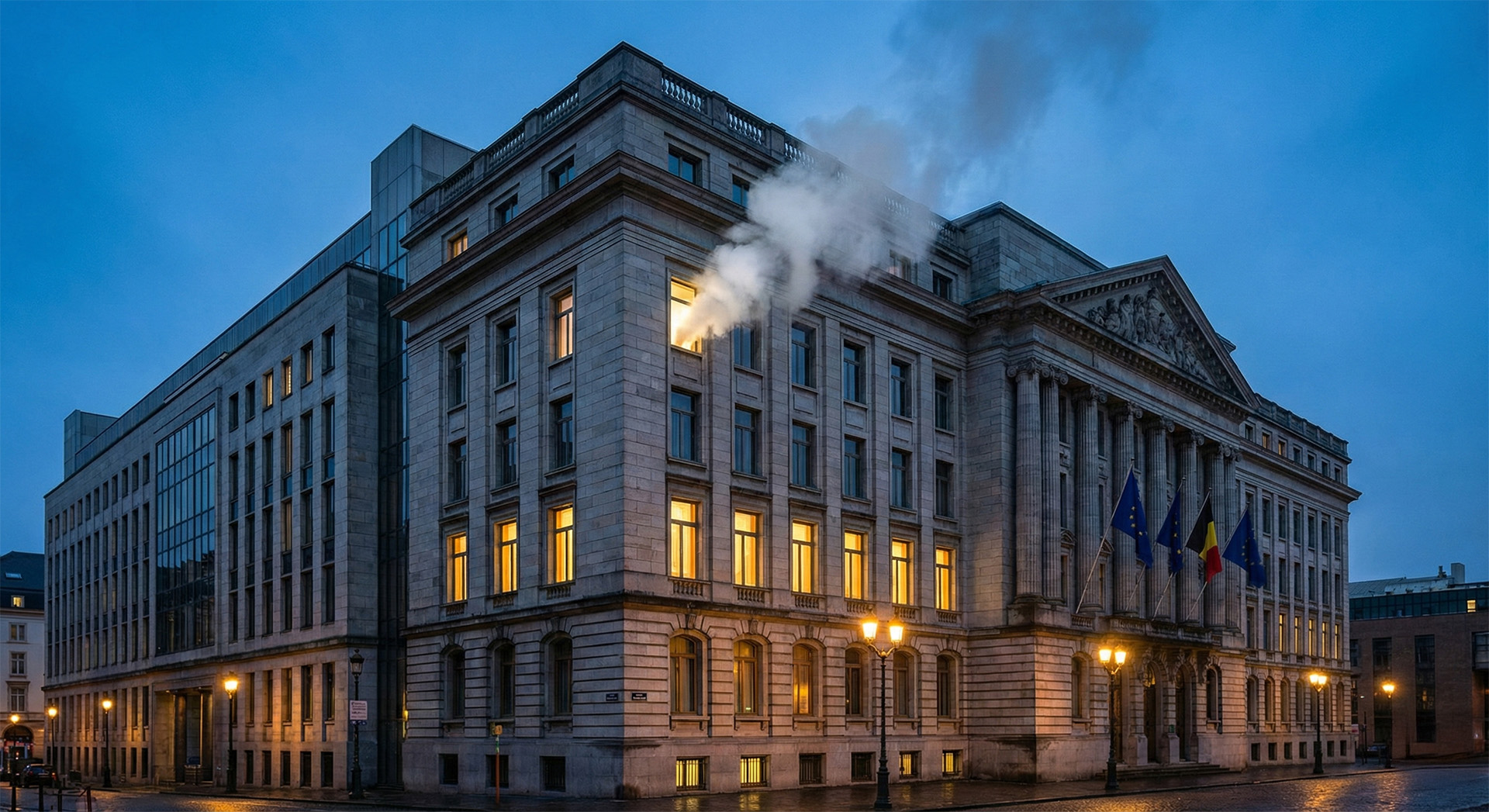
The scene deserves to be told in full. When negotiators from the seven coalition parties emerged from the University Foundation after three days of closed-door talks, a staff member appeared dressed as a cardinal, proclaimed "habemus government," raised the Regional flag and released white smoke from a smoke bomb. Georges-Louis Bouchez, president of the liberal Mouvement Réformateur who had convened the conclave, posted the white smoke announcement on X. The Flemish nationalist N-VA opposition, excluded from the deal, promptly christened it "the Friday the 13th coalition," doomed from the start. N-VA representative Mathias Vanden Borre pointed out that the very same parties that had driven Brussels to the brink of bankruptcy were now promising to rescue it. Reality, occasionally, produces a comedy no screenwriter would dare pitch.
The mechanism that produced 613 days of paralysis is a textbook case of flawed institutional design. The Brussels-Capital Region requires a double majority: every government must command a majority in both the French-speaking and Dutch-speaking language groups within the regional parliament. Two groups with different parties, different political cultures, different priorities, each equipped with an effective veto over the other. The system was designed in 1989 to protect Brussels' Flemish minority, but it has produced precisely what any student of game theory would predict: when you distribute blocking powers without building in mechanisms to break deadlock, you do not get balance, you get paralysis. The principle is identical to what freezes the UN Security Council, with one difference: at the United Nations, at least nobody pretends the system works.
The French-speaking Socialist Party refused to work with the New Flemish Alliance. The Flemish liberal party Anders insisted that the N-VA must be part of any coalition. Two interlocking vetoes, no mechanism for resolution. For twenty months the region limped along in caretaker mode under outgoing minister-president Rudi Vervoort, who administered without real authority while ministers continued to draw full salaries. Meanwhile Belfius, the state-owned bank, withdrew its €500 million credit line in November 2024, citing deteriorating creditworthiness and the prolonged absence of a regional government. Standard & Poor's maintained a negative outlook. NGOs shut down programmes, investment projects were frozen, and the region applied to the European Union for emergency funding to complete the redevelopment of Schuman Square, the very heart of the EU institutional quarter.
And here is where the paradox becomes structural. Because despite all this, Brussels kept functioning. Public transport ran, schools opened, essential services continued. Exactly as had happened between 2010 and 2011, when Belgium set a Guinness World Record for the country that went longest without a federal government: 541 days, beating Iraq. At the time, an adviser to the royal mediator observed that "in the sixties, the people were agitated but politics was serene; nowadays, politics is agitated but the people remain serene." Belgians responded with commemorative beers and a protest movement that asked citizens not to shave until a government was formed. The country not only survived but managed the rotating presidency of the European Union during the second half of 2010 without notable incident.
This is usually told as an amusing anecdote about Belgian eccentricity, and the temptation to conclude that "government is unnecessary" is strong. But that would be a shallow reading. Brussels did not survive unscathed: it simply consumed accumulated capital without replacing it. Médecins du Monde halved the budget for one of its main projects in the capital and a partner programme was forced to close operations entirely, as director Federico Dessi told local media. Cultural organisations saw their subsidies frozen. Infrastructure projects were suspended. The Schuman Square redevelopment sat idle while the region asked the European Union, housed in the buildings surrounding that very square, for emergency funds. None of this is resilience: it is deferred maintenance that accumulates exactly like technical debt in a software system. Nothing breaks today, but degradation is cumulative and the bill will arrive with force in the years ahead. The question, then, is not whether the regional government is necessary, but whether its current architecture produces more governance or more positional rent for those who occupy it.
The coalition just formed is an involuntary demonstration. Seven parties, three French-speaking and four Dutch-speaking, together controlling 55 of 89 seats in the regional parliament. Seven parties to govern a region of 1.2 million people. The agreement targets a balanced budget by 2029 against a deficit exceeding one billion euros on a budget of nearly eight billion. It includes merging some administrations, appointing a regional drug commissioner, allocating ten million euros annually for security at Brussels Midi and Brussels North stations, a one per cent cut in personal income tax, and the retention of the Good Move mobility plan and the low-emission zone, albeit under new names. As Frédéric De Gucht of Anders put it, Brussels will finally have "the real reform government it needs." The track record suggests caution regarding that promise.
Anyone who has followed British politics through the hung parliament of 2017, the Brexit paralysis of 2019, or the revolving door of three prime ministers in a single calendar year will recognise the underlying pattern. The Belgian system is simply an extreme version of a structural problem that haunts every parliamentary democracy with fragmented representation: when no single party can govern alone and the rules make coalition formation painful, the rational strategy for every player is to maximise blocking power while externalising the cost of stalemate onto citizens. Westminster has one advantage over Brussels, namely the first-past-the-post system that brutally manufactures majorities. Belgium's proportional representation, combined with the linguistic double-majority requirement, manufactures deadlock with the same mechanical reliability.
Federal Prime Minister Bart De Wever, whose N-VA was shut out of the coalition at the Socialist Party's insistence, said he was "a little sceptical" about the new majority's capacity to put the region's finances in order. He added that a 1989 law prevents the federal government from intervening in regional budgetary matters, otherwise he would already have done so. This is the same man who declared on public television days earlier: "Wherever I go in the world, in Europe, everyone asks me about it and says: what the hell is this mess?" He is right, of course. But the mess is not an accident: it is the predictable product of an institutional architecture that distributes blocking power without distributing accountability for consequences.
Belgium holds three world records in government deadlock: 541 days at the federal level in 2010, 652 days in 2018 after the fall of the Michel government, and now 613 days at the regional level in Brussels. This is not misfortune. It is not the famous "Belgian complexity" that commentators invoke with an indulgent smile. It is a system operating exactly as designed, producing exactly the outcomes its architecture makes inevitable. The fact that each time the solution arrives through exhaustion, when the cost of deadlock finally exceeds the benefit of blocking, confirms the mechanism: it is not goodwill that produces agreements, it is financial breaking point. Belfius withdrawing half a billion in credit is more effective than any royal mediator.
Meanwhile, in the European Commission offices a few streets from the regional parliament, officials continue to draft recommendations on member states' economic governance, monitor the Maastricht parameters, and issue formal warnings to countries that exceed deficit limits. The International Monetary Fund, in its December 2025 consultation, estimated that Belgium's public deficit would reach 5.5% of GDP in 2026 without additional intervention, the worst performance in the entire eurozone. And the solution found in Brussels involves a bookkeeping revision that makes a quarter of a billion disappear.
The irony requires no commentary. But perhaps it requires a more sober reflection than the surface paradox suggests. Brussels has not demonstrated that one can live without government. It has demonstrated that the cost of absent government is slow, invisible and cumulative: precisely the kind of cost that political systems are structurally incapable of perceiving in time, because those who pay the price of stalemate are not those who produce it. In that sense, the capital of Europe has offered all member states a masterclass. Only the lesson is not the one its protagonists would have wished to teach.