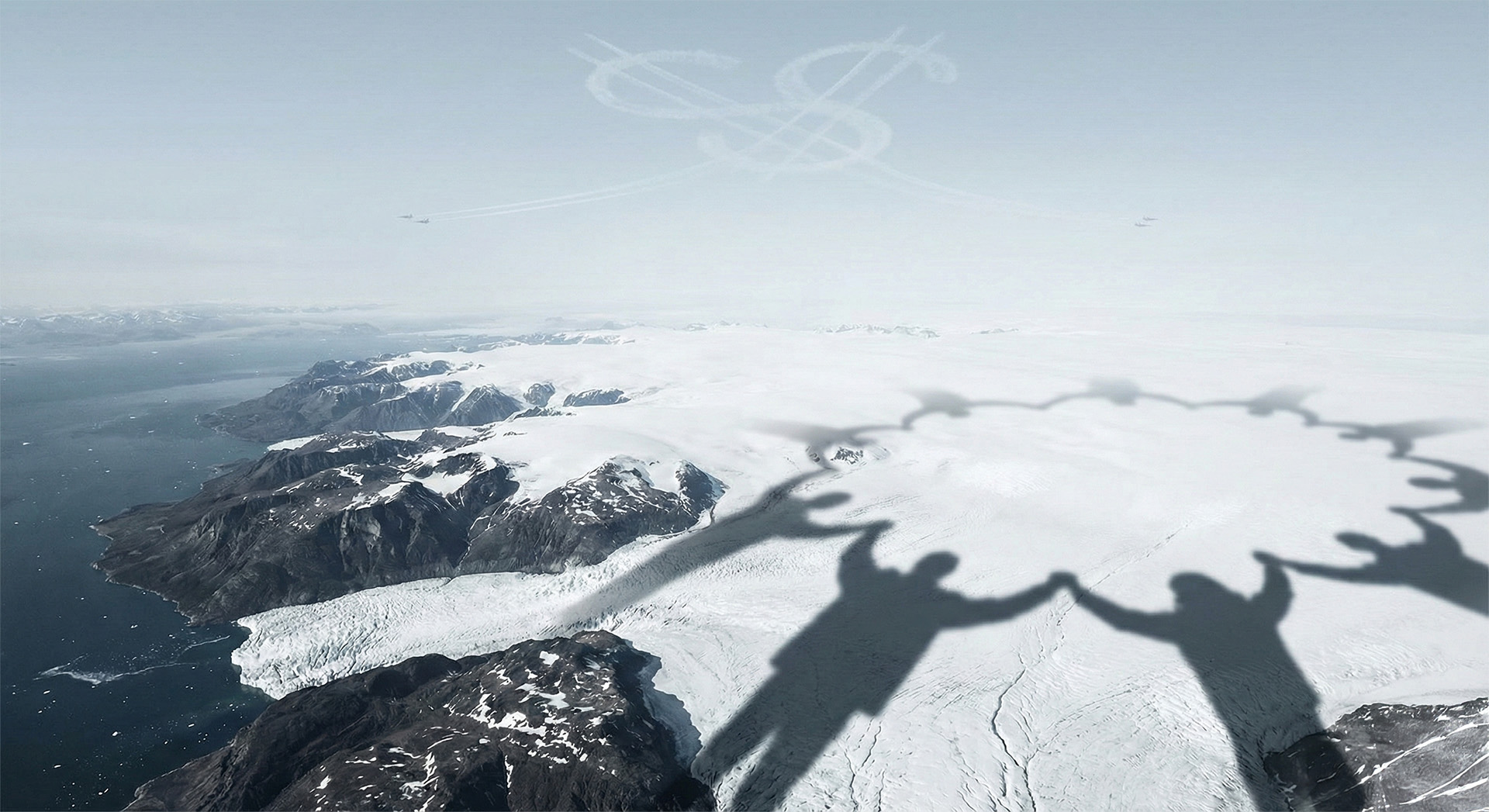
Greenland and the fear industry
Posted on: 18 January 2026
Greenland and the fear industry: who profits when allies pretend to quarrel
On Saturday 17 January, Donald Trump announced ten per cent tariffs against eight NATO countries, rising to twenty-five per cent by June, until Denmark agrees to "the complete and total purchase of Greenland". Headlines speak of transatlantic crisis, the end of NATO, a grave historical precedent. Commentators divide between those who see yet another Trumpian folly and those who detect a sophisticated geopolitical strategy. Both interpretations miss the point.
To understand what is actually happening, one must examine the numbers rather than the declarations. The numbers tell a rather different story.
Denmark, a country of six million with a tradition of benevolent neutrality and generous welfare, has just enacted the largest increase in military spending in its modern history. In 2021, it spent less than two per cent of GDP on defence. In 2025, it will exceed three per cent. The declared objective is to reach five per cent by 2032, a figure that would have startled Cold War generals. The so-called Acceleration Fund mobilises fifty billion Danish kroner, roughly seven billion dollars, in just two years. Among the principal purchases: sixteen F-35 fighters for four and a half billion dollars. Manufacturer: Lockheed Martin, United States.
The coincidence merits attention. Denmark is purchasing billions of dollars in armaments from the very nation that is officially "threatening" it. The crisis that supposedly endangers the transatlantic alliance is producing, in practice, the largest transfer of Danish money to American military industry in decades.
The pattern replicates at continental scale. European military spending rose from two hundred and eighteen billion euros in 2021 to three hundred and ninety-two billion in 2025, nearly doubling in four years. Defence investments increased by forty-two per cent in a single year. The NATO summit at The Hague in June 2025 set a new target of five per cent of GDP by 2035, against the two per cent that seemed ambitious in 2014. Hundreds of billions of euros that were seeking political justification have found it.
Here emerges the first element of the structural mechanism. In democracies, massively increasing military expenditure requires consent. Consent requires a perceived threat. The Russian threat, however real, has normalised after three years of war in Ukraine. European citizens have grown accustomed to it. Something new was needed, something closer, something more emotionally engaging. Trump wanting to "take" Greenland is perfect: serious enough to justify extraordinary spending, absurd enough not to require preparations for actual war.
There is, however, a second level, more subtle. While Denmark buys American F-35s, the rest of Europe is doing precisely the opposite. The European Commission's ReArm Europe plan requires that by 2030, fifty-five per cent of European military purchases must come from European or Ukrainian manufacturers. Germany, historically one of the largest buyers of American armaments, has reduced the share of US suppliers to eight per cent of new contracts. The irony does not escape analysts: Trump spent years pressuring NATO allies to spend more on defence. Now they are spending more, but the money flows to European industries rather than American ones.
And so the "Greenland crisis" serves different functions for different actors. For Trump, it is a negotiating lever: he will not obtain Greenland, but he will obtain concessions on trade, military access, Arctic cooperation. For the American defence industry, Denmark and a few other Nordic countries remain loyal customers while the rest of Europe drifts away. For European defence industry, transatlantic tension accelerates the replacement of American suppliers. For European governments, the crisis provides political cover for spending increases that would otherwise prove unpopular. For the media, it is guaranteed engagement: the combination of Trump, military threats, and small Nordic countries is irresistible.
Who pays? The taxpayer, naturally. The Danish taxpayer funding F-35s to defend against the ally selling them. The German taxpayer funding Leopard 2 tanks against a Russian threat that their own intelligence services describe as "not imminent". The British taxpayer, now facing tariffs from an ally whilst simultaneously increasing defence commitments. The costs are diffuse and invisible; the benefits are concentrated and tangible.
The pattern has a name in game theory: profitable stalemate. It occurs when all principal actors benefit from maintaining an apparently conflictual situation, whilst costs are externalised to parties who do not sit at the decision table. No one has an interest in resolving the conflict because its perpetuation is more remunerative than its conclusion.
It is worth asking: what should we observe if this interpretation is correct? First, no actual military action. Threats will remain verbal, tariffs will be negotiated, Greenland will remain Danish. Second, military spending will continue to grow regardless of how the "crisis" evolves. Third, armament purchases will proceed according to industrial rather than strategic logic: those who were buying American will continue buying American, those already diversifying will continue diversifying. Fourth, no actor will seek a definitive resolution of the matter, because resolution would eliminate the justification for extraordinary measures.
The Danish military commander in Greenland admitted last week that he has seen "no Russian or Chinese warships" in Greenlandic waters over the past two and a half years, despite Trump's continued assertions that the island is "surrounded" by Russian and Chinese vessels. Eighty-five per cent of Greenlanders oppose American annexation, though this figure rarely appears in headlines. The bipartisan delegation of American senators who travelled to Copenhagen to reassure the Danes probably represents the majority view in Congress, but makes less news than presidential provocations.
The clinical question is not whether Trump will annex Greenland. He will not. Nor is it whether NATO will survive. It will survive, as it has survived far more serious crises. The question is: how long can a system endure in which the simulation of conflict between allies is more functional than genuine cooperation? How much can military spending grow before citizens demand to see the threats it is meant to counter? How wide can the gap between bellicose rhetoric and the reality of economic and military relations become?
Those who have lived long enough know that these cycles do not last forever. Sooner or later, someone breaks the game. It may be a politician who decides to tell the truth. It may be an external event that renders the pretence ridiculous. It may simply be the fiscal exhaustion of states that can no longer afford to finance geopolitical theatre. In the meantime, the most useful advice remains unchanged: follow the money, not the headlines. Observe who buys what from whom. Ask who benefits from the current situation and who bears its costs. And when someone tells you we stand on the brink of an epochal crisis, verify whether they might be selling something.
Greenland will remain Danish, at least for as long as it suits the Danes. Trump will obtain some concession to display. The defence industry will collect its contracts. The media will have their engagement metrics. And in a few months, when attention has shifted to the next emergency, someone will wonder why we spent so much for so little. But by then there will be new fears requiring funding.