Follow the bear, wherever it went
Posted on: 30 June 2026
Try to summon the jingle for a product you have not bought, or even thought about, in thirty years. Most people past a certain age manage it instantly, and that small feat deserves more attention than it gets. We retrieve on command the advertising for things that no longer exist, while the spot we sat through last night has already gone. This is not a flaw in memory. It is a property of how that advertising was built.
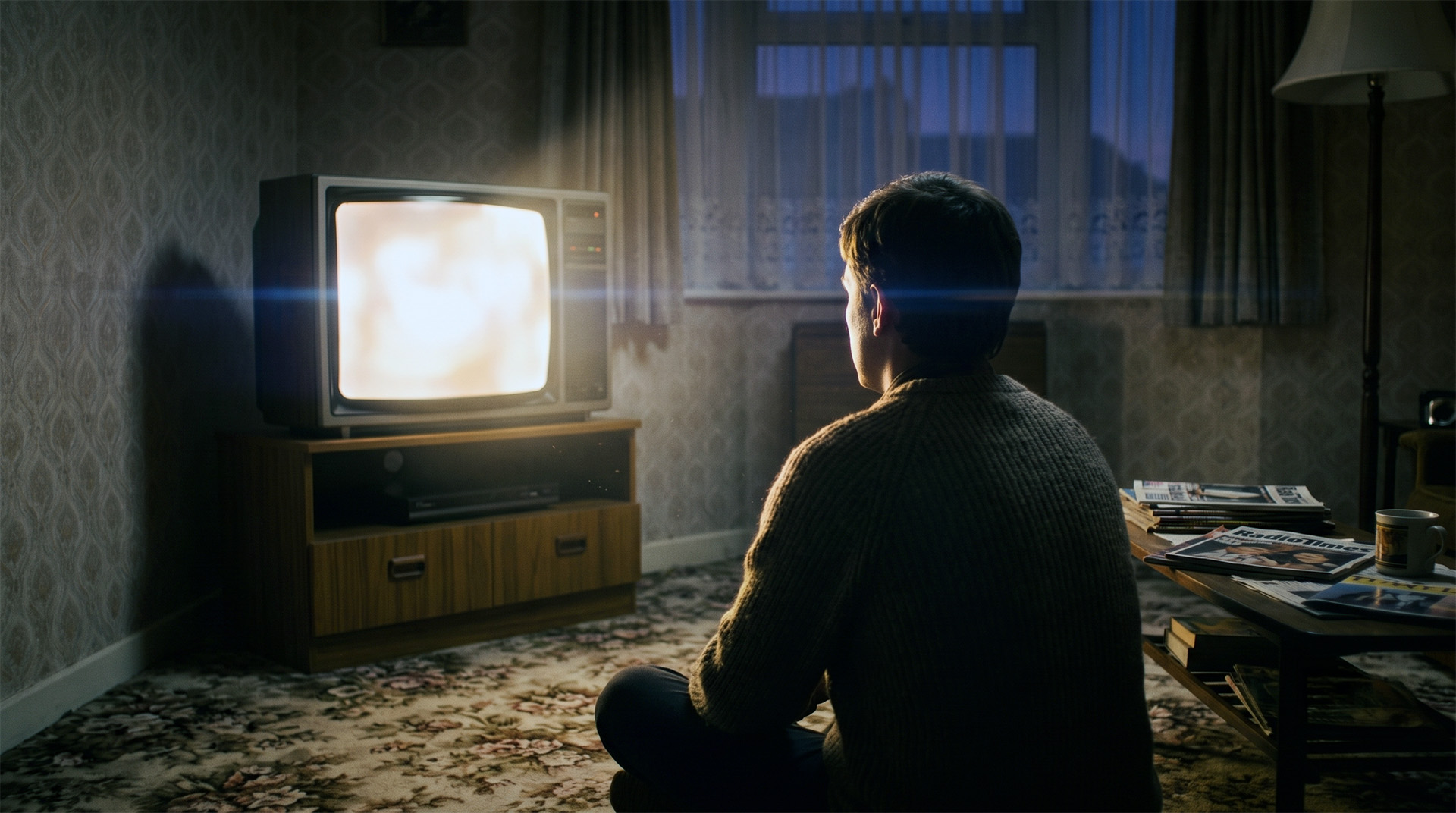
Anyone who grew up in Britain in the eighties can still perform the relevant party trick. Do the Shake n' Vac, and put the freshness back. A carpet deodorant powder, a woman in heels dancing round a sitting room, a tune in mock fifties rock and roll, and a melody that has outlasted every reason you ever had to think about carpets. The advert ran from 1980 to 1986. The jingle never left.
That stickiness was engineering, not luck. British advertising had long understood that the cleanest way to lodge a name was to bend the language slightly out of true. Beanz Meanz Heinz, three words deliberately misspelt into a rhyme so durable that Heinz eventually renamed the tins to match the slogan rather than the other way round. Drinka Pinta Milka Day, a string of half-invented words from the late fifties that pushed "pinta" into ordinary English, where it stayed for a generation. A word that does not quite exist has no competitor in your head. It takes an empty slot and keeps it, and rhyme is the nail that holds it there.
The spot itself was an autonomous object, a small film with an arc and a release, on which the product travelled as a passenger. The Milk Tray man abseiled down cliffs and swam through shark water to leave a box of chocolates on a pillow, and the chocolates were almost beside the point, the thirty seconds being a miniature Bond picture that happened to be selling confectionery. The jingle was the weaponised version of the same idea. It did not ask for your attention, it took it, because a melody with a name inside installs itself and repeats without permission. It worked precisely because the advert paid its way as entertainment, and you lower your guard in front of something that amuses you. I helped write a jingle in the nineties, so I am not admiring this from the outside.
Here is the question that interests me more than the nostalgia. Has the fragmentation of today, the thousand cuts across fourteen platforms, made products more memorable than that dancing woman and her carpet powder? No. And this is not impression, it is measured, and measured by the British. Les Binet and Peter Field, working through the IPA's databank of effectiveness cases, have shown for over a decade that campaigns built on memory and emotion, the broad and slow ones, generate more long-term growth than those optimised for immediate response. The industry moved its money en masse towards short-term activation at precisely the moment its own evidence pointed the other way. It chose the measurable over the effective, because the measurable can be defended in a meeting with a chart and the effective cannot.
So the jingle did not die because nobody can write one any more. It was decommissioned because it no longer fits the model. An earworm needs repetition on a stable audience to settle, it needs months and a public that returns to the same place at the same hour. Shatter that audience into six skippable seconds across a thousand screens and the repetition stops accumulating, it evaporates before it can become a memory. The most powerful device advertising ever invented for planting a name in your head was rendered useless not by a shortage of talent but by the destruction of the conditions that made it lethal.
There is a subtler reason the picture itself has flattened, and it has nothing to do with technical skill. The eighties spot had to please an enormous undifferentiated audience, and to please everyone at once it had to be beautiful, because beauty is one of the few languages that cross differing tastes without translation. Content made for the feed has instead to beat one person's thumb, to halt it for a quarter of a second before it scrolls on. These are two different objective functions and they produce two different aesthetics. One optimised for the memory you carried into the next evening, the other for the interruption of the instant. It is not that the craft has got worse. It is solving a different problem, and that problem does not ask for beauty, it asks only that the thumb stop.
Where has the lost thing gone, then. It survives in two places, and which two is instructive. It survives at the top, in luxury campaigns and a certain kind of prestige television, where someone still has reason to build desire rather than immediate conversion. And it survives, paradoxically, inside the very model that killed it, when a brand rediscovers that a recurring character or a sung refrain does more work than a thousand pieces of performance content, and on the rare occasion someone tries it the thing overdelivers, precisely because almost nobody else does. The scarcity of the language has become its advantage, which is a small irony Schelling would have enjoyed: the value of the move rises as everyone else abandons it.
George the Bear, meanwhile, is gone. Hofmeister, the lager he urged a generation to follow, was quietly axed in the early 2000s once premium imports buried it, and when the brand was later revived its new owners deliberately left the bear behind as too cheap and too tied to the old thing. Yet "follow the bear" is still lodged in men who have not bought a can in thirty years. And then there is Hamlet, the case that goes furthest. Happiness was a cigar called Hamlet, set to a jazzed Bach that the campaign itself turned into one of Britain's best-loved pieces of music, until tobacco advertising was driven off television in 1991 and out of the cinemas by the end of the decade. The product still exists somewhere, unadvertisable by law. The advert outlived not only the relevance of the thing it sold but the very legality of its own form, and the first bars of Air on the G String still finish the sentence for anyone old enough. Nothing remains of the product. The jingle plays on, in a head that no longer remembers what it was ever meant to buy.