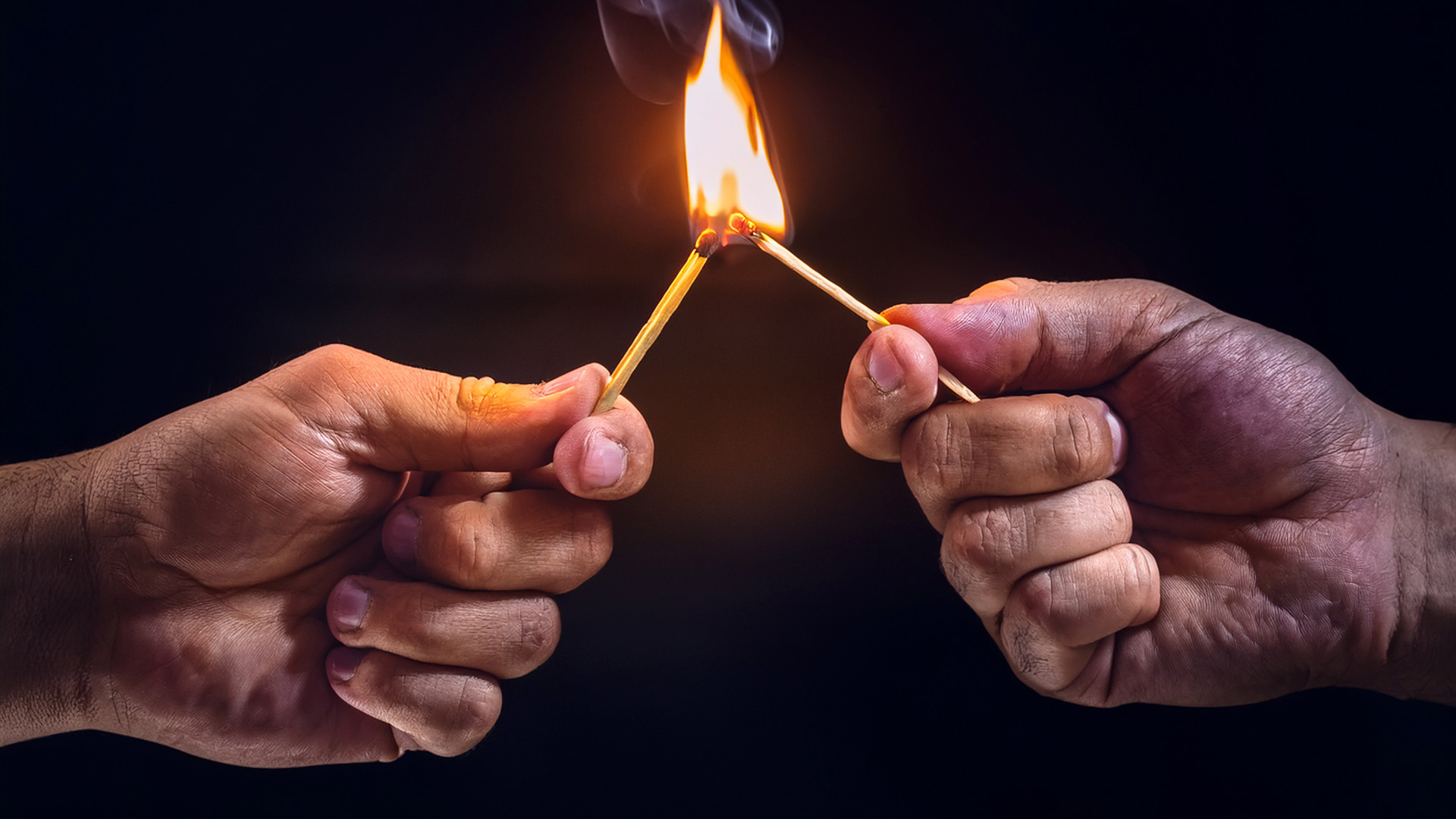
Everyone is playing with the same match
Posted on: 13 April 2026
There is something the news cycle is not saying clearly today. Not out of bad faith, but because the mechanism is uncomfortable to look at directly.
The Strait of Hormuz was already blocked by Iran. For weeks. Trump added an American blockade on top of the Iranian one. The mathematical result is two overlapping interdictions on the same passage, and oil is not moving.
This is not a military conflict. It is a geopolitical selection mechanism. Iran built a selective access system: China, Russia, India, Pakistan pass through. Ships linked to the US and its allies do not. Trump responded by blocking anyone who paid a toll to Tehran. NATO is not participating. And Britain, specifically, has refused to join.
Starmer said it plainly: "Whatever the pressure, and there's been some considerable pressure, we're not getting dragged into the war. "Trump's response was to compare him to Neville Chamberlain.
Let that sit for a moment. The President of the United States has publicly compared the British Prime Minister to the man who handed Czechoslovakia to Hitler. The special relationship, whatever is left of it, does not look very special from here.
But here is what makes the British position structurally interesting rather than just diplomatically awkward. Starmer is right and it does not matter, because being right about not joining a war does not tell you what you are for. He has the clearest positioning of any Western leader on this crisis, "not our war, nor getting dragged in" and it is entirely defined by negation. He knows what Britain is not. The question of what Britain actually is, in this new world where Washington and Brussels are both pulling in directions that suit them rather than London, remains unanswered.
Brexit was supposed to free Britain to act independently. Here is the moment of independent action and the government is hosting coalition meetings for forty countries and working the phones between Macron and the Sultan of Oman. That is not independence. That is the foreign policy of a country that lost its institutional anchors and has not yet built new ones.
Meanwhile the cost lands on ordinary people, a typical British household is expected to be nearly £500 worse off as energy prices feed through to bills, petrol and transport costs. Starmer himself said he is "fed up" watching energy bills swing up and down because of the actions of Trump and Putin. A sitting Prime Minister, publicly equating the behaviour of his principal ally with that of the leader of Russia. The words were careful. The meaning was not.
The structural problem is the same and it does not change by country. The world built an energy system with a single critical failure point thirty-three miles wide. Everyone knew. The military papers, the geopolitical analyses, the risk assessments of the major energy companies: Hormuz appeared in all of them, as a theoretical risk, as a textbook scenario. The implicit answer was always the same: we will deal with it when the time comes.
The time has come. There is no quick fix. Not because ideas are lacking, but because energy transition is measured in decades of infrastructure, not weeks of crisis. The renewables that exist today do not replace that volume in any politically relevant timeframe. Civil nuclear takes fifteen years from permit to production. Liquefied natural gas has alternative routes but not the capacity to absorb that shock.
So the question of who benefits becomes unavoidable. The answer is uncomfortable: those who do not depend on that passage. Russia, exporting through the Baltic and the Pacific, collects every barrel at double the price without having moved a finger. Domestic producers see their oil revalued. Those who signed bilateral agreements with Tehran in recent weeks buy at preferential prices while the rest of the world pays the scarcity premium. Europe and much of Asia pay the bill without a seat at the table.
Britain pays that bill too. And unlike France, which is moving fast to position itself as the alternative European leader; unlike Germany, which is quietly accelerating its energy independence agenda; unlike even Italy, whose government silence is at least a coherent domestic political choice — Britain is caught between an alliance that no longer feels reciprocal and a European structure it chose to leave.
That is not Starmer's fault. It is the consequence of a decision made a decade ago whose full cost is still arriving. Starmer, paradoxically, has the clearest positioning of any Western leader in this crisis. "Not our war. Not getting dragged in." Honest, direct and it cost him the Chamberlain comparison from Washington.
The problem is that knowing what you are not is only half an answer. The other half, what Britain actually is, what role it plays in a world where both Washington and Brussels are pulling in directions that suit them rather than London, remains unspoken. And in a crisis of this magnitude, unspoken is not a position. It is a gap.