Correct and exposed
Posted on: 3 November 2026
On Sunday the Neue Zürcher Zeitung placed two pieces of news side by side, each of which looks routine on its own. The first is that this winter, for the first time since 2022, Switzerland might genuinely run short of electricity, because European gas stocks are low and so are its own hydroelectric reservoirs. The second is that the country's new reserve plant, a gas turbine test bench owned by Ansaldo Energia at Birr in the canton of Aargau, with a capacity of 250 megawatts, will be ready only from 31 January. Until then the system is missing the output of a large power station, which is precisely the instrument designed for the months in which Switzerland imports power because its own production falls short.
The official answer from the federal department responsible for energy is that the truly critical period runs from February to April, when the reservoirs empty. On average that is true. This year, however, traders are bracing for a cold November with stocks already thin, so the bet on the late winter window is weaker than usual. Yet the calendar is the least interesting part of the story, and to understand where the gap comes from one has to go back four years.
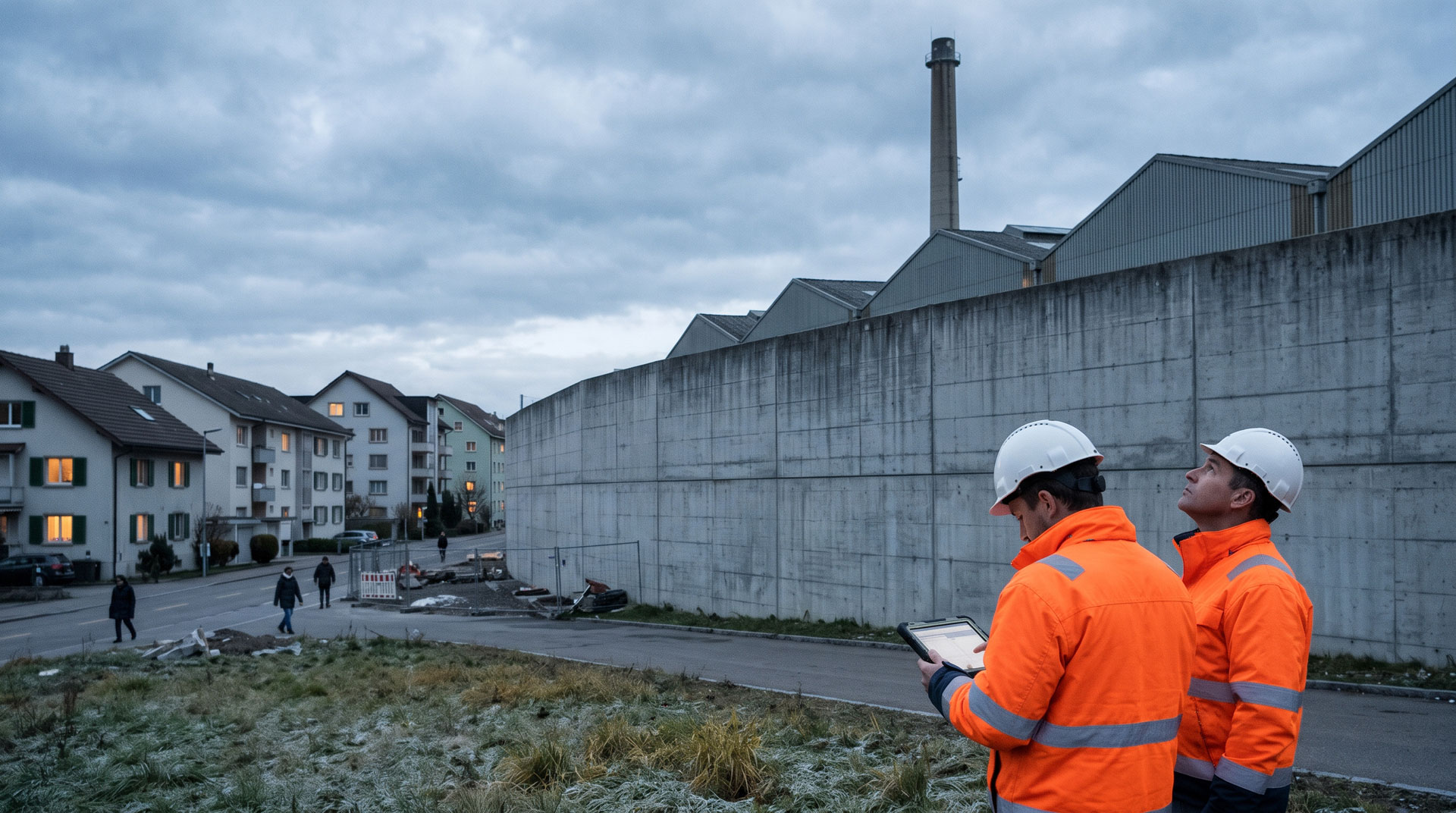
In 2022, after Russia invaded Ukraine, Europe lost most of its Russian gas while half the French nuclear fleet sat idle for maintenance and corrosion checks. Switzerland, which depends on imports in winter, found itself exposed, and the Federal Council, the collective executive of seven ministers that governs the country, reached for emergency powers. Within a few months General Electric had installed eight mobile turbines on its own site at Birr, roughly 250 megawatts in all, behind a noise barrier twenty metres high facing the houses next door, at an estimated total cost of 470 million francs. The operating permit was granted in December 2022 and ran until the end of May 2023. The plant was never switched on.
In February 2024 the Federal Administrative Court found in favour of a Birr resident, backed by the Swiss climate strike movement, and ruled that the government had not been entitled to issue the operating ordinance, since a severe shortage had not been demonstrated. The judgment was final. A year later a parliamentary oversight committee criticised the government for justifying its decision with too little transparency, noting that barely a week after rejecting local objections the Federal Office of Energy had announced that Birr would probably not be needed after all.
This is the first mechanism, and it reaches well beyond energy. An emergency instrument is judged afterwards, in the light of a crisis that did not happen, when the crisis may not have happened partly because the instrument existed. Every insurance policy that works looks like waste in hindsight. The emergency regime buys speed at the price of fragile legitimacy, while the ordinary regime has all the legitimacy it needs and none of the speed.
The return to the ordinary regime was carefully planned. The contracts for the three thermal reserves at Birr, Cornaux and Monthey, 336 megawatts in total, were due to expire at the end of spring 2026. The Federal Office of Energy launched the tender for their successors in July 2023, almost three years ahead, with a target of 400 megawatts recommended by ElCom, the federal regulator that oversees the electricity market. Nobody can claim that continuity was forgotten. The tender was nonetheless abandoned because the bids were too expensive. Revised offers arrived in February 2025, and in May the department awarded five projects worth 583 megawatts, due to come online between 2027 and 2030. At that point the gap was simple arithmetic. A bridge was needed, and in July 2025 Albert Rösti, the Swiss People's Party minister who has run the energy department since 2023, signed with Ansaldo to convert the Birr test bench, backed by an additional credit of 275 million francs running to 2030. The bridge arrives on 31 January. The old plant, born of an emergency ordinance with its dismantling date written in from the start and opposed by the cantonal government beyond 2026, could not simply be kept running.
Trace the chain back and every link holds. The court applied the law, the energy office refused prices it judged excessive, the canton protected its residents and the government kept to the deadline it had set itself. Nobody broke a rule. The outcome is nonetheless exactly the shortfall the reserve existed to prevent, because none of those rules required anyone to ensure that the new was running before the old expired. The overlap was left to the calendar, which is to say to the hope that procedures would finish on time.
British readers have seen this film before, with a different cast. Rough, the depleted gas field off the Yorkshire coast that had served as the country's storage since 1985 and held about seventy per cent of Britain's storage capacity, was closed by Centrica in 2017. The company judged it uneconomic and at the end of its design life, the competition authority allowed it to stop operating as a store and the government declined to pay for the repairs. Each decision was defensible on its own terms and each followed the rules of a liberalised market. Five years later, when Russian gas stopped flowing, Britain discovered that it had some of the smallest storage reserves in Europe, and Rough was hurriedly reopened in October 2022 at around a fifth of its former capacity. The Swiss and British cases start from opposite ends, one from an emergency that overreached and the other from a market that underpriced resilience, yet they arrive at the same place: a system that is correct at every step and exposed at the end.
The Swiss gap has the exact width of the difference between two speeds. Under emergency law, 250 megawatts of capacity appeared within months. Under ordinary law the same capacity requires a tender, a negotiation, a parliamentary credit, permits and engineering work, which in practice means four years. The system of 2022 compressed time by suspending the rules; the system of 2026 has handed that time back all at once.
Anyone who has led an organisation out of a crisis will recognise the moment. During the emergency decisions are taken quickly and shortcuts are accepted, then comes the phase in which someone has to account for those shortcuts, and the natural reaction is to return to process with some zeal. That is the right thing to do. The difficulty is that restored processes do not inherit the slack the emergency had created, so the organisation finds itself more correct and more exposed at the same time.
There is a second element, less visible than the delay and in my view more serious. The old Birr plant could also run on fuel oil, and that is how it appeared in the regulator's dispatch order. The new one, which this winter becomes the country's main reserve, runs on natural gas alone. A hedge against a European electricity shortage that depends on gas is tied to the very risk it is meant to cover, since the worst case for Switzerland is precisely a winter in which gas is scarce across the continent. The NZZ itself notes that in a severe and prolonged European crisis the usefulness of reserve plants is open to question anyway. One plant has been replaced by another of similar output, but the nature of the protection has changed, and that does not show up in any table of megawatts.
A few things follow about what not to do. The first is to read the gap as incompetence and call for resignations, because the next government facing the next crisis would then reach for emergency powers so as not to be caught short, and another court would rule against it once the crisis had passed, setting the same cycle in motion. The second is to think of a reserve as a stock, when it is really a chain of contracts with start and end dates, and chains always break at the joins. The third is to count megawatts without asking which fuel they depend on, since a reserve that shares its source of risk with the main system is worth less than its capacity suggests.
The design lesson is easy to state and awkward to apply. If continuity matters, the overlap between old and new has to be written in as a constraint, with the successor under contract before the predecessor's expiry is fixed and with a margin of time paid for in advance. Leaving it to the smooth running of procedures means betting that everything goes to plan in exactly the field where one is insuring against things not going to plan. Until 31 January Swiss electricity security rests on a mild winter, and a mild winter is not a rule.