Audi: the Perry stage and the missing signature
Posted on: 9 November 2026
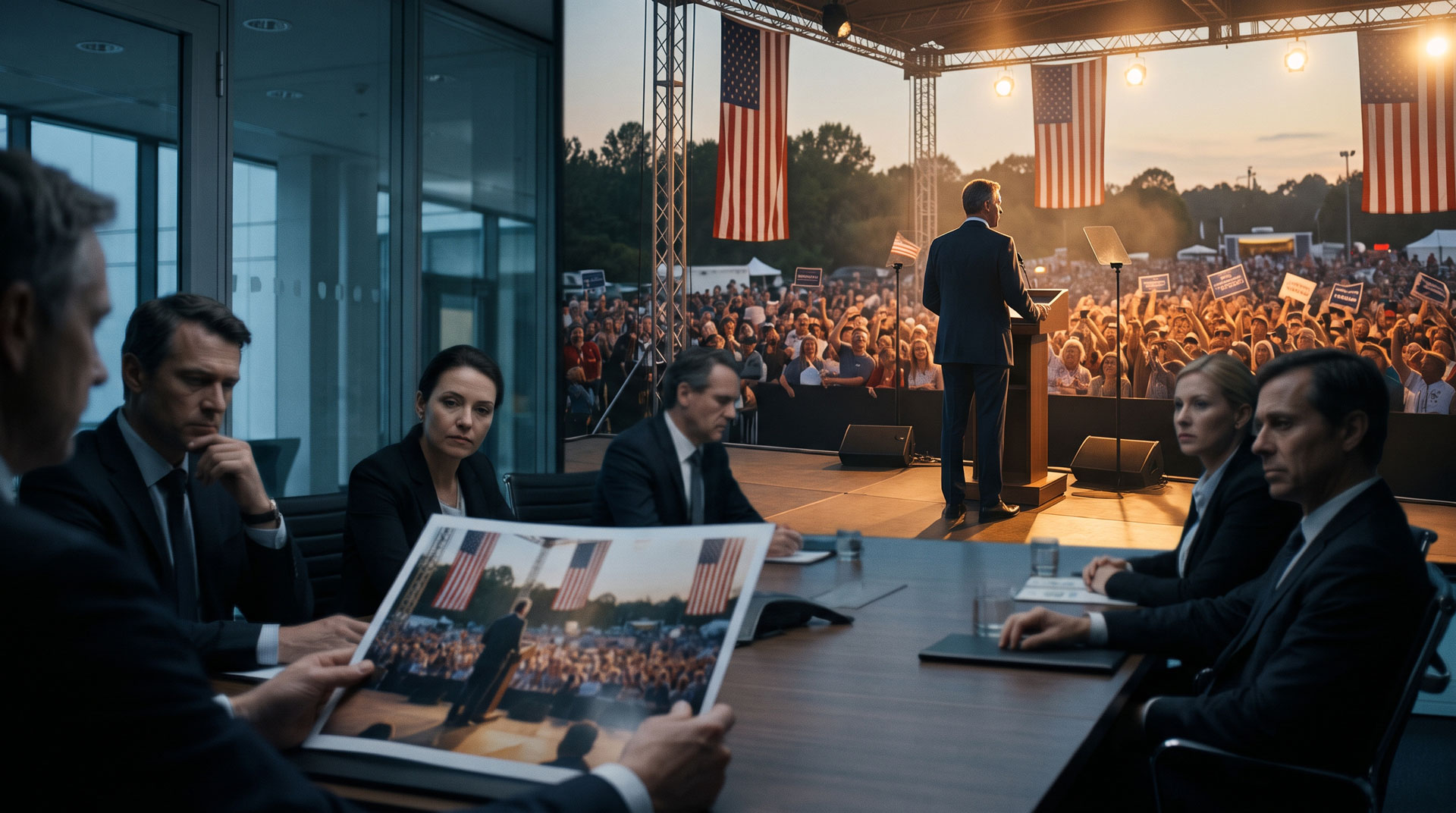
On Saturday 24 October, in Perry, Georgia, Donald Trump was holding one of his rallies ahead of the 3 November midterms when he announced that Audi would build its first American factory in the state: an investment of roughly 4 billion dollars, 200,000 SUVs a year and 4,500 jobs. He then invited Gernot Döllner on stage. Döllner, an engineer who rose through Volkswagen and has run Audi since 2023, thanked the president for his support. In Germany the scene went down badly. The group's worker representatives and the IG Metall union said they were shocked, whilst one senior Audi manager told Handelsblatt that he had found the whole thing disturbing.
Two weeks later Handelsblatt, Germany's leading business daily, reported that Volkswagen is preparing an internal investigation into possible breaches of the rules surrounding Audi's American plans. Besides Döllner, it may reach Manfred Döss, the lawyer who chairs Audi's supervisory board and who, on Volkswagen's management board, is responsible for integrity and legal affairs. The paper adds that a particular faction is pushing for the inquiry, without saying which.
The moral reading has been doing the rounds for days: a German executive playing an extra in Trump's campaign has crossed a line. Perhaps so, but that account explains nothing about what is happening now, because internal investigations at a group like Volkswagen are rarely a matter of taste. To understand the game one has to look at a detail that most commentary has left in the background, namely that the factory has not yet been decided.
The site agreement with Georgia carries neither Audi's signature nor the state's, since before anyone signs Volkswagen's supervisory board, which owns all of Audi, has to approve it. Until the day before the rally Audi had repeatedly denied Handelsblatt's reports of the investment. Yet on the stage at Perry Döllner announced, standing next to the President of the United States, a decision his own group had not yet taken.
Thomas Schelling, the American economist who published The Strategy of Conflict in 1960 and received the Nobel prize in 2005, called this a credible commitment: the move by which one deliberately gives up options in order to force others to adapt. Whoever ties his hands in public makes it very expensive for anyone else to turn back. Announcing an unapproved project live, at Trump's side, turns a possible refusal by the board into a slap in the face for the White House in the middle of a tariff war that cost Audi 1.2 billion euros last year alone, given that every car it sells in the United States is imported. Döllner has said it was the American administration that asked him to make the announcement at the rally. That may well be true, but it does not change the mechanics, since accepting was still the most effective way to lock the project in against anyone at home who might have slowed it down.
The move has a famous precedent that leadership manuals only tell by half. In 1519 Hernán Cortés, the Spanish conquistador of Mexico, had his own ships scuttled off the coast at Veracruz. The edifying version says he wanted to remove every line of retreat in order to motivate his men. The historical version is more useful, because on board were men loyal to Diego Velázquez, the governor of Cuba who had financed the expedition and who, before it sailed, had tried to strip Cortés of the command. The sunken ships were a message to his own side rather than to the Aztecs, so much so that Velázquez responded by sending an expedition to arrest him. By then nobody was arguing about whether to conquer Mexico any more; the fight was over who should be in charge of it.
The same structure is visible now in Wolfsburg, where a supervisory body presented with a fait accompli cannot attack the deal without damaging itself, and therefore attacks whoever imposed it. British readers may need reminding how unusual that body is by their standards. Under German co-determination law half of the twenty seats on Volkswagen's supervisory board belong to employee representatives, whilst the state of Lower Saxony, which holds 20 per cent of the voting rights, has two members of its own. Together these actors have historically settled the group's heavy decisions. Volkswagen is currently cutting 50,000 jobs and plans to close four German plants between 2031 and 2034, one of them an Audi plant. The Georgia factory is meant to reach full production in 2031. Audi keeps saying that the American investment takes nothing away from Germany, but for those sitting on the employee side approving it without anything in return would mean signing off, with their own hands, on the transfer of production.
Blocking the factory suits nobody, since without American production the tariffs keep eating into margins, and the investigation thus becomes the only lever available: a way of raising the price of a yes. Were the faction behind it a different one, the substance would not change. Döss has for years been a man trusted by the Porsche and Piëch families, who control Volkswagen through the holding company Porsche SE, where he also sits on the board with responsibility for legal affairs. An inquiry that brushes against him shifts the balance between Wolfsburg and Stuttgart before it has established anything at all. There is also a paradox of which whoever started the process is well aware: if the investigation does reach him, the person charged with guaranteeing that the group follows its own rules will be among those under scrutiny.
The most revealing detail, however, lies in the documents of Georgia's regional development authority seen by Handelsblatt. The clawbacks due if Audi fails to meet its commitments only apply once the transaction has closed, which means Audi can walk away even after signing. Meanwhile the state is giving it the land, about 458 million dollars in tax incentives and more than 120 million in grants for infrastructure, whilst Audi is already weighing a second phase worth a further 3 billion and 3,000 more jobs. It is a classic asymmetry, in which one party commits and the other buys an option, and that option has value inside the group as well, because it allows the board to approve without really placing a bet and so lowers the cost of saying yes. It is one of the reasons the investigation looks more like a negotiation than an attempt to stop the project.
A British board would offer far less of a counterweight. Worker representation on company boards was floated by Theresa May in 2016 and then quietly diluted into one option among three in the corporate governance code, so a chief executive here who committed his company on someone else's stage would face fewer people at home with the standing to make him pay for it. That is not necessarily an advantage. The German system is slow and often exasperating, yet it is precisely what turns a political gesture into a priced transaction rather than a done deal.
If the history of comparable situations is any guide, the factory will be built and what is being negotiated now is its price. The possible currencies are well known, namely guarantees for the German sites or the political diminishment of Döllner, and they are by no means mutually exclusive. Whoever imposes a decision by fait accompli rarely comes out stronger even when the decision proves right, because the success is credited to the necessities of the market whilst the method stays attached to his name. Cortés did take Mexico, yet within a few years the Crown had removed him from the government of the colony. I have watched the same dynamic in boardrooms far smaller than Wolfsburg's, where whoever announces outside what he has not yet secured inside almost always wins the first round and almost always loses the next.
The useful lesson concerns anyone running a subsidiary within a group that has a powerful shareholder and an employee voice that counts. Using an external stage to bind an internal decision works once only and spends a stock of trust that will be needed precisely afterwards. Döllner will have to negotiate the reduction of the German workforce with the same people who now regard him as the man who went over their heads in front of Trump. For those who sit on boards the risk runs the other way, because punishing the man through the deal, perhaps by using that exit clause as a weapon, would destroy an option the group has paid dearly to obtain. The commitment an executive makes in public to someone powerful outside the company stays on the record, and sooner or later somebody inside the company uses it against him.