Alstom and the customers who use up their suppliers
Posted on: 4 November 2026
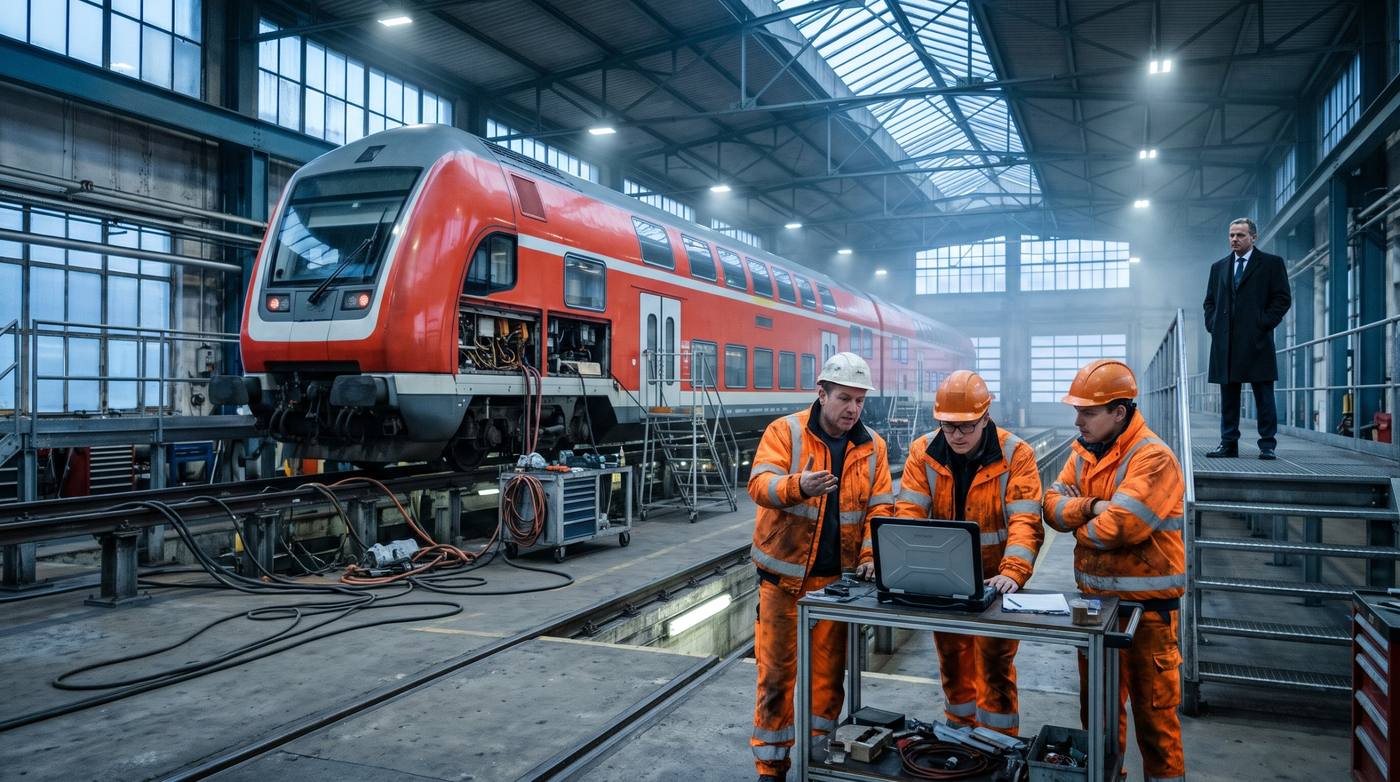
In April 2024 the production lines at Litchurch Lane in Derby came to a halt. The last train in the order book had left the factory on 21 March, and Alstom opened consultations on 1,300 manufacturing jobs at a works that had been building rolling stock for 148 years and is the largest train factory in Britain. Ten months of talks with the government had produced some help, including five extra trains for the Elizabeth line, but not enough to fill the gap. The plant was eventually saved, and in September this year Alstom won a contract worth more than £1bn to build 29 battery-electric trains for TransPennine Express, with manufacturing in Derby due to start in 2028. Derby had been through this before. In July 2011, after the Thameslink fleet contract went to Siemens, Bombardier, which then owned the works, cut more than 1,400 jobs there. Britain has come close to losing its main train factory twice in thirteen years, and both times the reason lay in the way trains are bought. That is worth keeping in mind when reading this week's news from Paris.
On Monday 2 November Alstom, the French group that builds trains and railway signalling systems, lost 28 per cent of its market value in a single session. The shares closed at €11.28, having lost more than half their value since January. The company cut its forecasts for the current financial year for the second time in seven months, so that the expected adjusted operating margin falls from about 6.5 per cent to about 1 per cent, while free cash flow, which was supposed to be positive, will be negative to the tune of €1.5bn. The first cut came in April, shortly after Martin Sion took over as chief executive, and the shares fell by 30 per cent then too.
The trouble starts with the Coradia Max, the regional train platform that Alstom supplies to several German states. During testing a team of experts sent in by Sion found design flaws in units that were partly built already, so the company had to halt the whole programme and go back to work on the carriages it had finished. The delays are now spreading to Alstom's other German contracts, and because the company is paid when it reaches contractual milestones, every delivery that slips past the end of the year is cash that does not come in. Analysts at the broker Kepler Cheuvreux estimate a one-off charge of close to €1bn. To keep its investment-grade rating, the credit grade that marks a borrower as safe, the group wants to cut its debt by €2bn by selling assets. Deutsche Bank has also pencilled in a possible rights issue of €1.5bn, although for now that is the bank's assumption and not something the company has announced.
It would be easy to file all this under bad execution, but the Financial Times points to a figure that makes the explanation hard to sustain. According to LSEG, the London Stock Exchange Group's data business, Alstom has missed analysts' earnings forecasts every year since 2018. The usual explanation blames the 2021 purchase of the rail division of Canada's Bombardier, Derby included, which brought with it a string of badly drafted contracts, and Alstom did go through a similar crisis in 2023 and 2024, with guidance cuts, disposals and a capital increase. Eight years of misses is a long run for a single inheritance, however, especially as orders keep growing. In the half year to September Alstom booked €11bn of new orders, 5 per cent more than a year earlier, and it still expects to win more business this year than it invoices. What we have, then, is a company that loses money on what it delivers while it goes on winning tenders.
The mechanism has had a name since 1971, when three physicists at the oil company Atlantic Richfield published a study of the auctions for drilling leases in the Gulf of Mexico. They had been working on the problem since the early 1960s, when their employer realised it had won almost every tract it bid for and was earning less from them than expected. They called it the winner's curse. When many bidders estimate the same uncertain value, the one who wins is usually the one who erred furthest on the optimistic side. In a fixed-price tender for a train that has not yet been designed, the winner tends to be whoever underestimated the cost the most, which means that the better a company is at winning, the more its order book fills up with the worst estimating errors in the industry. Eight years of missed forecasts look very much like the statistical signature of that process. Who found the faults on the Coradia Max matters too, because it was a team that arrived with the new management. The flaws were there before, but the people who signed those contracts had been rewarded at the moment of signing and had no reason to go looking for them.
Why should railways lend themselves so readily to this? The FT puts it down to the balance of power. Demand for rail travel is growing, yet the customers are large and often state-owned operators that insist on bespoke specifications and on delivery schedules that sometimes seem to follow the electoral cycle more closely than the industrial one. On top of that comes a European network built up in layers, to the point where a train running from Paris to Amsterdam has to carry seven different signalling systems. Each order becomes an almost unique product to be approved country by country, and the development risk falls on whoever signed the price. The FT's conclusion is that manufacturers should learn to walk away from tenders that offer no margin, even though each crisis leaves them weaker at the negotiating table.
There is a further step that the article touches on without developing. A train stays in service for thirty years, and whoever buys it needs to believe the supplier will still exist when the maintenance falls due. The credit rating and the order book therefore work as proof of survival, which means that a weakened manufacturer cannot afford to turn work down at precisely the moment it has the best reasons to. It has to keep buying orders and it pays for them with ever thinner margins. Weakness, in other words, produces more bad contracts rather than more discipline.
Airbus shows that the problem lies in the structure of the contract rather than in the industry. In civil aviation it suffers from nothing of the kind, because the balance of power runs the other way: two manufacturers on the supply side and hundreds of airlines and leasing companies on the demand side. An A320 is bought from a catalogue and certified once for the whole type, and the customer chooses little more than the cabin layout. When Airbus accepted the terms under which Alstom works, it fell ill in exactly the same way. In 2003 seven NATO countries, Britain among them, ordered the A400M military transport aircraft under a fixed-price contract, unusual for a defence programme, which Airbus signed in order to break into that market. The programme ran aground on its engines, which for political reasons were given to a European consortium rather than to the Canadian supplier Airbus would have preferred, as well as on schedules that were far too tight. In 2010 the governments stepped in with €3.5bn, and by 2018 the charges booked on the programme had reached €7.2bn. Tom Enders, then chief executive of Airbus, spoke of an original sin committed fourteen years earlier. It was the same company with the same engineers, making money on civil aircraft and losing it on the military one, so the only thing that had changed was the contract.
Buses show where the other half of the mechanism leads. Van Hool was a family-owned Belgian manufacturer founded in 1947 which in 2024 lost a large order for electric buses from De Lijn, the Flemish public transport company, to China's BYD, whose bid was 20 per cent cheaper than the European competition. Van Hool filed for bankruptcy on 8 April 2024. According to an analysis by the Egmont Institute, a Brussels foreign affairs think tank, it emerged after the tender that BYD had come last of the six bidders on after-sales guarantees and sustainability. The Dutch group VDL took over part of Van Hool and this year says that some of its plants are short of work because of cheaper imported buses. Buses are sold from a catalogue, so they are spared the winner's curse that comes with development contracts, but the buyer's behaviour is the same, because each operator optimises its own tender as if the number of competing suppliers were guaranteed for ever. That competition is a resource everyone uses and nobody pays to maintain.
In trains the shrinking has already begun. Bombardier has been absorbed into Alstom, leaving Germany's Siemens Mobility, Spain's CAF and Switzerland's Stadler at the table. In February 2019 the European Commission blocked the merger of Siemens and Alstom to protect customers from an over-mighty supplier, with Britain's Office of Rail and Road and Competition and Markets Authority among those pressing for the veto. Meanwhile the way those same customers buy trains works in the opposite direction, wearing suppliers down one at a time. If the A400M is any guide, Alstom's crisis will not be over in a quarter and is more likely to end in a long renegotiation with its German customers, in which the bill is shared out between the manufacturer and the public bodies, because neither side can afford to let the other fail.
The lesson is mostly about what to avoid, and it applies to both sides of the table. A manufacturer should not sign a fixed price on a platform that has not yet been approved, nor reward its managers on the value of orders won rather than on the margin at which they are delivered. A public buyer should not choose on price alone, because at the next tender it may find one bidder fewer. Britain has already watched that lesson play out at Derby twice. The German operators who will now collect penalties from Alstom might ask themselves who will answer their tenders in ten years' time.