A shoe needs a town
Posted on: 22 October 2026
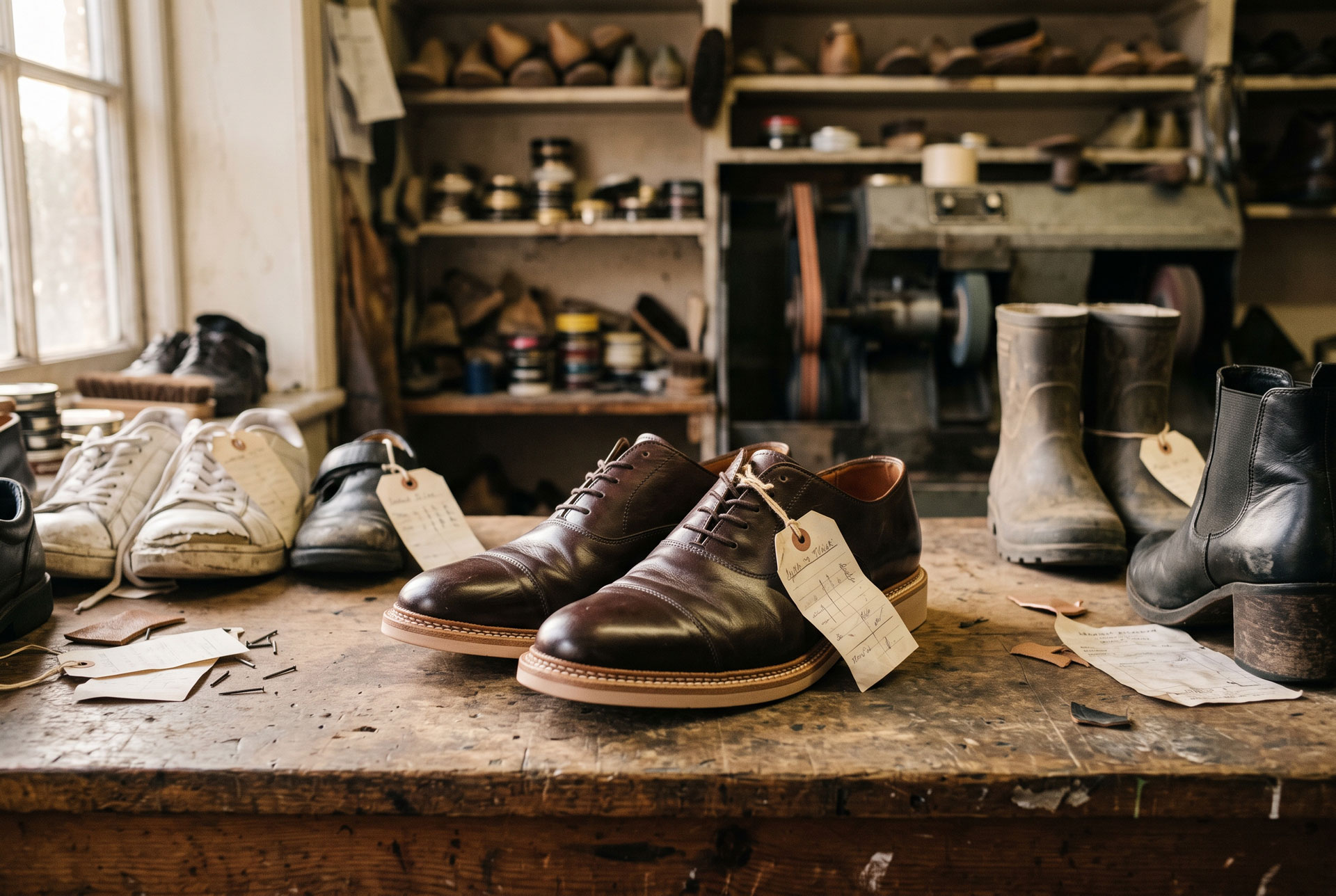
Crockett & Jones, the Northampton shoemaker founded in 1879, runs a repair service that will take a pair of its own shoes back and resole them on the very last they were made on, the wooden form that gives a shoe its shape. The company likes to tell the story of shoes returning to their lasts in the factory after twenty-five years, and says a well-kept pair can go through this up to four times. It is a lovely service, and it is also a quiet admission of something the British high street has been telling us for a while. When the shoe can no longer find a cobbler in town, it has to go back to the factory.
Philipp Arnet would understand. He mends shoes in Kriens, a small town on the edge of Lucerne in central Switzerland, in the shop he has run with his mother for almost sixty years, and where his father, also a cobbler, put a pair of pincers in his hand when he was four. In January he told the local paper zentralplus that they used to repair sixty or seventy pairs a day and now see ten or fifteen at most. He retires in six and a half years, and when his customers ask him where they should take their shoes after that, he has no answer. That unanswered question is where I want to start, because it concerns everyone who owns a good pair of shoes, including those who have not been near a cobbler in years.
Anyone who has bought a decent pair of shoes has heard the same pitch. They cost more, but they are Goodyear welted, so they can be resoled. The name comes from Charles Goodyear Jr, son of the man who gave us vulcanised rubber, who in 1869 developed the machines that turned a stitch previously done by hand into something a factory could repeat. The principle is simple. A strip of leather called the welt runs around the edge of the shoe, and the upper is stitched to it with one seam while the sole is stitched to it with another, quite separate. When the sole wears out the cobbler unpicks it and fits a new one without touching the upper, so what you are really buying is an upper that lasts and a series of soles that wear out, whereas a shoe with a glued sole ends on the day the sole does.
The argument that follows is usually an accounting one, and it is correct, because the price divided by the years of wear comes out in favour of the welted shoe. Yet that sum rests on an assumption printed nowhere on the box, namely that for the next twenty years someone capable of unpicking the welt will be working within a reasonable distance of your front door.
In 2018 Hans Lüchinger, who has a workshop in Rebstein in the Rhine valley of eastern Switzerland and a second shop in St Gallen, told the St. Galler Tagblatt that a cobbler needs a catchment of between 15,000 and 20,000 people to make a living, and that repairs alone would not pay for a single member of staff. He lives off made-to-measure shoes, insoles and orthopaedic footwear, while the customers who bring shoes in for mending are mostly men who have paid a lot for them. That year the Swiss trade body, the Verband Fuss & Schuh, founded in 1874, counted 85 cobblers in the whole country, plus about a hundred master orthopaedic shoemakers. Today, according to the same association, no more than two people a year begin the apprenticeship nationally and six are currently training. The only branch holding steady is orthopaedics, with around fifteen new apprentices a year, helped by the fact that orthopaedic shoes are paid for by Swiss disability insurance.
Put those numbers side by side and they say something that the talk about quality tends to skip, which is that the lifespan of a shoe is not a property of the shoe at all, because it depends on where you wear it. The leather may be good for twenty years, but if nobody within a few miles knows how to work it, that shoe has become a glued shoe again, just heavier and more expensive. Whoever buys it is also buying an option on a craftsman's survival, and the value of that option depends less on them than on how many other people nearby keep taking their shoes to the same shop.
Every resole pays a slice of the cobbler's rent, and in doing so keeps repair available to the neighbour as well. Someone who throws a pair away instead of having it mended is not only short-changing themselves, because they are taking something out of the 15,000 people the cobbler needs to keep the lights on. When enough people make the same choice the shop closes, and from that day even those who spent wisely are left with shoes nobody nearby knows how to remake.
The factory service in Northampton is what happens next. The shoe still gets its new sole, done properly and on its own last, but it has to travel back to the factory through one of the brand's shops and it costs what a specialist service costs. Repair stops being something the town does and becomes something the brand offers its better customers. Even Timpson, which has been mending shoes since 1903 and is the closest thing Britain has to a national cobbler, has spent years diversifying away from heels and soles into keys, locks, watch repairs and dry cleaning. Nobody decided that shoe repair should become a luxury. It drifted there one discarded pair at a time.
Nor is the decline recent. Romeo Musio, who runs the Swiss association, dates it to roughly a century ago, more or less when Bata, the Czechoslovak shoe giant, set up at Möhlin, in the canton of Aargau, at the end of the 1920s with cheap shoes made in vast quantities. The political response is telling. In 1934 the Swiss federal government banned the opening or expansion of shoe factories to curb overproduction, and so protected the factories, while for the people who mended shoes it did nothing comparable. Musio also recalls that the army once provided regular and profitable repair work, which has long since gone.
The detail that strikes me most comes from Arnet, when he says that young adults do not even know that shoes can be repaired, because nobody taught them, and when something breaks they buy a new one. So this is not a preference for the new, since to prefer something you need to know the alternative exists. The fact that a shoe can be mended is passed on the way an accent is, at home and without anyone explaining it, and it only takes one generation to skip it for the market to vanish without anybody ever having chosen to make it vanish.
There is also a question of form that has little to do with accounting. A shoe kept for years has taken the shape of its owner's foot and stride, which a new shoe cannot have by definition, any more than it can have the colour and patina leather acquires from polish worked in by hand hundreds of times. Buying a new pair means starting that shape from scratch every time, while having a pair resoled mostly costs something we now give up grudgingly, namely waiting, because you have to leave the shoes at the shop, go back for them and wear something else in the meantime. Whoever accepts that small inconvenience is saying something about how they treat what they own, even though nobody asked.
During the interview the journalist had brought along her own trainers, whose sole was coming away. Arnet looked them over and said it was no problem at all: you clean out the dirt between sole and upper, sand it down, glue it again and finish it. So even a shoe nobody would call a quality shoe can be saved, because the limit was never the shoe but the habit of the person wearing it. Arnet ends with a warning that seems meant for climbers, saying that when the sole comes off an expensive climbing shoe there will be nobody left to fix it.
That is why the most useful thing anyone who has spent a few hundred pounds on a pair of welted shoes can do is not to polish them obsessively, but to take the other shoes to the cobbler as well, the ones that are worth nothing. They are the ones paying the rent on the shop the good shoes will one day go back to, and if they do not, the good shoes will be going back to Northampton.