A Small Taxonomy of Contented Mediocrity
Posted on: 21 February 2026
There is a human species that the manuals of social zoology have yet to catalogue, and yet it is everywhere. You recognise it by one unmistakable trait: it is content. Not at peace, not fulfilled after a journey of growth; content in the flattest possible sense, like a thermostat that has reached its set temperature and switched off. The temperature, in this case, is low. Remarkably low. But the thermostat doesn't know, because nobody has ever adjusted it.
It is worth observing this species up close, in its natural habitats. Not out of cruelty, but from the same impulse that drives the entomologist to document the behaviour of ants: he does not judge the ant, he describes it. Granted, if the ant could read the entomologist's notebook it would probably take offence. But that is a separate matter.
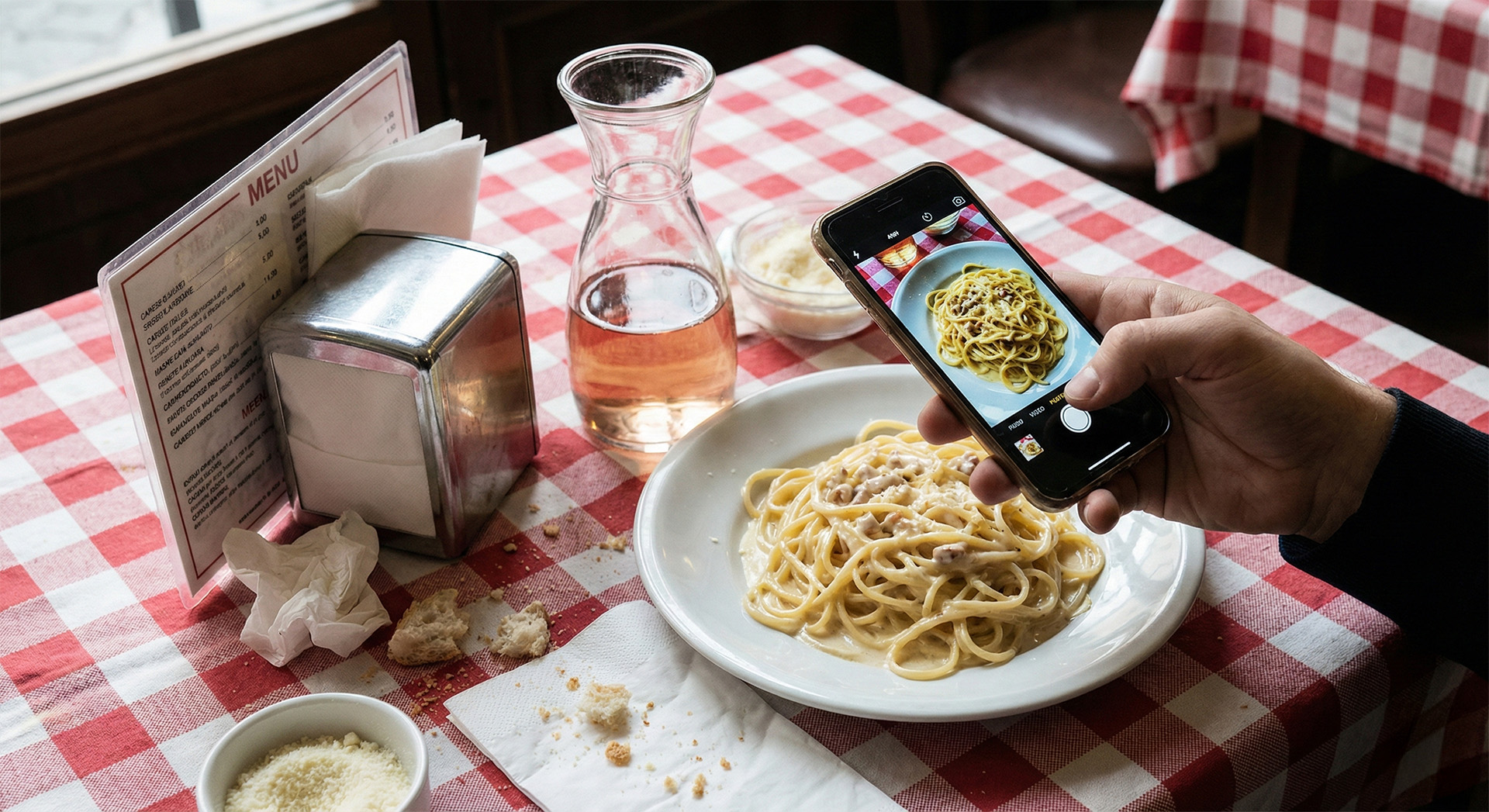
Let us begin with the table, because food is the most honest of social indicators. Nobody lies in front of a plate, or rather: everybody lies, but the plate does not. There is a pub in every British town, one of those with sticky menus and a chalkboard promising "homemade classics," where the bartender asks "still or sparkling?" with the same tone an anaesthetist uses to ask you to count backwards from ten. The house wine is a liquid whose relationship with the grape is comparable to that of a chicken nugget with the chicken: technically derived, spiritually unrecognisable. Yet millions of people drink it every evening, nod, and return. The main course is a Sunday roast with meat so overcooked it has achieved a texture somewhere between cardboard and penance, served with gravy from a granule tin and received without a flicker of disappointment. On a island that spent decades mocking its own cuisine only to declare a food renaissance, the average tolerance for mediocre cooking is a phenomenon that deserves a parliamentary select committee. This is not about demanding a Michelin star; it is about noticing that the soup tastes of packet. But noticing requires attention, and attention has become a scarcer resource than saffron. Then there is the contemporary variant: the plate designed to be photographed rather than eaten. Aesthetics have replaced flavour, the phone has replaced the palate, and the result is a generation that eats with its eyes in the most literal and disheartening sense of the expression. The plate exists for the shot, the shot exists for the like, the like exists for a micro-spike of dopamine that lasts less than the aftertaste the plate never had.
Let us move to work, an even more fertile territory. Here, contented mediocrity reaches heights that border on the sublime. There is a type of professional, cutting across every sector and level of seniority, who delivers approximate work with the same confidence a surgeon announces a successful operation. The presentation with crooked graphs. The report riddled with typos. The project that has been "nearly done" for three months. The deliverable that requires another deliverable to explain the first. And the telltale phrase, delivered with a smile that already functions as preemptive absolution: "that's good enough, isn't it?" No. It is not good enough. But the question does not admit a negative answer, because it is not really a question; it is a social ritual, a request for complicity in the collective fiction that the current standard is acceptable. Anyone who replies "no, actually, it isn't" is regarded much the same way as someone who brings their own lunch to an office picnic: technically legitimate, socially alien. The remarkable thing is that this professional mediocrity is never perceived as such by those who practise it. Satisficing, that cognitive mechanism by which the brain stops at the first solution sufficient to eliminate discomfort, has become a workplace philosophy. One does not seek the excellent; one seeks the point at which nobody complains. And since the complaint threshold has dropped in lockstep with everyone else's standards, the equilibrium sinks a few centimetres each year, like a slow, imperceptible subsidence that nobody notices until the floor meets the water.
Then there is travel, and here the observation becomes almost poignant in its absurdity. The contemporary human being has access to every corner of the planet, a possibility that for ninety-nine per cent of the species' history would have seemed like science fiction. And what does he do with this possibility? He goes to the same resort as his colleagues, the same all-inclusive as his brother-in-law, the same Greek island he saw on Instagram in the same identical pose. Travel has become a checklist to tick, not an experience to inhabit. One departs with the itinerary already written by TripAdvisor, eats where Google says, photographs what everyone else has photographed, and returns with the sensation of having "done" a place the way one "does" a tax return. The all-inclusive resort is the perfect monument to this philosophy: a non-place engineered to eliminate any friction with the reality of the country it occupies. You could be in Mexico, Turkey, or Zanzibar, but the experience is identical because the objective is not to encounter the unfamiliar; it is to transport your sofa to somewhere with sunshine. And the photograph. The photograph is the final product, the proof that the trip occurred, the certificate of existence in a place you never truly inhabited. The difference between travelling and being transported is the same as the difference between reading a book and glancing at its cover. But the cover is faster, more shareable, and does not require that inconvenient thing called curiosity.
There remains conversation, the most undervalued indicator of civilisation. Here the taxonomy grows particularly rich. There is professional small talk, that verbal ping-pong of interchangeable phrases ("good weekend?", "how's things?", "did you see the match?") that serves not to communicate but to fill the silence, because silence has become intolerable. There is dinner party conversation, which follows a trajectory as predictable as a train on rails: children, property, holidays, a generic complaint about the government, a work anecdote, then children again. The circuit closes in forty minutes and restarts with minimal variations, like a playlist on shuffle that contains only six songs. But the most significant phenomenon is the growing inability to sustain a topic for more than two minutes. Not through stupidity, but through disuse. Deep conversation is a muscle, and like all muscles it atrophies when neglected. Twenty years of fragmented communication, of twenty-word messages, of attention split across three simultaneous screens, have produced a generation that can start a thousand conversations and finish none. Try developing a complex idea at dinner: by the third logical step someone will reach for their phone. Not out of rudeness, out of reflex. The brain has hit its limit of sustained attention and demands its digital snack the way a child demands a biscuit.
Up to this point the entomologist smiles. He observes, documents, finds the specimen amusing in its predictability. But there is a point where the smile fades, and that point is the satisfaction itself. Not the mediocrity, which is human, understandable, even physiological. The problem is the mediocrity that looks in the mirror and likes what it sees. That not only does not aspire to better, but considers aspiration itself a kind of pathology. The phrase "I'm fine with that" has become the collective epitaph of an era that has confused self-acceptance with unconditional surrender. Accepting yourself is healthy. Ceasing to search is something else entirely.
There is a subtle but decisive difference between those who consciously choose a simple life, with few things but good ones, few relationships but real ones, few trips but truly lived; and those who exist in default mode, on autopilot, at the thermostat temperature nobody ever adjusted. The first have standards; they have simply calibrated them differently. The second have no standards. They have habits. And habits, left alone long enough, become identity. At that point you are no longer accepting the mediocre; you are defending it. Because questioning it would mean questioning yourself, and that, in a culture that has elevated psychological comfort to a fundamental right, is the real taboo.
The entomologist closes his notebook. The ants continue their path, identical to yesterday, identical to tomorrow. None of them stops to ask whether the path makes sense. But then, no ant has ever claimed to be happy.