The premises were the cost, now they are the product
Posted on: 28 July 2026
Britain has spent fifteen years watching its high streets empty and has developed a settled vocabulary for the process. Debenhams, BHS, Woolworths, the department stores that anchored provincial town centres and then did not: the story is told as attrition, as the slow defeat of physical retail by online competition and business rates. What that vocabulary cannot easily accommodate is the possibility that closing the shop might be the beginning of something rather than the end of it, and that the premises themselves, rather than the goods inside them, might turn out to be the thing worth selling.
An Italian case has been circulating on LinkedIn in the past week, presented by a marketing commentator as an instructive example of community building. A clothing retailer in Puglia organised a holiday in its own region for a hundred women drawn from its customer base. The participants paid their own way. The idea, according to the post, was not conceived in a boardroom but emerged from listening to customers at pop-up events and from watching a Facebook group that the customers themselves had set up without prompting. The post anticipated the obvious objection, which is that the business charged its customers to attend what is in substance a marketing exercise, and answered that the willingness to pay is itself proof of how solid the relationship has become.
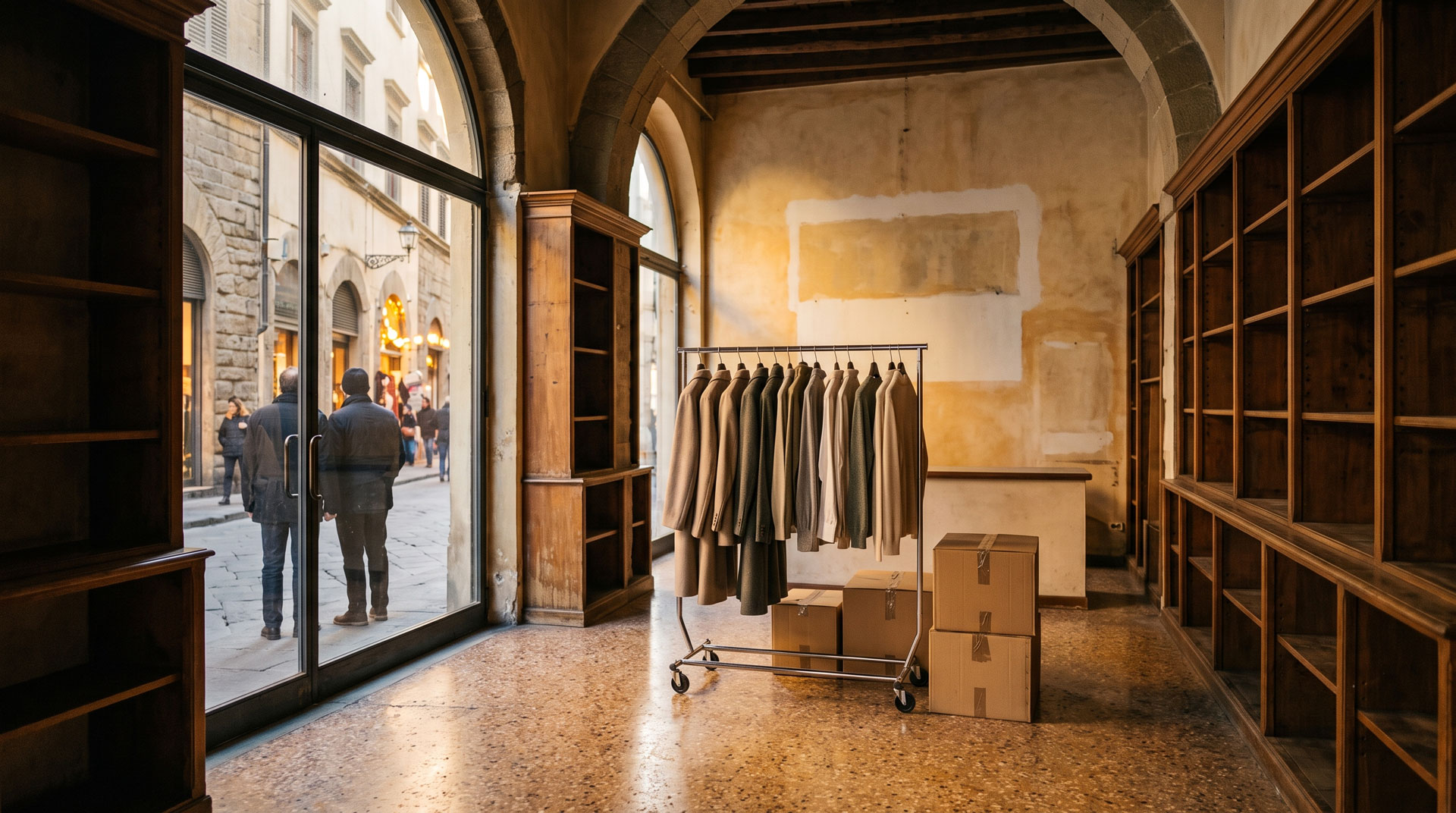
The reasoning about solidity is sound. The description of the business is not, because the shop in question no longer exists. Santamadonna 1891, which had traded from the same street in Bisceglie for one hundred and thirty-four years, closed its premises in August 2025. Local Puglian newspapers covered the final four days of trading, with queues along the pavement and a statement from the Ramelli family describing the move as a transformation rather than a closure. The business continues online through live selling sessions, a WhatsApp channel, its own app, an Instagram following that has passed two hundred and fifty thousand, and itinerant pop-up shops in Bari, Rome and elsewhere. The Puglian holiday had been announced months earlier in the same communication that launched an end-of-season mystery box and the Bari pop-up.
This matters rather more than a point of fact-checking, because it inverts the meaning of the case. A hundred women paying to spend a week with their shopkeeper is not evidence that a shop has succeeded in building a community around itself. It is a consequence of the shop having gone, and of something being required to take its place.
For one hundred and thirty-four years those premises were a cost. Rent or tied-up capital, utilities, staff on the floor, fitting out, stock held where customers could see it: all of them lines that retail absorbs into the margin on goods sold. The premises are not the thing being sold, the premises are what one pays for in order to sell something else. This is the silent assumption underneath every shop since shops began, and it goes unexamined because it presents itself as a law of nature rather than as an accounting convention.
The available numbers suggest the assumption had stopped working. Italian company filings, as reported by the commercial aggregators that resell registry data, show turnover for the operating company of a little over three million euros in 2023, up roughly a third on 2021, alongside a loss of more than three hundred thousand euros. These are secondary sources and should be treated accordingly, but the shape they describe is coherent and thoroughly familiar. The digital channel brings revenue and brings its own costs with it, in logistics and returns and acquisition and the labour of producing live sessions, while the physical shop continues to cost what it always cost, serving footfall that has gone somewhere else. At which point the premises cease to be the infrastructure of the business and become a liability with sentimental value attached, the second of which appears on no line of the profit and loss account.
What the family did was dismantle the thing and put it back on sale in pieces. A pop-up shop is premises with an expiry date: it costs for four days rather than for twelve months, it travels to wherever demand has already assembled itself online, and precisely because it is about to disappear it generates the crowding that the permanent shop had ceased to generate. The holiday is the same operation carried to its logical end, premises that last a week, paid for directly by the customer. Not a marketing event requiring a budget line and a justification, but a revenue centre. The function that the building in Bisceglie had performed free of charge, which was to give the same people somewhere to gather under the pretext of buying things, is now delivered intermittently and invoiced. The fixed cost has been converted into variable revenue, and the entry that sat on one side of the accounts has moved to the other.
There is a detail that makes the logic almost didactic, which is the mystery box. The customer pays a set price and receives garments she has not seen, has not chosen and has not tried on. Every residue of the classical retail function, the one in which I go to a particular place because the goods I want to inspect are there, has been removed. When somebody agrees to pay for unknown contents, the goods have stopped being the object of the transaction and have become the material pretext for a relationship. What is actually being purchased is confirmation of belonging to a group that receives the same box on the same day and then discusses it.
The reason this works has, in my view, less to do with the communicative gifts of one Puglian family than with a vacancy left open by everybody else. There exists a demand for somewhere to be that ordinary commerce has stopped supplying. The chains optimised floor space, removed the seating, measured average dwell time and treated as inefficiency exactly that portion of the experience which produced no immediate transaction. Anyone who was around the record shops before they went knows the same film under a different title: people went in on a Saturday afternoon and bought nothing, they talked, occasionally somebody left with a record, and the man behind the counter understood perfectly well that the apparently wasted hours were the reason the shop existed at all. When the goods dematerialised it turned out that nobody had been buying the goods.
The Facebook group deserves separate attention and is probably the most remarkable element in the whole affair. If it genuinely arose on the customers' own initiative, which I take from the LinkedIn account and cannot verify, then the signal is clean precisely because it was not solicited. The standard reflex of any marketing department would have been to acquire it: rename it, attach the logo, appoint a company moderator, measure its engagement. That would have been the move that kills the thing in the act of capturing it, because the entire value of the group lay in its not belonging to the company. The literature on the governance of common resources describes the pattern well enough. Communities that regulate themselves function until an external authority arrives to formalise them, and formalisation almost always destroys the informal norm that was holding the group together. Having watched it without touching it is a rare discipline, and I suspect it was instinctive rather than strategic.
There remains the fragile part, which does not appear in the LinkedIn account because that account views the operation from the position of having won. The company held a transferable asset, the goodwill of a century-old shop in a commercial street, and it has disposed of it. What remains is a personal relationship with four individuals who appear on camera under their own names. It is not replicable, it is not delegable and it cannot be sold. On the day one of the daughters decides to do something else, the community does not pass to a successor the way the clientele of a shop once passed. They have exchanged a dull and saleable asset for a living and unsaleable one, and for the moment the exchange is advantageous, because the first was producing losses and the second is producing revenue. Over a ten-year horizon that conclusion may reverse.
It is worth stating what would falsify this reading. Were it to emerge that the closure was forced by external circumstance, an eviction or a dispute over the building or a legal action, then there is no deliberate conversion of cost into revenue and what remains is a retreat narrated well, with the holiday as a dressing on the wound. And if over the next eighteen months no other Italian or British retailer of comparable scale dismantles its permanent site in order to resell that site's function intermittently, then I will have described a local anomaly attached to four particular people rather than a mechanism. Both are conditions one settles by watching rather than by arguing.
As to the question the LinkedIn post ended on, which was whether readers knew of comparable cases, the more useful answer is not a list of examples. It is to notice that we are calling this community building when it looks a good deal more like a house move. The social function of retail is leaving the building where it used to be accommodated free of charge, and going out to find somewhere that somebody is prepared to pay for. A hundred people were.