An aircraft is worth more in pieces
Posted on: 20 October 2026
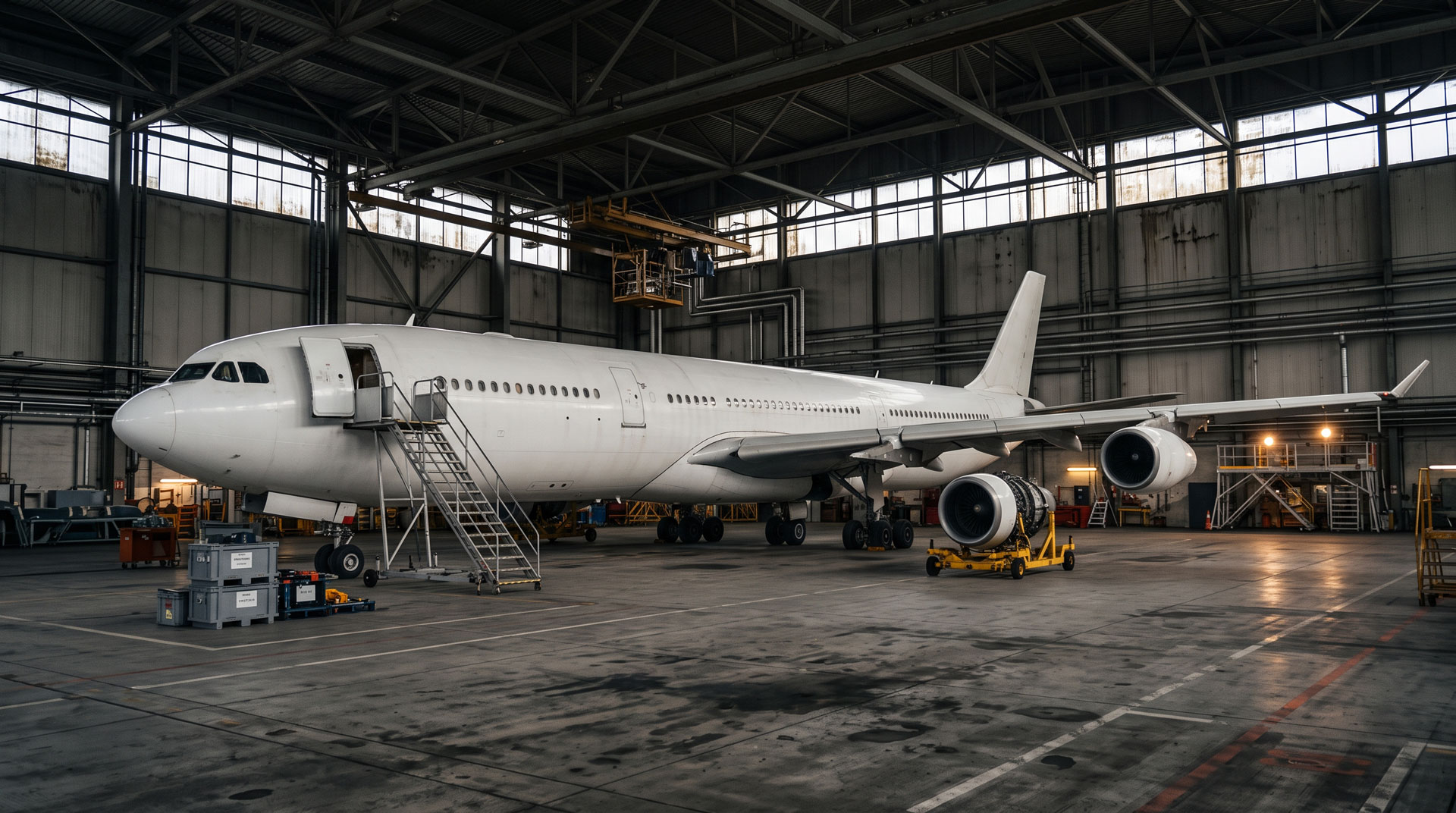
When British Airways retired Concorde in 2003, nobody took a spanner to it. The airframes were kept whole and most of them now stand in museums, from East Fortune outside Edinburgh to Barbados. Sentiment played its part, but there was also a colder reason: nobody else flew Concorde, so its parts had no customers, and an aircraft that no one is left to fly is worth more as a monument than as a box of spares. On Wednesday 14 October Zurich saw the opposite logic at work. HB-JMB, one of the last four Airbus A340-300s in the Swiss fleet, left for the final time, rocked its wings three times for the spotters along the fence and landed about an hour later at Twente, a small airport in the east of the Netherlands near Enschede. We said goodbye to it with the affection you keep for an old friend that spent twenty-three years carrying a piece of Switzerland to Johannesburg and Shanghai, yet the interesting question is not the nostalgia but the destination, because there is no museum at Twente and none of those American desert lots where parked aircraft wait for a second owner.
What Twente has instead is AELS, Aircraft End-of-Life Solutions, a company founded in 2006 by a technician who had overseen the dismantling of a Boeing 747 at KLM. AELS buys aircraft at the end of their careers, takes them apart in its own hangar, recertifies whatever can be used again and sells it on with the paperwork that proves where each part came from. The engines come off first, then everything that carries a serial number and a maintenance history, until what remains of the fuselage is aluminium for recycling. There is a symmetry here that would make an accountant smile: the first widebody AELS took apart at Twente, in April 2017, was another Swiss A340, flown in from Zurich after its last service from Johannesburg.
Seen up close, an aircraft is not one object but a collection of parts with different lifespans. The airframe accumulates pressurisation cycles and ages in a way that cannot be reversed, whereas a freshly overhauled engine or a certified landing gear has immediate value to anyone still flying the same type. Lufthansa, for one, keeps a dozen or so A340-300s in service until 2027 or 2028, so every example that comes down becomes a store of spares for those still in the air, and the retirement of one lowers the cost of keeping the others alive. That is why an aircraft is worth more in pieces than whole. Kept whole, it needs a single buyer willing to fly it; broken up, it finds many buyers who each need one part. Concorde stayed in one piece because there was nobody to sell the parts to, and the A340 is being taken apart precisely because there still is.
Which leaves the question of why airlines retire aircraft that still fly perfectly well. The A340 entered service in 1993 and was the child of a specific constraint. For decades the sixty-minute rule, which required twin-engined aircraft to stay within an hour's flying time of a diversion airport, had kept them off the longest ocean crossings, and ETOPS is the name for the exemptions that widened that limit step by step. With four engines the A340 simply did not face the restriction. Once engines became reliable enough to persuade the regulators to relax the rules, the constraint disappeared and took the four-engined aircraft's reason for existing with it. Lufthansa is now replacing its A340s with A350s and Boeing 787s that burn up to thirty per cent less fuel, and with fuel weighing ever more heavily on the accounts the argument settles itself.
I saw the same dynamic when recording studios went digital. The tape machines were not worn out; many of them would have run for another twenty years without trouble. What stopped them was the computer, which made redundant the physical medium that recording had depended on for decades, not wear and tear. Structures built around a constraint do not die when they wear out but when the constraint goes, and the people running them tend to notice late, because they keep measuring the health of the structure rather than the reason it exists.
There is also a detail that has slipped past almost unnoticed amid this week's farewells. Lufthansa's A340-600s, the stretched version that flew its last commercial service on Sunday 18 October, were meant to leave the fleet at the end of 2025. They stayed in the air for almost another year because the airline's new Boeing 787-9s were parked in the United States waiting for their cabin seats to be certified. The new aircraft sat on the ground over a question of seating, while the old, thirsty one kept the North American routes open. For that whole period the ageing fleet worked as an insurance policy against a supply chain that was not delivering, a job no business plan ever asked it to do and no balance sheet will ever credit it for.
That points to the first thing not to do, which is to retire the reserve before its replacement is genuinely ready to fly, seats included. In consultants' language redundancy is called inefficiency and is the first thing to be cut, until it turns out to have been the only thing standing between a supplier's delay and a hole in the timetable.
Which brings us to the A380, the double-decker whose wings were built at Broughton in north Wales and which went out of production in 2021. I should declare an interest. Learning that this masterpiece of engineering would no longer be built hit me the way losing someone close does. I won't try to explain it; my passion for that aircraft has always bordered on the pathological. One hears that the airlines which turned it down now want it back, but that is not what is happening. The call for a successor comes mainly from Tim Clark, president of Emirates, the man who built the Dubai carrier around the aircraft and who still operates more than a hundred of them. Clark once said that his six daily A380 flights into Heathrow were leaving without a single empty seat, and pointed out that Boeing's largest new twin, the 777-9, would carry 364 passengers in Emirates' configuration against 484 on the A380. But his model is a particular one, since most Emirates passengers change planes in Dubai to fly on elsewhere, which means the airline lives by concentrating enormous flows on a small number of routes.
The rest of the market is answering differently. Airbus is studying the A350-2000, a stretch of the current A350-1000 designed to carry more than four hundred passengers on two engines. In April Guillaume Faury, Airbus's chief executive, said a launch was not close, and Rolls-Royce, the sole engine supplier for the A350 family, has said that if a new engine were needed it would take six or seven years to develop. The need for capacity is coming back, while the form that used to satisfy it is not. What the industry wants is what the A380 did without what the A380 was.
That is the second thing not to do, and it applies well beyond aviation: confusing a need with the form that has historically served it. Whoever defends the form ends up defending a constraint that no longer exists, whereas whoever follows the need finds the new form, even when it looks less spectacular.
The last Swiss A340 will have a different fate from its sisters. Early in 2028 it is due to go to the Verkehrshaus, the Swiss Museum of Transport in Lucerne, provided the museum raises by the end of this year the several million francs needed to move 125 tonnes of aircraft from Zurich airport to the lakeside. One will end up on display, like the Concordes, while the others, if they follow HB-JMB, will end up on the shelves of a Dutch warehouse, each with its label and its certificate of origin.